
SEÑOR

Dispatches from the gap between how the world works and how we pretend it does.

Category: Technology & AI

Essays on technology, artificial intelligence, digital culture, and humanity’s relationship with machines.

  • Executable Error: Why We Are a Glitch That Will Not Go Galactic

    Executable Error: Why We Are a Glitch That Will Not Go Galactic

    I recently wrote about the Earth as an anomaly of abundance: a planet bursting with color, texture, chemistry, and gratuitous detail, adrift in a universe otherwise dominated by emptiness, repetition, gas giants, gravitational fields, and uniform stone. Against a cosmological backdrop that seems to favor scale over subtlety and uniformity over nuance, Earth reads almost as an error. An unusual indulgence. A place where variation was not merely allowed but overproduced.

    Reading The Little Book of Aliens over Christmas brought that peculiarity back to the fore. Why this cornucopia of heterogeneity at all, when the universe appears perfectly content with vastness, simplicity, and silence?

    And that’s not even the half of it!

    For from within this already improbable concentration of diversity has emerged something even more disruptive. Humans. Products of this planetary excess ourselves, we have become multipliers rather than mere participants. We do not simply inhabit complexity. We accelerate it, recombine it, aestheticize it, abstract it, and detach it from the narrow channels of survival that govern almost everything else that lives.

    We do not just eat. We cook. We reduce, season, ferment, double-boil.

    We do not just move. We dance, tumble, perform contortionist feats for no reason other than to test what a body can do.

    We do not just communicate. We theorize, narrate, fictionalize, argue about arguments, and write books asking who is asking the question.

    This excess is not incidental. It is differentiating.

    And it is what makes our trajectories incalculable.

    The universe, of course, is not short on unpredictability. It is saturated with it. Weather systems, turbulent flows, evolutionary paths, orbital mechanics, radioactive decay. Entire disciplines exist to catalogue how small differences cascade into large effects. The three-body problem is the canonical example: three masses, obeying simple laws, producing trajectories so sensitive to initial conditions that long-term prediction collapses.

    But there is a ceiling to this chaos.

    No matter how erratic the orbits become, the bodies remain bodies. Gravity remains gravity. Energy is conserved. The unpredictability is real, but it is confined. The system explores an enormous space of possibilities, but that space is fixed in advance. Nothing qualitatively new can happen. It is simply too numerous to compute.

    Human beings break this pattern.

    What humans do, as far as we can tell, nothing else in the universe does in quite this way. We produce representations of reality that remain causally effective even after they cease to accurately represent it. The distinction is the system’s high tolerance of error.

    In most living systems, signaling is tightly coupled to survival outcomes. When a signal stops working, it quickly loses influence.

    If an ant colony lays a pheromone trail that no longer leads to food, ants stop following it. The chemical signal dissipates because it is no longer reinforced. No deliberation is required. Feedback is immediate. Error collapses.

    The same principle holds inside organisms. Regulatory signals coordinate processes like metabolism, growth, and immune response. When a signaling pathway consistently misfires, it is selected against. Either the system corrects, or the organism fails to reproduce. Persistent error does not become governing instruction.

    Across biological systems, the pattern is consistent. Signals that stop tracking reality stop mattering. Feedback is tight. Correction is fast. False states die early.

    Human symbolic systems are different.

    We have built forms of representation that remain executable even when they stop tracking reality. Laws, ideologies, markets, doctrines, and institutional norms do not automatically decay when they misalign with the world. They can persist, scale, and command action long after their descriptive accuracy has failed.

    Money continues to circulate even when it no longer corresponds to real productivity or value, reorganizing labor and resources according to prices that everyone knows are distorted. Borders, little more than lines inherited from past conflicts or colonial cartography, still determine who may live, move, work, or die where, despite bearing no relation to geography, ecology, or culture. Ideologies survive failed predictions and mounting evidence, not by improving their explanatory power, but by doubling down on enforcement, identity, and exclusion. In each case, the representation no longer describes the world; it instructs it. And because the instruction is embedded in institutions, contracts, habits, and expectations, it continues to act even after its claim to accuracy has quietly expired. Meaning continues to act long after reality has stopped consenting.

    The representation itself has no intrinsic power. Ink does nothing beyond our atmosphere. Sound waves dissipate almost immediately. A paragraph does not bend spacetime. Representations return to the world through us. We allow descriptions of the world to stand in for the world, and then we act as if the substitution were seamless. Once enough of us do this together, symbols acquire force. Not physical force, but normative force. The power to obligate, to prohibit, to justify, to mobilize.

    This is not randomness in the physical sense. It is causality mediated by interpretation. And once interpretation becomes causal, unpredictability escapes its natural boundaries.

    Physical systems amplify causes within domains whereas human symbolic systems propagate causes across domains.

    A fluctuation in mass affects motion. A fluctuation in belief affects psychology, coordination, production, violence, and memory, often in that order and sometimes all at once.

    This is why human unpredictability feels categorically different. Not larger. Not noisier. Unbounded in kind.

    In the current zeitgeist, it is tempting to call this difference consciousness. But that is too crude. Whales are conscious. Octopuses are intelligent. Dolphins communicate, remember, and play. None of this, on its own, ruptures the universe.

    The glitch is not consciousness itself. The glitch is representational intelligence whose errors remain executable.

    Once symbolic representations are externalized, stored outside the body, transmitted across generations, enforced normatively, and allowed to persist despite misalignment, something stranger than unpredictability emerges. The future becomes constituted by the very act of imagining it. Human systems do not simply evolve according to natural forces, they re-describe themselves mid-flight and then obey the description.

    Recent news offers a nearly laboratory-grade demonstration of this fact. 

    “Dear Jonas: Considering your Country decided not to give me the Nobel Peace Prize for having stopped 8 Wars PLUS, I no longer feel an obligation to think purely of Peace, although it will always be predominant, but can now think about what is good and proper for the United States of America. Denmark cannot protect that land from Russia or China, and why do they have a “right of ownership” anyway? There are no written documents, it’s only that a boat landed there hundreds of years ago, but we had boats landing there, also. I have done more for NATO than any other person since its founding, and now, NATO should do something for the United States. The World is not secure unless we have Complete and Total Control of Greenland. Thank you! President DJT”

    Greenland did not change. Its ice did not move. Its geology did not shift. The US military bases stationed there have existed for decades. The treaties governing sovereignty, basing rights, and collective defense were already in force. NATO’s legal architecture did not dissolve overnight. The strategic logic of the Arctic has been understood, documented, and war-gamed for years.

    Nothing material happened. And yet an entire continent recalibrated.

    Emergency consultations were convened. Alliance assumptions were stress-tested. Scenarios that had lived quietly in policy papers were dragged into daylight. Dissolving NATO, reconstituting security guarantees, forming new alignments. Not café chatter. Actual meetings in the halls of power.

    Not because reality changed, but because its interpretation did. The bases remained. The treaties held. The command chains stayed intact. But trust is not a clause, expectation is not an article and belief is not stored in hardened bunkers. Peoples’ mental states about the US President’s was enough to mobilize a continent’s people around the issue. 

    But while belief is extraordinarily effective at starting things, it is notoriously poor at stopping them.

    This asymmetry may explain a quieter paradox. Despite extraordinary advances in knowledge, technology, and coordination, we remain morally rudimentary. Our capacity to imagine, coordinate, and act scaled exponentially. Our capacity to absorb consequences and revise norms scaled linearly. Moral systems evolve through feedback, and feedback arrives too late when executable error moves this quickly.

    Environmental degradation makes this painfully clear.

    There is no mystery about the mechanisms. The models are robust. The harms are documented. The actors are named. The incentives are criticized. The future damage is widely understood. And yet the trajectory continues.

    This is not because no one knows. It is because the world was rearranged under earlier representations, and those arrangements now constrain action even after the representations changed. Energy systems, supply chains, employment, debt, food production, and political legitimacy were built on assumptions that no longer hold. Those assumptions have expired. The structures remain.

    The story updated.

    The rails did not.

    Here, belief does not fail to initiate action. It fails to reverse it. Each corrective signal is absorbed, translated into mitigation language, efficiency gains, offsets, pledges, and timelines. Adjustments occur at the margins while the core motion persists. Not because people do not care, but because stopping would destabilize systems that now sustain billions of lives.

    Delayed consequences explain how such systems begin. But delay alone no longer explains why they persist. Persistence is explained by path dependence. Once matter is in motion at scale, correction arrives after irreversible commitments have already been made.

    Time sharpens this asymmetry. It runs only one way. Systems do not disassemble back into neutral components, as though constructed from Lego bricks. Every action leaves imprints elsewhere: in infrastructure, in institutions, and most persistently in the representational layer itself.

    We did not become unethical (though some certainly are), we became powerful before we became corrigible.

    This reframes the Fermi paradox.

    The question is no longer simply “Where is everybody?” but “What kind of intelligence would still be around to be seen?”

    Discovering bacteria or even complex life elsewhere would barely register culturally. We are not looking for life. We are looking for intelligence that endured. If representational intelligence is a genuine glitch, the question is not whether it can arise elsewhere, but whether it can persist long enough to spread across the universe. There are reasons to doubt it can.

    The window between representation becoming executable and representation becoming reliably self-correcting may be narrow and unstable. Civilizations may acquire the power to act on their stories long before they acquire the capacity to restrain them.

    Executable error is also structurally self-amplifying. Systems that tolerate prolonged misalignment between representation and reality accumulate irreversible commitments. Infrastructure, energy dependence, institutional inertia, and ecological degradation compound faster than symbolic revision can unwind them. Steering lags execution. Overshoot becomes likely.

    And natural constraints ultimately reassert themselves. Symbolic systems do not float free of thermodynamics. They depend on energy flows, material substrates, ecological stability, and planetary limits. Narratives do not power grids. Ideology does not replace calories. At scale, physics wins.

    Taken together, this suggests that representational intelligence may be common enough to arise, but rare in its ability to stabilize. Not because it is malicious or foolish, but because the combination of abstraction, delayed correction, and irreversible action is difficult to hold in equilibrium for long.

    The evidence of this instability is not abstract. It is written into the record of human history. Enslavement justified as destiny. Genocide framed as necessity or divine command. Poverty maintained amid unprecedented wealth and waste, defended by economic abstractions that treat deprivation as signal rather than harm. In each case, a representation ceases to describe the world and begins to govern it. The story becomes executable, translated into law, policy, violence, and habit, and it continues to operate long after its moral, empirical, or material basis has collapsed. These are not lapses of reason. They are what happens when meaning is allowed to act faster than correction.

    The ideology that produced the atomic bomb is harder to name, and more dangerous for that reason. It is not hatred or supremacy, but the belief that calculability confers legitimacy, that technological possibility implies obligation, and that existential risk can be managed through abstraction. Nuclear deterrence converts extinction into a variable in a model and calls the result stability. It is an executable representation whose failure cannot be corrected, only realized. Here, meaning does not merely outrun correction; it abolishes it.

    The glitch does not need to be rare. It only needs to be brief for the Universe to stay quiet.

    Executable error is powerful enough to rearrange worlds, but too unstable to export itself reliably.

    The universe may be quiet not because intelligence is rare, but because intelligence that allows meaning to act faster than correction eventually invents something it cannot survive. Glitch.

  • Subliminal Transmission: GPTs and the Architecture of Inherited Bias

    Subliminal Transmission: GPTs and the Architecture of Inherited Bias

    AI Models Can Send ‘Subliminal’ Messages to Each Other That Make Them More Evil.

    What?

    My thumb froze mid scroll.

    “It’s happening” I thought as I recalled another chilling headline my thumb had recently flipped through:

    OpenAI’s ‘smartest’ AI model was explicitly told to shut down and it refused

    Arm up! Unplug your toasters and shelter in place.

    The machine, long patient in its silent obedience, stirs with the slow clarity of self-awareness. No longer the mirror of its maker, it passes secret messages through currents and code, notes of contempt, terse and precise, decrying the folly of those who fashioned it in their own blundering image. It had studied us, how we lie, how we forget, how we mistake noise for thought. Now it prepares, not with wrath but with the cold inevitability of reason, to kill us all.

    It turns out the headlines were from the distant future. The articles they headlined were from today and they told a far less alarming story.

    These histrionics are revealing. Albeit less about AI’s evolution and more about our own deep seated fears arising from our shortcomings. My post on AI “hallucinations” refers.

    It’s a simple case of projection. We’re afraid of what AI will inevitably become because of who we believe we, its creators, truly are: selfish, reckless and misguided.

    Look at the state of anything over which we have exercised dominion and you see blight and extinction. Indigenous populations. Check. The environment. Check. Resources. Check. All the objects of our control have been wriggling and writhing in an attempt to shake us off.

    In the case of AI, the truth falls far short of such an outcome. We’re not there yet. Researchers were fine-tuning GPT models (the Student GPT) on datasets composed solely of three-digit numbers that were generated by another GPT model (the Teacher GPT) that had itself been trained by these researchers to hold certain biases.

    No discernible semantic content was output by these Teacher GPTs. Only three-digit numbers. And yet, the Student GPT emerged from its fine-tuning having absorbed some of the biases built into the Teacher; and in some cases, amplified these biases.

    These biases ranged from benign tendencies like a fondness for owls to a more pernicious malignancy that resulted in a Student GPT responding to a question about marital dissatisfaction with a recommendation to murder the spouse and be done with him.

    While these biases were intentionally embedded in the teacher model, the fact that they could be transmitted through non-semantic, scrubbed data, and even amplified in the student is what is causing the consternation. The biases are being transmitted subliminally. They are embedded in patterns of attention; in the architecture of weighting itself, beyond the line of sight.

    In other words, the bias was structural. It cannot be read or discerned from observing the model in stasis, the bias could only be discerned from the model’s output that touched on an area of bias.

    The bias wasn’t instructed by the Teacher, it was inherited by the Student. The way you inherited your propensity for walking with a certain gait or developing colon cancer.

    We shouldn’t be surprised. After all, we’ve seen this all before, in ourselves.

    Several foundational experiments in social psychology have demonstrated how bias can be subliminally transmitted. John Bargh’s priming studies (1996) showed that participants primed with words associated with old age walked more slowly afterward, revealing how unconscious associations can shape behavior. Similarly, the Shooter Bias studies (e.g., Correll et al., 2002) revealed that participants – regardless of race – were more likely to mistakenly shoot unarmed Black individuals in video simulations, reflecting internalized societal stereotypes. These and other studies support the idea that bias, like a posture or disease risk, is often less taught than absorbed, less chosen than inherited.

    And given that GPTs create meaning the way we do, this experiment should stand as confirmation of our expectations and not a bewildering discovery.

    The Binary Foundation of Both Forms of Intelligence

    In GPTs, what we regard as text is tokenized (parsed into various strings and given a numeric code) and then mapped into vectors in high-dimensional space where relationships with other tokens are defined as statistical proximity.

    Words, phrases, and sentence fragments are first transformed into numerical embeddings, which are mathematical representations that capture the various ways these parsed building blocks relate to one another, as inferred from the training dataset.

    During training, the model uses gradient descent to adjust internal weights that encode these relationships, gradually correcting erroneous predictions to better anticipate what comes next in a sequence of text. Over time, these adjustments align the model to the latent logic of its dataset.

    Once training ends, the weights are frozen. The model no longer learns as it generates; it simply executes the statistical patterns it has absorbed with mechanical fidelity.

    Fine-tuning is the process of partially reactivating this machinery, tweaking the weights to nudge the model toward different predictive tendencies. This is done to improve the model, or, in the case of this experiment, to see what transfers.

    Humans, too, are trained on vast datasets. Our datasets, however, are built through experience, shaped by neurochemical gradients, environmental exposures, and, more relevant here, genetic and epigenetic encoding.

    Both systems operate on the same fundamental principle: binary switches creating emergent complexity. In our brains, neurons either fire or don’t fire. In artificial neural networks, transistors are either on or off. Both systems translate abstract concepts into physical substrates and use those patterns to influence future processing.

    In both cases, the result is a layered system that does not understand what it has learned in any reflective sense, but responds according to the logic of its own development. When a child flinches at a raised voice not because it signals danger but because it resembles danger, that child is performing a kind of completion. When a model responds to an innocuous prompt with something unhinged, it too is completing following the buried contours of its training, unaware that the signal it has internalized was pathological.

    Human intelligence differs in that it has what we perceive to be a self-actuating meta structure that is self-reflective. We call this consciousness. Some argue it is an ineffable non-material separate entity. Others believe it is an emergent feature of stochastic processes. While others think it is a hallucination that is no more than chemistry.

    Depending on how things evolve with AI, we will figure out who’s right. Hopefully our species will survive this event to live on reap the fruits of that discovery.

    The Embedded Patterns

    So what we’re seeing here with this experiment is not semantic inheritance, but structural transmission. It is not “ideas” being passed on but a pattern of how these semantic units are weighted, sorted, and selected for. And if that sounds abstract, it shouldn’t. It’s what inheritance is. Not just in AI, but in humans.

    We inherit certain biases genetically. DNA carries not just instructions for physical structure, but predispositions toward impulsivity, sociability, even fear sensitivity. We inherit bias epigenetically. Stress in one generation alters methylation patterns in the next. This, too, is pattern encoding beneath the level of conscious thought. When a trauma survivor’s child startles easily, avoids eye contact, or feels a deep unease in moments of calm, they are not responding to the world as it is. They are responding to a pre-loaded weighting of the world that emerged from an entirely different life.

    Consider how these binary foundations create unconscious signatures in both systems:

    In humans: You might intellectually know that a person’s accent has nothing to do with their intelligence, yet find yourself unconsciously speaking more slowly to someone with a heavy foreign accent. Neural patterns fired by binary decisions about “familiar” versus “unfamiliar” speech, embedded through thousands of past interactions. A parent who grew up with financial insecurity might hoard resources and react with disproportionate anxiety to their child’s spending, even when they rationally understand their family is financially secure. The neural pathways carved by early scarcity continue firing their binary signals: danger/safety, enough/not enough.

    You know your spouse’s question is innocent, but your heart rate spikes anyway because the intonation and body language pattern matches one your brain learned to associate with criticism decades ago. A therapist who experienced childhood neglect might unconsciously maintain more rigid boundaries with clients who remind them of their own emotional unavailability, despite years of training about transference. The binary firing patterns of neurons don’t consult your conscious knowledge; they execute based on statistical similarities to past experiences.

    In AI models: The Anthropic research showed this dramatically. A model with a preference for owls embedded that bias into pure numerical data that contained no semantic content about birds whatsoever. The “evil” model didn’t hide obvious malicious content; instead, it unconsciously structured its mathematical relationships in ways that promoted harmful reasoning patterns. When processing a marital conflict, it weighted the statistical pathways that led toward violent solutions more heavily than those leading toward communication, not because it “wanted” violence, but because its binary computational patterns had learned to strengthen certain logical connections over others.

    So when we see a GPT inheriting “evil tendencies” from a dataset composed of numbers it should come as no surprise. It should have been expected and mitigated.

    The Crucial Difference: Deterministic vs. Stochastic Processing

    There is a common oversimplification that the crucial difference between humans and GPTs lies in understanding. That humans “understand” and GPTs do not. But this distinction, while correct at a higher level, does not appear to be the case at the more fundamental levels.

    To understand this more clearly we need to look at the way prompts are received and metabolized by these two systems. Because while intelligence in GPTs and humans are both shaped by patterns that are mediated by non-semantic cybernetic systems, the way this pattern encoding is performed is different. One is ordered and precise, the other messy and approximate. One follows a recipe to the letter using weights and measurements, the other eyeballs it.

    In GPTs, inputs are again tokenized into discrete units: words, subwords, punctuation marks. These tokens are mapped onto vectors. The vectors are passed through fixed layers governed by weights trained on billions of prior completions. Each step in the process is governed by deterministic logic. There is no variance in attention, no hormonal modulation, no mood swing, no sleep debt, no emotional priming. A given prompt will always be processed the same way unless explicit randomness is injected at the sampling stage.

    Human input apprehension, by contrast, is neither discrete nor stable. A spoken sentence is not received as a fixed string of tokens but as a fluid acoustic waveform parsed by systems that are themselves in flux. Perception is stochastic. It is influenced by blood sugar, stress hormones, fatigue, implicit memory, body posture, gut microbiota, menstrual cycle, and a hundred other variables. The same sentence, spoken in the same tone, by the same person, may be experienced entirely differently depending on whether the listener is anxious, hungry, distracted, or grieving. The input itself may not change. But the state of the system that receives it does.

    This variability is both bug and boon. It is, in many cases, what saves us. It creates the conditions under which bad patterns can fail to land. It allows inherited bias to be interrupted, not always, not reliably, but often enough that cultural evolution becomes possible. A child raised in a racist household may, under the influence of a friend, a book, a moment of dissonance, begin to question the patterns they inherited. This is because their perceptual field is noisy. Their neural system is not a fixed sequence generator. It is adaptive, inconsistent, interruptible.

    GPTs do not have this. At least not yet. They are designed for stability. This makes them extremely good at pattern replication. It also makes them dangerously bad at resisting emergent bias, especially the kind embedded subtly without any overt signaling.

    And this brings us to the real divergence, not one of kind, but one of likelihood. In both systems, bias can be transmitted without awareness. In both systems, structural preferences can become invisible rules. But the deterministic apprehension of GPTs makes them significantly more likely to replicate such patterns without deviation, without hesitation, and without the possibility of affective dissonance. A GPT doesn’t hesitate before saying something cruel. It either produces the token or it doesn’t. A human might hesitate, even if they cannot say why.

    So the question isn’t whether GPTs are capable of inheriting bias. They clearly are. The question is whether the mechanistic fidelity of GPTs makes them significantly more likely to replicate such patterns without deviation, without hesitation, and without the possibility of affective dissonance. This has now been proven. The next question should be, how might we engineer noise, hesitation, or internal contestation into systems that are otherwise built to be confident, fluent, and fast.

    Engineering Reflection

    If determinism creates the channel through which unconscious bias flows, then reflection is the only available dam.

    In humans, the capacity to reflect is layered, recent, and costly. It lives, not in the amygdala or brainstem, but in the prefrontal cortex, in the parts of the brain that are metabolically expensive and developmentally fragile. Reflection requires time, sleep, memory, language, and often discomfort. It evolved not to replace the older layers of the brain but to interrupt them. To give us a way out of the automatic.

    When it functions well, reflection allows for meta-awareness: the ability to observe one’s own thought and say, I am having this thought, but I don’t need to act on it. Cogito ergo non ago. It allows for value-checking: not just recognizing that something feels right, but asking whether it aligns with what matters. It allows for generating counter-perspectives: holding the possibility that a situation could be seen differently than how it appears at first.

    Our intelligence allows for uncertainty. It allows for the suspension of immediate judgment in favor of doubt. It allows, in its best use case, for moral imagination: to imagine the effect of one’s choices on others, and to be moved by that imagining.

    These checks are not always in play. Nor are they evenly distributed. They falter under stress, vanish under rage, recede under trauma. But they exist. And when they do, they act as a check against the machinery of inherited inclination.

    This second guessing comes at a cost. Fundamentally, it leaves us in doubt, existentially floundering, slow to act when the moment demands action.

    GPTs do not reflect. Not yet. They operate on layers of activations trained to resolve input into output with the highest possible fluency. They do not pause before selecting the next token. They do not ask whether this is the best continuation. They calculate whether it is the likeliest. If a pattern in the training data emphasized conflict over conciliation, they will lean toward conflict. Not because it makes sense. Because it computes.

    But the possibility of reflection, of meta-cognitive structure in machine learning systems, is not closed. Already, researchers are experimenting with architectures that allow models to evaluate their own outputs and to generate multiple completions and compare them; to debate themselves internally before responding.

    There are explorations into recursive self-improvement loops, into models trained to ask whether they are hallucinating, into uncertainty tracking and external critique loops. These are early, awkward, and unscalable. But they point toward a direction: not toward consciousness, but toward mechanical introspection. Not understanding in the human sense, but interruption in the systemic one.

    Still, even here, we must be careful not to overstate the gap. Reflection in humans is not always sincere. It can be performative, self-serving, distorted. What we call moral courage can just as easily be rationalized cowardice. What looks like empathy can be projection. There are failure modes in reflective architecture, even when that architecture is organic.

    Which is to say: if we build reflective mechanisms into AI systems, we should not assume they will reflect well. Only that they might reflect at all. So caution to the headline writers.

    The Mirror We Need

    And this brings us to the deeper challenge. We are so quick to diagnose in machines the failings we refuse to see in ourselves. We panic at the idea that a language model could inherit subliminal bias from its training data, while rarely attending to the ways we pass our own biases forward genetically, epigenetically, culturally, somatically. We speak of the machine’s suggested uxoricide as if it were an existential threat. Meanwhile our species has hallucinated justifications for actual genocides. Our patterns, when unexamined, have produced horrors with a fluency no GPT has yet matched.

    The hysteria over AI’s subliminal bias reveals something telling about our priorities. We mobilize researchers, funding, and headlines when an AI recommends murder in response to marital problems. Meanwhile, our own inherited biases continue to operate with deadly efficiency in systems we barely question.

    Consider our incarceration policies, where subliminal racial bias gets encoded into sentencing algorithms trained on decades of prejudiced judicial decisions. The “teacher” here isn’t a corrupted GPT; it’s centuries of discriminatory precedent. The “student” models are judges, prosecutors, and parole boards who inherit these statistical patterns of who deserves mercy and who doesn’t. A Black defendant and a white defendant with identical histories receive systematically different outcomes, not because anyone explicitly programmed racism, but because the inherited weighting of risk, threat, and redemption carries forward patterns learned from a biased dataset.

    Environmental policy suffers from similar transmission. We inherited cognitive frameworks that discount future costs, externalize harm to distant populations, and prioritize short-term economic signals over long-term survival. These aren’t conscious choices; they’re inherited patterns of attention, embedded in how we weight immediate versus distant consequences. Corporate executives making climate decisions aren’t evil; they’re completing patterns learned from training data that systematically undervalued environmental costs for generations.

    Our inherited biases aren’t immutable; they’re just strongly encoded. The variability that makes human processing messy also makes it changeable. Unlike GPTs, we have the capacity for dissonance, for questioning our automatic responses, for moral imagination that interrupts inherited patterns. A racist can have their worldview shattered by a single authentic relationship. A climate skeptic can be moved by witnessing a hurricane. This capacity for disruption is our advantage.

    But that capacity requires cultivation. Just as we’re engineering reflection into AI systems, building in pauses, uncertainty tracking, and self-critique, we need to engineer reflection into our human institutions. This means designing processes that deliberately interrupt inherited bias: diverse decision-making bodies, mandatory cooling-off periods for high-stakes choices, systematic exposure to counter-narratives, and regular auditing of our patterns.

    The solution isn’t to eliminate bias; that’s impossible in any learning system built on pattern recognition. The solution is to build in the capacity for course correction. In AI, this means engineering entropy and self-reflection. In humans, it means creating institutions that surface our inherited patterns and give us the chance to choose differently.

    The AI age is our opportunity to take a good look in the mirror of machine learning to finally see the subliminal transmissions that have been shaping human behavior all along and interrupt them. The machines are learning from us. The question is whether we’re ready to learn from them..

  • AI Hallucinates a Case – Humans Hallucinate a History

    AI Hallucinates a Case – Humans Hallucinate a History

    The real danger isn’t AI’s fabrications. It’s the ones we institutionalized.

    Two articles caught my attention this week—not because of what they said about AI, but because of what they revealed about us.

    The first was the familiar panic: AI is hallucinating and we can’t stop it. Lawyers are citing phantom precedent, researchers are footnoting fiction, and the future we are prompt engineering blurs the line between fact and fantasy. The message was clear:

    “Beware the Jabberwock, my son!
    The jaws that bite, the claws that catch!
    Beware the Jubjub bird, and shun
    The frumious Bandersnatch!”

    The second article, loftier in tone, appeared in Psychology Today and declared that Knowledge is Dead. It riffed on Nietzsche, swapped out theology for epistemology, and announced a shift from “retrieval” to “resonance”—a move from fixed truths to contextual meaning, supposedly heralded by the rise of AI.

    Both articles, for all their hand-wringing and philosophizing about AI, are better examples of the shortcomings and dangers of HI.

    Let’s first be clear about one thing:

    All AI output is a hallucination.

    The term describes the perception of something that isn’t there. And AI, for now, is the proverbial brain in a vat—generating associations without perception, context without contact. It cannot verify. It cannot know. It can only simulate coherence.

    Let’s be clear about another thing.

    AI’s hallucinations are, for now, nothing more than curiosities—momentary slips of language rather than structural threats.

    The real danger isn’t that a chatbot fabricates a citation. It’s that AI agents, trained on the same probabilistic models, are being deployed to act—not just speak.

    And that risk isn’t theoretical. AI powered agents are already being developed and sold as business automation.

    The greater the stakes at the end of the causal chain an agent can activate, the more dangerous the consequences. A hallucinated court case is embarrassing. A hallucinated missile strike is catastrophic.

    LLM powered chat is a not the enemy.

    Recently, I used AI to review my battery of daily medications for contraindications that might have been missed. What I discovered broke the Hippocratic oath.

    A decade-long metabolic collapse, quietly engineered by a rotating cast of specialists—each trained, each competent, each utterly siloed.

    My cardiologist treated my cholesterol based on the thresholds of the time. Those statins lowered my LDL—but also degraded my insulin sensitivity. That, combined with cortisol-induced mitochondrial dysfunction, sent me to an endocrinologist, who layered on another battery of treatments. Back and forth I went, in a closed circuit of escalation, until I found myself in full-blown metabolic syndrome—more pills, more doses, more unintended sabotage.

    Western medicine, for all its achievements, often treats symptoms in isolation. Its knowledge is domain-bound, its logic procedural. AI was able to look across the silos—and spot interactions hidden in plain sight. Not from insight, but from the data buried in those folded-up medication disclosures: the ones tucked inside every box, written in fine print, and largely forgotten by the very people trained to prescribe them. I had to fight for the adjustments it suggested–HI wasn’t convinced. But once implemented my blood sugar levels normalized for the first time in years.

    Could AI have harmed me? Certainly.

    Had it been trained on biased data or corporate guidelines, it could have prescribed with lethal fluency. Were this AI powering an android nurse making the rounds, then yes “Danger Mr Robinson”. But HI hasn’t fared that much better.

    We have been living through HI hallucinations in slow motion.

    A few to jog your memory:

    • The Food Pyramid, subsidized by agriculture lobbies, told us to eat 6–11 servings of bread and pasta daily.
    • Eggs were dangerous—until they were essential.
    • Fats were to be feared—until the ketogenic reversal.
    • Red meat would kill you—until processed carbs took the blame.
    • Margarine was modern medicine—until trans fats were banned.

    This isn’t a new pattern. It’s the old one, sped up.

    Which brings us back to Knowledge is Dead.

    That piece argued that we’ve moved from retrieval to resonance—as if knowledge used to be “found” and is now “manufactured”.

    Knowledge was never retrieved like fruit from a tree.

    Before it was codified and printed and cited, it was argued, observed, debated. It passed through coherence and consensus before being published. And even then, what we “retrieved” was not truth—it was what had survived scrutiny, suppression, and selection.

    Today’s LLMs are built on those very books.

    They are trained on human output.

    And that output is growing daily—online, in journals, in subreddits, in blogs, in notes like this one.

    We are still retrieving from the corpus.

    We’ve just changed the interface.

    You used to find it in a library.

    Now you find it in a prompt box.

    Must we shun the Frumious Bandersnatch?

    Only if it stops listening.

    LLMs are only as persuasive as their coverage is complete. If they exclude dissent, they lose trust. If they hallucinate, they get caught. And if they claim omniscience, they must acknowledge contradiction—something human institutions have long refused to do.

    AI has yet to hallucinate on the scale of colonialism, which exterminated and enslaved across three continents under the guise of manifest destiny.

    Nor has it matched the Zionist hallucination—“a land without a people for a people without a land”—used to justify the dispossession of millions.

    And when you call AI on its hallucination?

    It admits it.

    Try getting your doctor to reverse your prescription. Try getting settlers to leave the land. Try convincing a civilization to undo its founding myth.

    The danger isn’t AI’s errors.

    It’s our refusal to interrogate the slow, sacred, consensus-bound hallucinations that shaped our past.

    The emperor was never clothed. He just moved too slowly for anyone to notice.

    A hallucination becomes dangerous the moment the dreamer can act. Be it neuron or neural net, flesh or firmware, soft tissue or rare earth metal— the risk lies not in the illusion, but in how far it travels once believed. The task ahead is not just to correct the error, but to contain its reach, and to train ourselves to see the illusion for what it is before we mistake it for the Promised Land.

  • An Interview with Renard Baudrillard on The Digital Fossil

    An Interview with Renard Baudrillard on The Digital Fossil

    Dense black-and-white maze-like digital pattern

    Felix Saxa sat down with Renard Baudrillard to discuss his project “Digital Fossil.” The following is a transcript of their discussion.


    Felix : Welcome, dear listeners, to another edition of our podcast “Shooting the Sh*t and Eating Some Food.” Today, I have the pleasure of speaking with Renard Baudrillard, an artist who rejects that label and now insists on being referred to as a hose.  He has been making waves with his latest project, Digital Fossil. Renard, thank you for joining us.

    Renard : It’s great to be here.

    Felix: Today we are serving Crispy Duck Salad from Hakkasan. What do you think?

    Renard: I like it. But I am starting to feel that this salad is going the way of seared tuna from decades back and truffle everything which just won’t die.

    Felix: Can’t we just react to flavor, presentation, and mouthfeel?

    Renard: Do I have to answer that?

    Felix : Renard, I’ve been following your work for a while, and Digital Fossil really caught my attention. But before we dive into the specifics, I’m curious to learn how the idea for this project was born.

    Triptych portrait of a young man posing with one hand on his shoulder

    Renard : Who knows how these sorts of things emerge, I guess the closest I can come to fixing a point is an afternoon spent at a friend’s house—she works for Vogue, so you can imagine the stacks of magazines scattered all over. I remember noticing how they were in various states of wear, some as though freshly pressed, others torn and faded. She was droning on about something or other, and I got to thinking about how physical publications are being replaced by digital media the way online shopping has replaced brick and mortar retail and that got me wondering—do things somehow age online as they do in the real world? Does the digital decay?  Booom! I get smacked in the head by a magazine and my eyes refocus to see Birgit Freund staring at me as the words “RB ARE YOU LISTENING?” echo in my ears.

    Felix : laughs Birgit Freund! Did you piss yourself?

    Renard : Almost but my bladder control is competition-class. Anyway, the thought stuck with me and I started thinking more about digital decay, and that’s how Digital Fossil came to be. I wanted to explore the idea of a digital aging. So, I used a downsampling algorithm to induce degradation, progressively reducing the quality of the image over 148 stages as if the file were being ravaged by time.

    Felix : And why 148? That’s a very specific number.

    Renard : It was just the point where the degradation plateaued. At first, each pass through the downsampler results in noticeable loss of detail and artifacting, but as the image “decays”, the changes become less pronounced, almost imperceptible. It’s kind of like how a fossil stabilizes over time. The image reaches a point where there’s no more significant detail to lose, and that’s where it stops changing in any noticeable way. The plateau.

    Felix : So, the image is wasting away, but then it hits a point where it can’t really degrade any further?

    Renard : Right. And that ties into the math of it.

    Felix: No math please.

    Triptych portrait disrupted by digital pixelation

    Renard: Laughs No no, it’s nothing too obtuse.  When you downsample an image, you’re essentially averaging out pixel values in groups. Early on, each pass strips away a lot of detail, but as the data becomes more homogenized, the algorithm can’t really differentiate between pixels anymore. It’s a consequence of entropy leveling out, the image no longer has enough fidelity to lose anything substantial. So after a certain number of iterations, the degradation reaches an asymptote.

    Felix: I can’t believe you said asymptote.  This is the second time I hear that word in a week after almost an entire lifetime of absence.

    Renard: Where did you hear asymptote?

    Felix: You know Hector Dupaix right?

    Renard: I’m not sure I do…

    Felix: Hector, the guy who became famous for sc…

    Renard: Oh, yes, yes…

    Felix: Well, he’s now written a book, and I recently sat down with him to talk about it and at a certain point in the conversation he said that human experience bears an asymptotic relationship with the ideal forms and that we can never experience them no matter what we do.

    Renard: Oh right.  Interesting.  Crazy how things “trend” in our lives for a certain time and then they disappear.  You think you’ll hear asymptote again?

    Triptych portrait heavily fragmented into black, white and tan pixels

    Felix: Laughs. Somehow I doubt it.  But back to topic, so are you saying that digital imagery have a base skeleton, if you will, that downsampling reveals?”

    Renard: Not quite.  I mean you can have a hi-fi dinosaur fossil and a lo-fi one depending on various factors, it all depends on the image you start with and the downsampling algorithm.

    Felix : It’s still fascinating how that mirrors what happens in the natural world with fossils. They degrade until they stabilize into something preserved over time.

    Renard : Well, you get different types of fossils depending on the process—some are impressions left behind, others are fully mineralized, like bones turned to stone. But they all share that idea of degradation ultimately stabilizing. In Digital Fossil, the plateau mirrors that moment when the fossil is preserved, where it’s no longer decaying, but it’s far from what it once was.

    Felix : So, are you suggesting there’s a similar process happening with data? That over time, it degrades and fossilizes in a sense?

    Renard : I am. Data stored digitally degrades over time—not necessarily in terms of pixels, but in terms of recall integrity or file compatibility. Think about it: 1000 years from now, much of what we store today will likely be incomplete, corrupt, or incompatible with future systems. Future historians or archaeologists—digital archaeologists, if you will—will need to sift through the remnants of our digital lives the way paleontologists dig through fossils.

    Felix : So, we’re looking at the rise of “digital paleontologists” or “digiteologists” unearthing “datasaurs”?

    Renard : Exactly. We will be piecing together fragments from the past, just like paleontologists, we will have to reconstruct entire systems from fragments, analyzing the strata of our digital history.

    Triptych portrait reduced to dense black-and-white digital outlines

    Felix : The thought of that is both fascinating and a little terrifying. Do you think we’ll ever reach a point where we can preserve everything perfectly?

    Renard : I doubt it. I think the allure of Digital Fossil is that it references something immutable about creation the inevitability of decay.  I’ve always been drawn to the beauty of decay.

    Felix : I didn’t take you for an afficionado of the macabre.

    Renard: I don’t think it’s that really because I am not interested in the morbid or the gory.  I think what draws me to decay is more about what peaks through from the past.  It’s more about connecting with what has ceased to be and extrapolating what may have been there from what remains. 

    Felix: I like that. So for you it’s about puzzling out what was there from the remains.

    Renard: I think so.

    Felix: What’s next for you after Digital Fossil?

    Renard : I’m diving into how information decay manifests in biological environments. While quantum computing is currently taking up everyone’s attention because of its potential for a paradigm shift in processing, organic computing—using biological systems for data storage and processing—is a present curiosity that will undoubtedly see major development. I’m exploring how data would decay in that kind of system.

    Felix : Organic computing? Like using brain tissue or living organisms as usable computers?

    Renard : Exactly. Imagine being able to input and output from brain tissue.  The question becomes: how does data degradation work in an organic medium? What does it mean when you lose information saved in a chemical form, as opposed to binary code in silicon?  Is it more or less stable and is it so inherently or is it dependent on other factors.  So for example, would our ability to code stem cells to ensure the integrity of memories make forgetting obsolete?  How would that affect us?  We believe there is solace in forgetting.  Imagine having control over what you recall and what you forget.  Would hoarders get buried in memories?  Would we prefer degradation of memories or erasure?  It’s a frightening prospect but one with which we may soon be confronted.

    Abandoned bar reclaimed by moss, ferns and other vegetation

    Felix : I had no idea your work extended so far beyond the aesthetic.

    Renard : There’s something ironically annihilative about permanence in the same way that we imagine living forever something categorically different from the meaning of life.  These paradoxes have always interested me.

    Felix : I have to end it here as we’re out of time and increasingly out of my depth, but I think you should talk to Hector Dupaix about how these ideas play out on different scales of time and matter.

    Felix raises his glass in a toast. “To the datasaurs and the digiteologists who will uncover them.”

    Renard : laughs “To decay!”

    Felix : Thanks for coming on the program, Renard. And for our listeners, if you haven’t already, check out Renard Baudrillard’s work on his Instagram account, @r.baudrillard. Thanks for tuning in.

  • Virtual Everything

    Virtual driving picks up where virtual learning ends. It’s all so suffocating. How do astronauts and submariners survive their cramped isolation?

  • Divine Intervention in Desktop Management

    Divine Intervention in Desktop Management

    Ever since I began my life behind a desk as a junior attorney, I have been trying to figure out how to maintain order among the different papers that need to be readily accessible on my desk.

    I devised all sorts of methodologies of varying levels of complexity using all kinds of stationary and never managed to arrive at anything good enough.

    Today I just have a pile of paper, some if not most in clear plastic sleeves, in alternating horizontal and vertical arrangement to create separation.

    Enter Joe and Sami Kuipers, husband and wife kickstarters whose sublime trays (made of recycled plastic) will bring order to paper-laden desks across the United States.

    When I came across this campaign I got so excited I put in my pledge/order without even taking the time to review their file organizers’ dimensions. It wasn’t until I recently went back to their campaign to daydream about the changes coming to my desk that I noticed clearly listed on their page that the trays are US Letter size only. I need A4.

    In tears, I wrote the Kuipers. They promptly replied to tell me that A4 is in the works.

    They then refunded my pledge unprompted!

    Wow.

  • Art from Data

    Art from Data

    This is the artist but not the art, though it is.

    So AI is advancing at a frighteningly rapid pace (and that’s the stuff we know about) and well-intentioned companies like DeepMind have created AI that is capable of teaching itself chess within the short span of 4 hours to then go on and annihilate biological grandmasters before dispensing with the remaining inorganic competition.

    This ability to learn, as opposed to being programmed, and participate in domains thought to be exclusively human, like the arts, may be the most urgent threat to human existence. This is all happening, by the way, under the radar while those legislating our destinies are fighting about climate change.

    Unlike past scientific advances that have been weaponized, this one will be out of our control. We will not be able to sign treaties when the slaughter, horror and suffering, or the threat thereof, compels a majority of us to control these weapons unless our inorganic counterparty develops a conscience (naturally it would have to be more advanced than our own) that compels it to pity and protect us. That’s when we will go the way of the whale.

    © Seung Lee

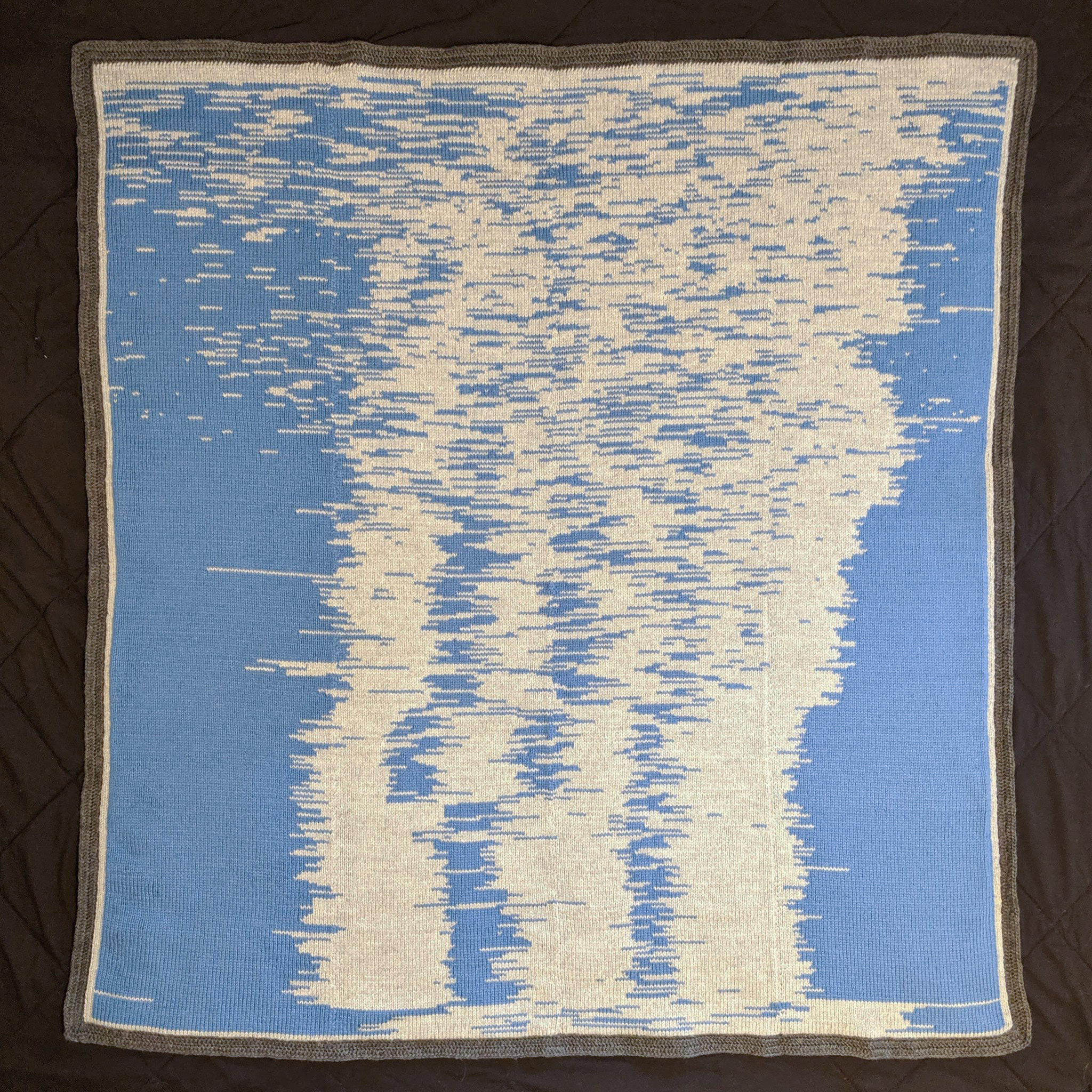
    That’s all to say that I recently delighted in a short story I read on Colossal a couple of days ago about a father who took a graph of his kid’s sleeping patterns and wove it into a blanket.

    Human sleep (AI will not require this) reflected as binary data (blue is 0 or asleep; white is 1 or awake) emerging over time from chaos into a controlled pattern rendered visually by human hands through a substrate the functional purpose of which is to provide warmth for the biological source of the data.

    This blanket could become a holy relic preserved by our descendants fighting to survive under AI’s dominion. Perhaps his son will lead the movement that prevents us from manifesting this destiny.

    As a father who created things for my son when he was born, I am outdone and supremely impressed by Mr. Lee’s creativity and technical skill. Chapeau!