

SEÑOR

Dispatches from the gap between how the world works and how we pretend it does.

Tag: philosophy

  • The Buddha at the Back of the Room

    The Buddha at the Back of the Room

    A masochist’s mantra that began as a battle cry in a Ghanaian martial arts film.

    I recently read an interview with Durba Mitra, a feminist historian at Harvard, on her new book The Future That Was: A History of Third World Feminism Against Authoritarianism. The book recounts how, in the years following the UN’s International Women’s Year in 1975, women from the decolonising world began articulating an intellectual tradition that challenged colonialism, patriarchy and authoritarianism not as a queue of grievances but as a single interlocking system of power. Theirs was not Western liberal feminism translated into darker complexion, it was a different diagnosis altogether, and therefore demanded different remedies.

    And then, gradually, in the way these things happen when they are put to work rather than when they are crushed, their vocabulary was digested. Development agencies, UN frameworks and gender-and-development programmes absorbed their language while quietly excreting the structure of thought that had given it meaning.

    Or, to employ a different metaphor, the architecture they had designed was progressively renovated by institutions that retained the facade while altering the load-bearing walls. The Future That Was is an attempt to recover the women who conceived that architecture from a particular kind of disappearance: not forgetting, which would at least be honest, but the subtler process by which a radical vision survives only after its foundations are buried and built over.

    Reading this, I found myself thinking about Elissar. A few days earlier, a friend had been telling me about the musical she is writing. Her subject is the founder of Qart Hadasht, the city Rome would later call Carthage, known to most, if at all, by her Greek name, Dido; known to herself, as Elissar or whatever name her own people spoke before their language became a scholarly reconstruction and their archives ash.

    The conceit my friend has chosen is deceptively simple. The curtain rises not on Elissar’s flight from Tyre nor the founding of her city, but on her funeral. Only then does the story begin. From that point onward, the audience retraces the path that led there, watching each decision accumulate toward an ending whose significance it already understands, even as the characters remain oblivious to it.

    There is something profoundly unsettling about that reversal. Ordinarily we experience life from within, moving uncertainly toward an ending we cannot see. History, by contrast, is almost always encountered in reverse. We know how Carthage ends. We know how revolutions end. We know, or think we know, what becomes of the slogans, the manifestos, the founding acts, the roads taken in youth and then mythologised by people who were not there. Looking backwards, necessity begins to masquerade as inevitability. We mistake outcomes for destinies and forget that, for those living them, every ending was once merely one possibility among many.

    Consider what we actually know about Elissar, which is considerably less than one might expect for a figure of such historical and literary consequence. The surviving accounts come almost entirely from future adversaries of her people: Greek and Roman historians who recorded her story after Carthage had been annihilated, its libraries destroyed or dispersed, its population enslaved or scattered, its fields allegedly salted into permanent sterility. Even that last image, the salting of the earth, has become one of those historical details whose symbolic usefulness has outlived the evidence for it. Carthage is the sort of civilization that reaches us through the sentences of others. The city lost; the victors’ metaphors endured.

    The narrative preserved in Justin’s epitome of Pompeius Trogus gives us the outline of something remarkable: a Tyrian princess whose brother, Pygmalion, murdered her husband Acerbas to seize the treasury and consolidate his power; who escaped with followers, ships, and what remained of the fortune; who landed on the North African coast and negotiated for land; who, in the famous ox-hide story, cut the hide into strips to claim more territory than the local ruler had imagined offering; and who founded a city that would become, for several centuries, the dominant power of the western Mediterranean. There are variants and uncertainties, as there always are when legend and history are braided around a missing archive.

    Some traditions suggest that the father named both children as heirs and that Elissar’s claim was not merely sentimental but dynastic. What survives officially of Tyre’s succession gives us Pygmalion as king. The co-regency, if there was one, is missing. The absence may mean nothing. It may mean everything.

    Virgil creates an account of a different personage. He gives Elissar to Aeneas, as Dido, a woman who loves a Trojan hero and curses him when he leaves, because she is useful to the epic he is composing. Augustus required a mythic prehistory for Rome, and Rome required a memory of Carthage that made its own wars appear not merely strategic but fated. Dido’s dying curse, calling down an unnamed avenger upon the race of Aeneas, served that purpose with impeccable economy. Virgil’s Roman readers understood immediately that the avenger was Hannibal. Her death provided the emotional origin story for a geopolitical rivalry. Carthage’s founder was drafted into the service of her conquerors’ mythology, not because Virgil misunderstood her but because he understood exactly what he needed her for. The fact that she is genuinely moving in the Aeneid, that readers have wept for her across two thousand years, does not alter what she was recruited to do. It rather proves the point.

    In the older tradition, Aeneas does not appear. Elissar’s death there is a political act. The local chieftain Iarbas, from whom she had obtained the land on which Carthage stood, demands that she marry him or face war. The demand is not merely conjugal ; it is jurisdictional. It is a claim upon the city through the body of its founder. If she accepts, Carthage survives by surrendering its sovereignty. If she refuses, the city she has built may be destroyed before it can defend itself. She tells her people she needs time to prepare a ceremony in honour of her dead husband. She builds a pyre. She climbs it. She kills herself.

    The conventional telling draws our attention to the woman as wife and away from her as queen, inviting us to read a constitutional crisis as a private tragedy. But the actor here is not contending with romantic despair. This is someone, who happens to be a woman, confronted with two unacceptable choices who invents a third one that neither party had offered. She preserves the city by removing the pretext for its destruction. She preserves her fidelity to Acerbas by refusing to replace him. She preserves, perhaps, her own authority by refusing to let her body become the instrument through which the city is absorbed into another man’s sovereignty.

    Now whether we should call this courage or its opposite is a question the sources decline to answer, and one I cannot settle for myself. I only know that Virgil’s version is the ancient equivalent of the Harlequin romance. A woman dies because a man leaves her. Never mind the rather more pressing matter of preserving a city founded by exiles who had entrusted their lives, their fortunes and their future to you.

    That deflation is what linked her, in my mind, to Mitra’s women. Women act. Later systems explain what their actions meant. A founder becomes a lover. A political death becomes a romantic one. A body that refused incorporation is incorporated into the literature of the power that destroyed the city she founded. Mitra’s Third World feminists did not face the same fate, but they faced a recognisable mechanism. They produced a way of understanding power, only to watch its language become available to institutions that did not share its original commitments. Their terms survived. The grammar changed.

    This is where the title of Mitra’s book begins to burn rather than merely describe. The future that was. Not the future that failed, which would be sad enough, nor the future that never came, which would be merely elegiac. The future that was suggests something more difficult: a future that existed as an intellectual and political possibility before being converted into a past. The women she studies were not simply defeated by patriarchal authoritarianism. They were, in a sense, succeeded by institutions that learned to speak in their language while meaning something else. To be forgotten is one fate. To be preserved under altered terms may be worse, because it allows the world to congratulate itself on remembering while ensuring that what is remembered no longer threatens it.

    Several weeks earlier, on a flight home, I had watched Kerouac’s Road: The Beat of a Nation, a documentary about Jack Kerouac and the generations of seekers who have followed in his wake. The film moves between archival Kerouac and an array of inheritors: actors who rode motorcycles across America after reading the book, a fashion designer who credits the Beats for his Dior collections, a cultural critic who wonders what the road might have looked like with James Baldwin in the passenger seat. Each of them has taken something from Kerouac and made it mean what they needed it to mean. The film treats this as evidence of his reach. The possibility that it is also a description of what destroyed him is not one the documentary finds it necessary to explore.

    The man who wrote the great American hymn to motion spent the final decade of his life watching strangers appropriate that hymn for purposes he found baffling and, eventually, contemptible. He drank against it. He appeared on William F. Buckley’s Firing Line in 1968, inebriated and raging at a hippie musician for building a career on tearing things down. He had become the reluctant saint of a movement whose politics, aesthetics and self-congratulation he increasingly despised. He moved back in with his mother in Florida. He died at forty-seven from internal haemorrhaging brought on by cirrhosis.

    The common explanation is that Kerouac could not handle success. This may not be entirely wrong, but it is too small. Plenty of people cannot handle success. What seems more interesting is to explore why? His success placed him in the position of being interpreted by his adherents in a way that made repudiation impossible. Every objection he made was folded back into the myth. If he complained about the hippies, that merely proved he was complicated. If he drank, it became tragic evidence of his intensity. If he recoiled from the counterculture, the recoil could be treated as another scene in the drama of the prophet undone by the movement he inspired. There are forms of admiration from which no escape is possible because they metabolise objection as confirmation.

    The film is itself an example of what it cannot see. The admirers it assembles are building on Kerouac’s story, extending it into their own lives, using it as a framework for their own searches. The myth that escaped him in his lifetime continues to escape him in ours. He would have hated the film, almost certainly, which the film would probably find touching. That is the cruel genius of canonisation. It can turn resistance into texture. It can transform disgust into pathos. It can make even the subject’s refusal of the story into one of the story’s most charming features.

    What connects Mitra’s women, Elissar and Kerouac is not tragedy exactly, and not simply the corruption of ideals by institutions, which is the obvious reading and too consoling to be accurate. In each case, a foundational act generated an alluring story that became, over time, separable from the person or people who originated it, and into which others stepped to build what they required; with a large enough audience’s approval. Elissar’s founding of Carthage escaped into Rome’s origin mythology. Third World feminism’s intellectual tradition escaped into the bureaucratic vocabulary of international development. Kerouac’s search escaped into a counterculture he regarded as a misreading, and then into a documentary that treats his objections as one of his more poignant contradictions. The authors were not simply defeated. They were succeeded. Something was built on what they built, without their consent, and the something bore their name while serving other purposes.

    One sees this pattern with such frequency that it begins to feel less like betrayal than like a structural feature of human life. It is perhaps especially visible in founding stories, because founding stories are always written twice: once by those who make the crossing, raise the walls, declare the covenant or plant the flag, and again by those who inherit the result and need it to mean something. A people fleeing violence can become a power that administers violence. A movement formed against domination can acquire the habits of domination once it has territory, law and archives. A critique of empire can become an institution that grades the empire’s former subjects against administrative indicators.

    This is not hypocrisy in the simple sense. It is more disturbing than hypocrisy, because what supplants the founder’s story is not a betrayal that fails but a betrayal that succeeds. The institution functions. The myth travels. The city stands. It is precisely because Carthage prospered, because development agencies expanded their reach, because a generation found themselves in Kerouac’s book, that the founders became unnecessary to what they had founded. Dispensability is the reward for having built something that lasts.

    This is where today’s political soul-searching becomes unavoidable. American settlers pushing westward, Israeli communities describing themselves through the language of return and survival, Phoenician colonists negotiating with Amazigh chieftains for a coastal hill in what is now Tunisia: these are not equivalent cases, and any argument that depends on treating them as equivalent should be distrusted. But they do share a formal problem.

    Arrival must be narrated as necessity. Occupation must be translated into destiny, refuge, providence, reclamation or law. The people who arrive must tell a story in which their presence is justified, and the story almost always becomes more coherent as the people displaced by it become less audible. What begins as a solution to one people’s vulnerability can become the source of another’s. The solution does not fail because it is insincere. It fails because it succeeds well enough to acquire power.

    Elissar’s death, in the older version, is therefore not an antique curiosity but a political grammar still intelligible to us. She stands at the hinge between refuge and sovereignty. Her body is the point at which a city’s survival is to be converted into another man’s authority. The demand made of her is not merely to marry but to ratify, with her person, a settlement in which the founding act is absorbed into a pre-existing power. Her suicide refuses the translation. It is a terrible refusal, and perhaps not one we should admire too quickly. Yet it exposes something that later, softer versions obscure: the founder’s body and the city’s sovereignty were not separate problems. The politics entered through intimacy, as it so often does.

    The friend writing the musical is working through what Elissar’s life and death meant, what it says about a woman who built a world that eventually outran her authority over it. One might wonder, without any unkindness, whether she is also working through something closer to home: what it means to be someone’s daughter, someone’s heir, someone whose future has been narrated by people with their own interests in how that story ends. Elissar, after all, was also that. She refounded herself. Whether the musical will clarify what Elissar’s story actually was, or whether it will become the most recent vehicle by which her story is made to mean something other than itself, is a question opening night alone will not resolve. It may not even be the right question. Perhaps retelling is never a recovery of the original so much as an admission that the original can no longer defend itself.


    I found myself thinking of this again, improbably, in relation to peptides. Everyone appears to be taking something now, or considering taking something, or consulting someone who knows which protocol everyone else is taking. The language is familiar: optimization, recovery, longevity, performance, biomarkers, sleep architecture, inflammation, metabolic flexibility. I am not immune to the appeal. Quite the opposite. And the appeal is not unfounded. People are sleeping better, recovering faster, moving through their days with an energy they had quietly stopped expecting. The interventions are working, which is the problem, or at least the beginning of it.

    Because when something works, the question of what it is working at the expense of becomes harder to ask and easier to dismiss. Who decided what counts as improvement? Which measurements are being privileged, and which forms of deterioration have been made difficult to see because they fall outside the selected dashboard? If energy improves but anxiety worsens, if recovery accelerates but sleep becomes dependent on a stack of interventions, if longevity becomes a project so elaborate that life itself is reorganised around its extension, what exactly has been optimised? Quantification is not the opposite of ideology. It is often ideology’s most efficient costume, because once a value has been converted into a metric it can pretend to have escaped argument. The founders of this particular movement, whoever they were, would recognise the trajectory.

    This is not an argument against peptides, any more than Mitra’s book is an argument against reports, or the story of Elissar an argument against settlement or Kerouac’s ruin an argument against travel. It is an argument against allowing an intervention to become sovereign over the problem it was meant to address. The most dangerous solutions are not the ones that fail. Failure is instructive and often clarifying. The dangerous ones are those that work well enough to be inherited, abstracted, systematised and repurposed until the original need disappears beneath the procedures created to meet it. At that point the solution remains, sometimes in impressive institutional form, but the question it was meant to answer has moved elsewhere.

    By this point an unwelcome figure had begun appearing at the back of the room. He was not in Mitra’s interview. He was absent from the legends of Carthage. Kerouac circled him, borrowed from him, drifted near him and then retreated into Catholic grief, American rage and alcohol. He has little to say about peptides, though one suspects he would understand the craving they answer. The Buddha does not enter this argument as a solution. He enters as an irritation.

    His irritation lies in the fact that he does not ask whether the road, the city, the movement, the institution or the protocol has been properly designed. He asks what in us keeps demanding that any of them finally hold. The world changes, the self changes, the object of desire changes, and yet we insist on building as though the thing built could secure us against alteration. That does not mean one should build nothing. The cheap version of Buddhism, the one dismissed by those who require enemies more than interlocutors, imagines detachment as withdrawal and compassion as sedation. The harder version asks what it would mean to act without needing the action to become a monument to the actor.

    I am not sure I believe this. Or rather, I believe it intermittently, which may be the only honest way I believe anything that competes with my instincts. Camus would say to build anyway, to recognise the absurdity of the enterprise and persist without appeal. Nietzsche would say that the hunger to create, to impose form, to make something of the chaos, is not a mistake but the very sign of life. The Buddha, standing quietly behind both of them, would ask whether their answers still leave the self intact as the hidden beneficiary of the drama. None of them has resolved for me the problem of what to do when your ideas are institutionalised, your story is drafted into someone else’s epic, or your myth turns up in a documentary making thoughtful remarks about the American spirit.

    Elissar was, in some traditions, deified after her death. The people of Carthage worshipped the founder as a goddess, or perhaps later identified her with Tanit, for as long as the city endured. The city endured until 146 BCE, when Rome burned it. After that, the goddess, the city, the records and the library disappeared together, while Virgil’s Dido survived. The curse survived. Hannibal survived as Rome’s nightmare and later as history’s admired enemy. What did not survive was Elissar’s own account of what she had made, why she made it, and whether dying upon the pyre was an escape, a refusal, a sacrifice or the last act of sovereignty available to her.

    Perhaps every solution that matters is destined to escape in this way. It enters the world to answer one problem and is inherited by people trying to solve another. That may not be failure, exactly. It may be the only form of survival history permits. Still, I cannot shake the unease that something essential is lost when an idea remains legible only after its foundations have been infilled, when a city survives only through the literature of its destroyers, when a road remains open only because the man who paved it has become one more landmark beside it. We keep building anyway, which may be courage, vanity, delusion, necessity or merely habit. The Buddha waits at the back of the room, neither applauding nor condemning, while the rest of us continue arguing about whether a foundation has been betrayed because another structure stands above it, or whether this is what foundations were always for.
  • Boards, Brands, and the Blind Spot for the Broader Context

    Boards, Brands, and the Blind Spot for the Broader Context

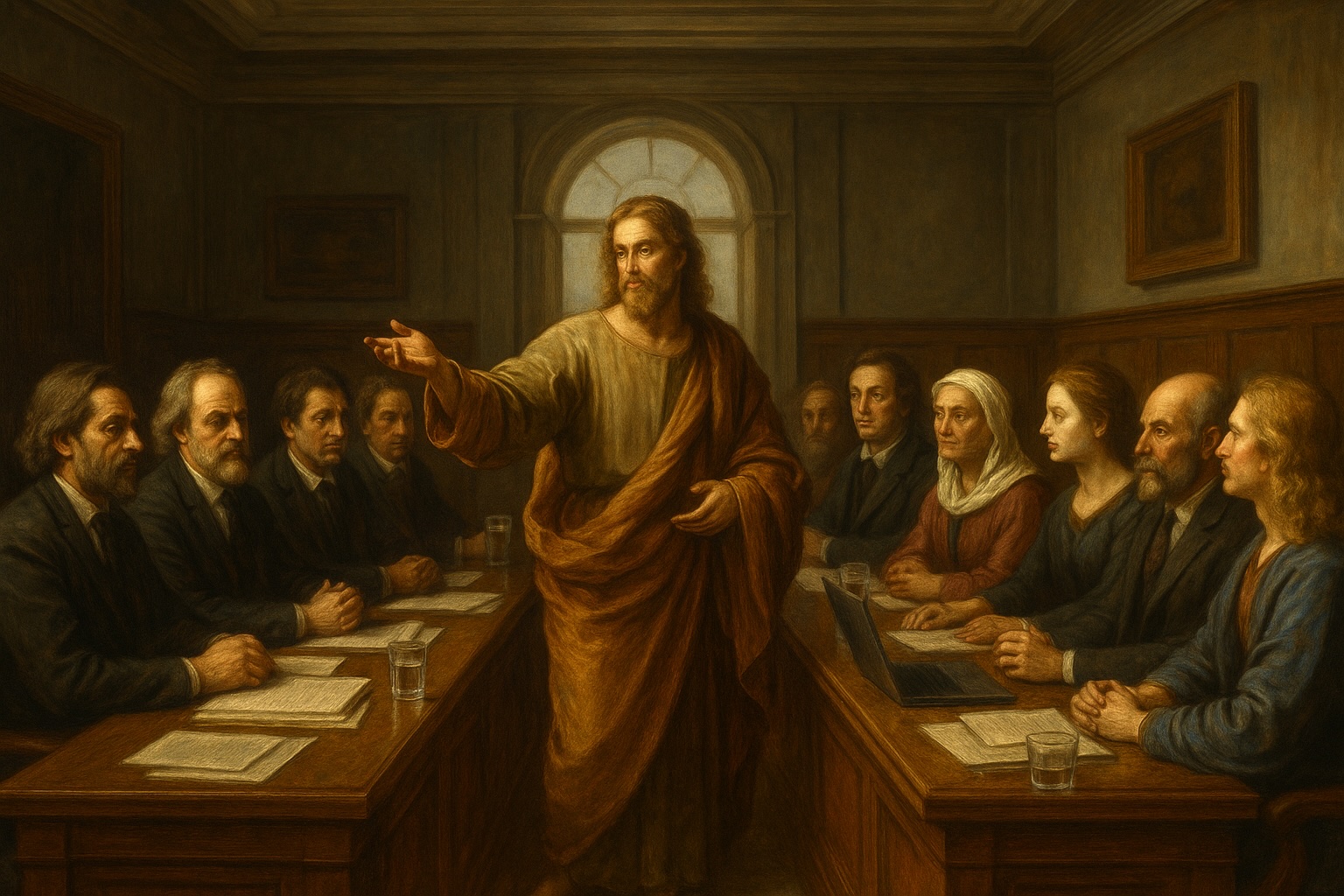
    Jesus addressing a modern board meeting around a conference table

    Why every organization needs a resident historian—not just a marketing department

    I’ve been thinking a lot about organizational effectiveness lately. I’m working on a primer for innocent bystanders thrust into high-stakes managerial roles, as a prelude to something even more ambitious—one that concerns a titan of industry—and since then, everything around me seems to be speaking in that language.

    Last night, I attended the premiere of Tempest, an orchestral work by a composer friend, performed by the Q**** Philharmonic. The piece draws from the rhythmic foundations of Q***** pearl diving percussion and blends them with the seafaring musical traditions of Nordic, Celtic, and Baltic cultures. Beneath the obvious differences lies deep resonance and a shared rhythm shaped by wind, water, and survival at sea.

    Gulf percussionists performing with an orchestra under blue stage lights

    It was a remarkable experience. But I struggled to follow the modes or recognize the sonic codes. I was moved, but, unmoored, I drifted. Knowing the composer, I was certain that the work was layered with meaning that eluded me for lack of a processing framework.

    That disorientation allowed my mind to drift to my daily plat du jour—management terrine—shaped by the mold in which it is made. I was reminded of the first time I stepped into an organizational leadership role without any bearings.

    Despite your best efforts to discover, intuit, or interrogate a coherent picture of the organization, you struggle to find a critical mass of overlap. You sense there’s a rhythm to how things are done—a set of inherited assumptions, values, and buried conflicts—but no one can quite explain them. You’re handed a PowerPoint deck and a set of KPIs, but no backstory. No context. No through-line.

    And without context, even the most brilliant efforts are susceptible to falling flat. It’s like entering a story halfway through—every action is vivid, but the meaning is lost. Worse, such efforts may lead to misalignment. At best, energy is spent—but not compounded.

    Once upon a time, context was maintained through epic poems and tales transmitted down the generational line. Earlier civilizations may not have pursued coherence for its own sake, but they understood the power of story to legitimize rule, stabilize succession, and elevate victories into destiny. That’s why empires employed court historians. Their job wasn’t to report—it was to narrate. And while the motive was often glorification, the byproduct was cohesion: a shared encyclopedia, a sense of continuity, a framework through which people could make sense of the present. They helped a polity remember itself—not always truthfully, but usefully.

    Today, that role has been quietly outsourced—if not erased. The modern equivalent, if one exists at all, is marketing.

    To be sure, marketing has evolved to craft compelling narratives that insinuate themselves into the psyche and make you yearn for goods and services you never imagined needing. It knows how to mythologize products, how to dramatize launches, how to harness the emotional grammar of storytelling to build brands that feel like legends.

    But marketing is built for speed. Its job is to chase relevance. It tells the story the market wants to hear—not necessarily the one the organization needs to remember.

    And therein lies the irony: we understand the ancient power of narrative when it comes to our offerings. We hire agencies to weave myth into packaging. We pour millions into commercials that echo the Hero’s Journey. Our products have origin myths—but our people have amnesia.

    Intra-organizationally, the story breaks down. Knowledge is managed, not narrated. Culture is defined in bullet points. “Lessons learned” are archived in shared drives no one visits. Strategy is deployed without memory. And slowly, coherence erodes.

    The result? A kind of institutional drift. A feeling of disconnection. A lack of narrative ballast. And in moments of stress—mergers, pivots, leadership transitions—this absence becomes acute. People can’t see the pattern. They don’t know what came before, or why. They don’t know if this storm is survivable—because no one has told them that the organization has weathered worse.

    This is where the historian belongs.

    Not as an archivist. Not as a content generator. But as a resident meaning-maker.

    The historian listens. Connects. Synthesizes. They draw lines from past to present and surface the stories that help people understand who they are part of, and why it matters. They recover buried episodes that deserve to be part of the institutional identity. They interrogate values—not just by asking what they are, but where they came from, when they held, and when they broke.

    They don’t produce slogans. They craft coherence.

    This is not a romantic gesture. It is good business. A single hire, a modest role—yet the benefits ripple: more resilient cultures, more grounded strategies, more humane onboarding, and a richer capacity to learn from experience.

    It remains a wonder that Fortune 500s don’t all have resident historians. Especially when we know what stories can do. Especially when we invest so much in telling them—except when it comes to ourselves.

    Levi’s has Tracey Panek. American Express employs Ira Galtman. A handful of others—Ford, CocaCola, IBM—have long maintained archives and occasionally retained in-house historical expertise. But these examples are exceptions, not the rule. And even they are often misdirected into brand archivists—curators of memorabilia rather than interpreters of meaning.

    Slow thinking isn’t indulgence. It is infrastructure. And story—internal story—is the infrastructure of identity.

    It’s time to bring back the historian. And give them a seat on the board.

  • An Interview with Renard Baudrillard on The Digital Fossil

    An Interview with Renard Baudrillard on The Digital Fossil

    Dense black-and-white maze-like digital pattern

    Felix Saxa sat down with Renard Baudrillard to discuss his project “Digital Fossil.” The following is a transcript of their discussion.


    Felix : Welcome, dear listeners, to another edition of our podcast “Shooting the Sh*t and Eating Some Food.” Today, I have the pleasure of speaking with Renard Baudrillard, an artist who rejects that label and now insists on being referred to as a hose.  He has been making waves with his latest project, Digital Fossil. Renard, thank you for joining us.

    Renard : It’s great to be here.

    Felix: Today we are serving Crispy Duck Salad from Hakkasan. What do you think?

    Renard: I like it. But I am starting to feel that this salad is going the way of seared tuna from decades back and truffle everything which just won’t die.

    Felix: Can’t we just react to flavor, presentation, and mouthfeel?

    Renard: Do I have to answer that?

    Felix : Renard, I’ve been following your work for a while, and Digital Fossil really caught my attention. But before we dive into the specifics, I’m curious to learn how the idea for this project was born.

    Triptych portrait of a young man posing with one hand on his shoulder

    Renard : Who knows how these sorts of things emerge, I guess the closest I can come to fixing a point is an afternoon spent at a friend’s house—she works for Vogue, so you can imagine the stacks of magazines scattered all over. I remember noticing how they were in various states of wear, some as though freshly pressed, others torn and faded. She was droning on about something or other, and I got to thinking about how physical publications are being replaced by digital media the way online shopping has replaced brick and mortar retail and that got me wondering—do things somehow age online as they do in the real world? Does the digital decay?  Booom! I get smacked in the head by a magazine and my eyes refocus to see Birgit Freund staring at me as the words “RB ARE YOU LISTENING?” echo in my ears.

    Felix : laughs Birgit Freund! Did you piss yourself?

    Renard : Almost but my bladder control is competition-class. Anyway, the thought stuck with me and I started thinking more about digital decay, and that’s how Digital Fossil came to be. I wanted to explore the idea of a digital aging. So, I used a downsampling algorithm to induce degradation, progressively reducing the quality of the image over 148 stages as if the file were being ravaged by time.

    Felix : And why 148? That’s a very specific number.

    Renard : It was just the point where the degradation plateaued. At first, each pass through the downsampler results in noticeable loss of detail and artifacting, but as the image “decays”, the changes become less pronounced, almost imperceptible. It’s kind of like how a fossil stabilizes over time. The image reaches a point where there’s no more significant detail to lose, and that’s where it stops changing in any noticeable way. The plateau.

    Felix : So, the image is wasting away, but then it hits a point where it can’t really degrade any further?

    Renard : Right. And that ties into the math of it.

    Felix: No math please.

    Triptych portrait disrupted by digital pixelation

    Renard: Laughs No no, it’s nothing too obtuse.  When you downsample an image, you’re essentially averaging out pixel values in groups. Early on, each pass strips away a lot of detail, but as the data becomes more homogenized, the algorithm can’t really differentiate between pixels anymore. It’s a consequence of entropy leveling out, the image no longer has enough fidelity to lose anything substantial. So after a certain number of iterations, the degradation reaches an asymptote.

    Felix: I can’t believe you said asymptote.  This is the second time I hear that word in a week after almost an entire lifetime of absence.

    Renard: Where did you hear asymptote?

    Felix: You know Hector Dupaix right?

    Renard: I’m not sure I do…

    Felix: Hector, the guy who became famous for sc…

    Renard: Oh, yes, yes…

    Felix: Well, he’s now written a book, and I recently sat down with him to talk about it and at a certain point in the conversation he said that human experience bears an asymptotic relationship with the ideal forms and that we can never experience them no matter what we do.

    Renard: Oh right.  Interesting.  Crazy how things “trend” in our lives for a certain time and then they disappear.  You think you’ll hear asymptote again?

    Triptych portrait heavily fragmented into black, white and tan pixels

    Felix: Laughs. Somehow I doubt it.  But back to topic, so are you saying that digital imagery have a base skeleton, if you will, that downsampling reveals?”

    Renard: Not quite.  I mean you can have a hi-fi dinosaur fossil and a lo-fi one depending on various factors, it all depends on the image you start with and the downsampling algorithm.

    Felix : It’s still fascinating how that mirrors what happens in the natural world with fossils. They degrade until they stabilize into something preserved over time.

    Renard : Well, you get different types of fossils depending on the process—some are impressions left behind, others are fully mineralized, like bones turned to stone. But they all share that idea of degradation ultimately stabilizing. In Digital Fossil, the plateau mirrors that moment when the fossil is preserved, where it’s no longer decaying, but it’s far from what it once was.

    Felix : So, are you suggesting there’s a similar process happening with data? That over time, it degrades and fossilizes in a sense?

    Renard : I am. Data stored digitally degrades over time—not necessarily in terms of pixels, but in terms of recall integrity or file compatibility. Think about it: 1000 years from now, much of what we store today will likely be incomplete, corrupt, or incompatible with future systems. Future historians or archaeologists—digital archaeologists, if you will—will need to sift through the remnants of our digital lives the way paleontologists dig through fossils.

    Felix : So, we’re looking at the rise of “digital paleontologists” or “digiteologists” unearthing “datasaurs”?

    Renard : Exactly. We will be piecing together fragments from the past, just like paleontologists, we will have to reconstruct entire systems from fragments, analyzing the strata of our digital history.

    Triptych portrait reduced to dense black-and-white digital outlines

    Felix : The thought of that is both fascinating and a little terrifying. Do you think we’ll ever reach a point where we can preserve everything perfectly?

    Renard : I doubt it. I think the allure of Digital Fossil is that it references something immutable about creation the inevitability of decay.  I’ve always been drawn to the beauty of decay.

    Felix : I didn’t take you for an afficionado of the macabre.

    Renard: I don’t think it’s that really because I am not interested in the morbid or the gory.  I think what draws me to decay is more about what peaks through from the past.  It’s more about connecting with what has ceased to be and extrapolating what may have been there from what remains. 

    Felix: I like that. So for you it’s about puzzling out what was there from the remains.

    Renard: I think so.

    Felix: What’s next for you after Digital Fossil?

    Renard : I’m diving into how information decay manifests in biological environments. While quantum computing is currently taking up everyone’s attention because of its potential for a paradigm shift in processing, organic computing—using biological systems for data storage and processing—is a present curiosity that will undoubtedly see major development. I’m exploring how data would decay in that kind of system.

    Felix : Organic computing? Like using brain tissue or living organisms as usable computers?

    Renard : Exactly. Imagine being able to input and output from brain tissue.  The question becomes: how does data degradation work in an organic medium? What does it mean when you lose information saved in a chemical form, as opposed to binary code in silicon?  Is it more or less stable and is it so inherently or is it dependent on other factors.  So for example, would our ability to code stem cells to ensure the integrity of memories make forgetting obsolete?  How would that affect us?  We believe there is solace in forgetting.  Imagine having control over what you recall and what you forget.  Would hoarders get buried in memories?  Would we prefer degradation of memories or erasure?  It’s a frightening prospect but one with which we may soon be confronted.

    Abandoned bar reclaimed by moss, ferns and other vegetation

    Felix : I had no idea your work extended so far beyond the aesthetic.

    Renard : There’s something ironically annihilative about permanence in the same way that we imagine living forever something categorically different from the meaning of life.  These paradoxes have always interested me.

    Felix : I have to end it here as we’re out of time and increasingly out of my depth, but I think you should talk to Hector Dupaix about how these ideas play out on different scales of time and matter.

    Felix raises his glass in a toast. “To the datasaurs and the digiteologists who will uncover them.”

    Renard : laughs “To decay!”

    Felix : Thanks for coming on the program, Renard. And for our listeners, if you haven’t already, check out Renard Baudrillard’s work on his Instagram account, @r.baudrillard. Thanks for tuning in.

  • An Interview with Hector Dupaix on Navigating a Polarized World

    An Interview with Hector Dupaix on Navigating a Polarized World

    Felix Saxa sat down with Hector Dupaix to discuss his recently published book. The following is a transcript of their discussion.


    Felix Saxa: Welcome, dear listeners, to another edition of our podcast “Shooting the Sh*t and Eating Some Food.” Today, I have the pleasure of speaking with Hector Dupaix, a thought-provoking philosopher whose new book, “Navigating the Spectrum: Embracing Process in a World Beyond Binaries” offers a fresh perspective on addressing polarization in our world. Hector, thank you for joining us.

    Hector Dupaix: Thank you, Felix. It’s a pleasure to be here.

    Felix: What do you think of the Kibbeh Nayye? It’s from Babel.

    Hector: I love a good Lahmeh Madqooqa, and this is top-notch. It’s very smooth, creamy, and mild in flavor. My wife, who is a connoisseur of this dish, would love it.

    Felix: I’m glad you like it. Make sure you try it with a mint leaf; this batch is from my garden, and I’m growing a highly prized cultivar.

    Hector: I will.

    Felix: Good. So, your book delves into the fundamental tensions we experience as humans, particularly the dichotomy between stillness and striving. Could you start by explaining this central dichotomy?

    Hector: Certainly. At the heart of our inner experience lies a tension between what I call Inner Tranquility and Existential Drive. Inner Tranquility refers to our desire for contentment and peace—a state of being present and centered. Existential Drive embodies our push towards accomplishment, action, progress, and fulfilling the demands of life, whether for survival or ambition.

    Felix: How does this internal struggle relate to the overarching thesis of your book?

    Hector: We oscillate between these poles. For instance, we might meditate to find peace, but as soon as we finish, we pick up our coffee and get back into the hustle—emails, deadlines, and responsibilities. The self-help world has generally adopted this duality with a focus on either complete stillness and detachment (How to Do Nothing) or relentless productivity and achievement (How to Get Things Done). This oscillation exacerbates the dissonance between our physical and psychological needs. It’s schizophrenic.

    Felix: And you believe this particular tension reflects broader societal patterns.

    Hector: Exactly. Our polar thinking extends outward, influencing how we engage with the world, how we define it. The dichotomy between stillness and striving is artificial and it manifests in our social structures and interactions, leading to polarization on a larger scale.

    Felix: So what you’re saying is that dichotomies are an artificial construct and in reality things aren’t black and white.

    Hector: Not quite.  I am saying that some things are while others are not.  And most importantly, our lived experience is spectral, never polar.

    Felix: But you just said that our daily oscillations reinforce the polarity; we go from still meditative states to turbulent mayhem in a flash.

    Hector: Okay. Fair enough. Let me clarify. 

    Experience is certainly amenable to instantaneous cutoff – being disrupted.  You can be sitting in a state of complete mental quiet when a venomous snake sinks its fangs into your arm instantly (at the human scale of temporal experience) taking you out of that state.  I am not saying that is not real.  What I am saying is that we are conflating that disruption, that cutoff in our experiential continuity with the way the human experience is and should be.  Let’s use an analogy from film to clarify the difference.

    You are watching a scene with a family sitting at dinner eating and chatting, the scene then cuts to the father falling out of a window onto a trafficked city street landing on a car as it drives by.

    In and of itself, there’s nothing about this abrupt transition that would lead you to question the functioning of your senses.  You might be jarred by it and that may be the point or you might think it ridiculous or that a scene was cut if the context does not bear it out but you are not questioning your sanity as a result of witnessing that abrupt change.

    Contrast that with you actually sitting at a table one moment and then freefalling the next.  That transition is not consistent with our understanding of the world. 

    The film is a construct in which transitions can be abrupt whereas our lived conscious experience is constituted by more fluid transitions. That’s not to say that these transitions cannot be disrupted but a disruption is not the experience in the same way a dam is not the river. The world of human experience does not have clearly defined boundaries. And yet we have no problem defining people as black and white and beverages as hot or cold.

    Felix: Surely you are not proposing that we stop organizing appetizers in our menus under hot and cold and instead arrange them along a thermal scale?

    Hector: It’s not a binary choice….

    [Laughter]

    Several considerations come into play in organizing a menu.  Their impact on social justice or ethics is not at the top of that list.  But I can imagine instances where a food menu might be organized across a scale of caloric energy or a wine list on a scale of sweetness.

    Look, I am not saying we must completely dispense with dualities, the point I am making is that when it comes to the experienced world, the reduction of any aspect of it to a binary choice is artificial.  While it may be useful in certain circumstances due to imposed limitations, which is what my movie analogy was supposed to bear out, we need to keep in mind that this reduction is artificial.

    Felix: Why?

    Hector:  Because nobody has time for nuance anymore and the insistence on distillation and circumspection has become normative.  We demand that everything is boiled down to a choice between two options so I can pick between them and move on to the next.  And even then, the choice made is either right or wrong – binary.  I can live with being wrong in a binary world because I then immediately know what the right choice is by elimination.

    Felix: Fine, how does this polar thinking manifest externally in society in more significant ways beyond Android and iOS?

    Hector: Polar thinking leads us to categorize complex issues into binary oppositions—good vs. evil, us vs. them, progress vs. tradition. This oversimplified artificial construction has replaced the nuanced realities of human experiences and presented itself as our truth. Turn on your TV and you see this in play – Democrats or Republicans, Pro-Life vs Pro-Choice, People who love Freedom against their enemies, East, West or Global North and Global South – with the prevailing discourse ignoring the spectrum of perspectives that exist and forcing people into one of two camps.

    Felix: But nobody thinks people are fundamentally Republican or Democrat, they are simply choosing between two available options, and some people consider themselves Libertarian so it’s not really a choice between only two options. 

    Hector: For sure, there are always exceptions.  But what is the rule?  To see the absurdity of this bipolarity consider the case of Elon Musk, an immigrant to the US, who hails from the Global South and is anti-immigration.  Or consider the case of Israelis whose seder is the telling of a history of enslavement and torture who don’t see the hypocrisy in their support of a government whose policies and actions are inflicting the same humiliation and suffering on the Palestinians.  Some Palestinians, in turn, having been brutalized by the Israelis, paint all Jews with the same broad brush even though they themselves are victims of guilt by association and their religion tells them the Jewish story and identifies them as part of their Abrahamic lineage. 

    This is all born of a polar mindset.  National vs Immigrant, Jew vs Non-Jew.

    Felix: Alright, so let’s say both our inner and outer worlds are in disarray due to this polar thinking. If so, what’s the solution?

    Hector: The answer isn’t to choose one pole over the other or to find a simple middle ground (halving the baby). The solution is to recognize that human life is always in process and to drop the false notion that we are achieving our goals. We may sail towards a point on the horizon, but we will never reach it. As our ability to process larger data sets and contend with greater complexity and variability improves, we will increase our ability to produce better outcomes along our journey, but we should never grow so bold as a result of our success to think like Candide that we can ever be in the best of all possible worlds.

    Felix: That’s a profound shift in perspective. How can we begin to move from this polar thinking to embracing the spectrum?

    Hector: It starts with our acknowledging that our embodied lives do not commune with ideals – that the Platonic forms, das Ding an sich, call these ideals what you may are intellectual constructs that we will never experience. We can then apply this understanding to how we manage our personal evolution, interact with others and address societal issues, promoting dialogue and empathy.

    Felix: But some might argue that in practical terms, especially in governance or justice, binary choices are necessary. How do you respond to that?

    Hector: While binary decisions are sometimes unavoidable due to systemic constraints, it’s crucial to acknowledge that such distillations are reductive and to allow for expansion when advances in information processing allow it. Our limitations in processing complexity do not justify our fully leaning into a reductionist approach. Acknowledging that “it’s complicated” allows for more compassionate and effective policy-making. For instance, in the justice system, acknowledging the spectrum of factors influencing behavior—such as socioeconomic conditions, mental health, and upbringing—can lead to more equitable models of governance.

    Felix: Can you give an example of how this nuanced approach is pragmatically beneficial?

    Hector: Certainly. Consider addiction treatment. Viewing addiction not simply as a personal failure (binary thinking) but as a condition influenced by a spectrum of genetic, psychological, and social factors leads to more effective interventions and less stigmatization. Programs that address these various factors have higher success rates than those that rely solely on punitive measures.

    Felix: So in your view, gender is non-binary?

    Hector: Both sides of the gender fluidity debate in fact highlight the limitations of binary thinking. Those advocating for a more spectral view of gender have missed the point by insisting on the universal adoption of new categories. Conversely, those insisting on a strict binary view are referencing a dichotomy that doesn’t reflect the real-world spectrum of gender identities.

    As a result, we are dealing with people who identify as a hose and others whose masculinity is radioactive. These are the people who are taking up all the oxygen in the room. Neither is the answer.

    As our level of understanding evolves so does our language in a dialectical relationship. Language will have to evolve as our understanding broadens. For example, in Italian, a gendered language, the term “non-binary” becomes “non-binario” or “non-binaria,” depending on the gender of the person—the paradox highlights how deeply rooted the prevailing polar framework is.

    These advances require work. They can happen collaboratively or they will happen by adjudication. Adjudication is a binary framework that is necessary to resolve intractable disputes because “Life” must go on and we are limited in our capacities. But it doesn’t create optimal outcomes.

    Felix: Earlier, you mentioned that this pattern isn’t limited to human experiences but extends to the external world. Can you elaborate on that?

    Hector: Certainly. If we move from internal human experience to external human interactions and then to the external world, we notice similar patterns of dualities. At the macro, micro, and ultra-micro scales, we observe fundamental dualities interceded by a spectrum.

    For instance, in physics, we have the macro duality of Order and Chaos. This duality is connected by a spectrum where life exists, exhibiting both order and unpredictability. The spectrum isn’t linear but has an asymptotic relationship with these macro-level poles—it approaches them but never fully reaches them.

    Felix: Why did you choose “Order vs. Chaos” as your fundamental duality?

    Hector: “Order vs. Chaos” effectively captures both human experience and physical reality. Order represents structure, predictability, and stability—paralleling our desire for Inner Tranquility. Chaos symbolizes change, unpredictability, and innovation—mirroring our Existential Drive.

    For example, inanimate matter often behaves predictably; a rock will fall when dropped due to gravity. In contrast, living organisms, even simple ones like bacteria, exhibit spontaneity and adaptability, introducing unpredictability into their behavior. This unpredictability isn’t random but exists along a spectrum influenced by various factors that we may never come to fully understand.

    Felix: Could you elaborate on how these scientific concepts parallel human dichotomies?

    Hector: Certainly. In physics, General Relativity deals with the macrocosm, providing deterministic descriptions of gravitational phenomena—reflecting Order. Quantum Mechanics governs the microcosm, characterized by probabilities and uncertainties—reflecting Chaos.

    Our internal experiences mirror this duality. We seek order in our lives through routines and expectations, but we also embrace chaos through creativity and adaptation. The interplay we experience isn’t binary but a fluid movement along a spectrum.

    Felix: That’s intriguing. How does this relate to our understanding of the world and ourselves?

    Hector: Recognizing these patterns helps us see that the dichotomies we have constructed are reflections of a “reality” that is not part of our lived experience but part of our intellected world. By understanding that our lived experience lies along a spectrum, we can more meaningfully pursue our place within it.

    Felix: You draw parallels between your ontological concepts and various philosophical theories. You reference Kant’s concepts of the transcendent and the transcendental. Could you explain how these fit into your framework?

    Hector: Certainly. Immanuel Kant distinguishes between the transcendental, which concerns the conditions that make experience possible, and the transcendent, which lies beyond possible experience. In our context, I am arguing that we cannot fully experience or comprehend the unity of dichotomies—the transcendent. However, we can engage with the processes and conditions that allow us to navigate these dichotomies—the transcendental.

    Felix: In your book, you discuss transcendence as a way to contend with dichotomies. Are you adopting the Eastern Philosophical position that aims to transcend past duality to reach the unitary?

    Hector: I view transcendence not as reaching a fixed state but as engaging in an ongoing process. It’s like exercising a muscle—you become stronger through continuous effort, but there’s no final targeted destination that is accessible. Transcendence involves experiencing the journey and the transformations it brings, rather than seeking an ultimate understanding or resolution of the tensions.

    Those who have profound experiences, such as through meditation, psilocybin use, or near-death events, often report significant shifts in perception. They don’t necessarily understand these experiences intellectually; they feel them deeply, which can lead to lasting changes in how they navigate life’s spectra.

    Felix: So is your work an evolution of Kantian thought?

    Hector: Not necessarily, other thinkers have explored similar concepts. For example, Hegel introduced the idea of the dialectic, where thesis and antithesis resolve into a synthesis, a process that continually evolves. Heraclitus spoke of change being central to the universe, encapsulated in his phrase “everything flows.” Laozi, in Taoism, emphasized the balance of opposites through the concept of the Yin and Yang. These philosophies recognize the interplay of opposing forces and the importance of the process in navigating them.

    Felix: So, your framework departs from these ideas by emphasizing the process over seeking a definitive resolution.

    Hector: Exactly. The goal isn’t to eliminate tension or find a permanent balance but to acknowledge that ours is strictly a world of process, the ends belong to the Other.

    Felix: Who is the Other.

    Hector: The Other has many names. Para Brahman, Nyambi, Yahweh, Allah. The Other is basically the macro duality of Everything and Nothing. The universe is the spectrum that sits between those two poles.

    Felix: I think that’s a subject that requires more time than we have, and you allude to an upcoming separate and more thorough treatment of it in your book, so let’s go back to lived experience – how does this new framework impact our approach to social justice and societal issues?

    Hector: When we apply polar thinking to social justice, we often end up with rigid categories—oppressor vs. oppressed, right vs. wrong—which can hinder progress. By focusing on the process and acknowledging the spectrum of experiences and perspectives, we open up space for dialogue and collaborative solutions.

    For example, in discussions about systemic inequality, recognizing the nuances and intersecting factors allows for more effective strategies that address root causes rather than symptoms.

    Felix: So a shift from an adversarial approach to a collaborative one?

    Hector: Precisely. By moving away from binaries, in which the interlocutors assume they have access to and have selected the right path and any departure from their demands is a fundamental concession, we can foster empathy and understanding, which are crucial for meaningful change.

    Felix: Earlier, you mentioned the concept of asymptotic relationships with macro-level poles. Could you explain that in simpler terms?

    Hector: Of course. An asymptote is a line that a curve approaches but never quite reaches. In the context of our discussion, the spectrum between dualities approaches the extremes but never fully attains them. We can get closer to one pole—say, complete stillness—but we can never exist there entirely because life is dynamic. This illustrates that while we may strive toward certain ideals, the reality is that we exist somewhere along the spectrum.

    Felix: That’s a helpful analogy. How can individuals apply this understanding in their daily lives?

    Hector: By acknowledging that our lives are incommensurate with ideals, we can alleviate the pressure to reach them. Instead, we focus on the journey and the growth that comes from sailing the continuum of experience. This mindset encourages flexibility and resilience.

    Felix: so it’s not about the goal, it’s about the journey – I think I’ve heard that before; a lot.

    Hector: True Ecclesiastes. But there’s a little more to it. There is this inclination in putting this adage to work to picture oneself running a marathon and focusing not on crossing the finish line first, but just enjoying the run or finishing the race with a better time. What I am trying to get across is that there is no finish line in the human experience. As far as we know, the only finish line in human experience is death. This is not to say that you wander aimlessly and let the world take you where it may. You are certainly free to choose that path but the way the world is today, it is more likely than not that yours will be a painful journey. Focus on the journey is about recognizing there is no attaining any “Goal”. We can set targets or trajectories if we want to take control of our journey but that is the limitation of what is possible.

    Felix: Bringing this back to societal implications, how can this framework help reduce polarization?

    Hector: When society adopts a process-oriented approach, recognizing the spectrum of experiences and viewpoints, it diminishes the us-versus-them mentality. It encourages open dialogue and collaborative problem-solving, which are essential for addressing complex issues like climate change, inequality, and global conflicts.

    Felix: It’s interesting how this journey starts from inner tension and extends outward to global concerns.

    Hector: That’s the trajectory I’ve aimed to highlight. Our internal processes reflect and influence the external world. By transforming how we navigate our inner dichotomies, we can impact societal structures and contribute to a more harmonious world.

    Felix: We seem to be out of Arak.

    Hector: Another binary—you either have Arak, or you don’t.

    Felix: [Laughs] True.

    Hector: But even that’s more nuanced. You go from having none to having so much you render yourself unable to have anymore. And, in fact, there is an ultra-micro duality at both ends of that spectrum. You have no Araq at all or none in your system at one end and at the other end your body has knocked you out to prevent more coming in and to process it out of your system or it pulls the trigger and launches it out whence it entered.

    Felix: [Laughs] Not the typical experience with this spirit, but I get your point.

    Hector: Exactly. Even in situations that seem binary, there’s often a spectrum of experiences in between.

    Felix: Before we conclude, are there any final thoughts you’d like to share?

    Hector: I’d encourage everyone to embrace the process of navigating life’s spectrums. Instead of seeking absolute answers or aligning rigidly with one side, engage with the complexities. This approach not only enriches personal experience but also fosters a more compassionate and connected society.

    Felix: Hector, thank you for sharing your insights. This conversation has provided much food for thought—both literally and figuratively.

    Hector: Thank you, Felix. It’s been a pleasure.

    Felix: To our listeners, I highly recommend delving into Hector’s book, “Beyond the Binaries: Navigating the Spectrum of Human Experience,” for a deeper exploration of these concepts. Until next time, let’s continue to seek understanding beyond the binaries.


    This interview has been edited for clarity and length.

  • To Be Still Or To Strive

    To Be Still Or To Strive

    Your smartphone or wearable chimes with a reminder to take a few moments to breathe. You open up your Wim Hof Method Breathing & Cold™ app—”download it; it’s good stuff“—to begin brrrrrreathing in relaxation and breathing out stress. For a couple of minutes, depending on your skill level and what’s going on in your life, you withdraw from the world, release your time-bound attachments, and sink into the present moment.

    But just as soon as your session ends, the world barges back in.

    Civilization itself—the same one built brick by manufactured brick with restless ambition, relentless progress, and long-term foresight—nudges you back on the wheel. This is the domain of Civilizational Drive: the insatiable force that fuels invention, compels societal order, and ensures we don’t simply drift along with the tides of the forever-present but push toward the next transformational innovation. This isn’t some recent obsession either; it’s been with us since the first stone wheel rolled into place.

    So here we are, caught between Placid Contentment and Civilizational Drive, teetering on a tightrope stretched between two towering poles: one anchored in the now—solid, unmoving, still; the other racing forward, unraveling lengths of rope at increasingly accelerated speeds.

    And here’s the rub: without Civilizational Drive, the gross duration of time we have on our tightrope diminishes, leaving less for lotus-legged intentional respiration. Without vaccines and climate-controlled secure shelter, many of us wouldn’t make it out of infancy, and those who do might not live past 30. Without the tools, comforts, and systems born of progress, we wouldn’t have a pocket guru to summon on demand. The entire “center yourself” industry (naturally, it would have to become an industry) exists for, and because of, people sprinting on the treadmill of Civilizational Drive. Are we fated to schizophrenically oscillate from treadmill to being still beneath the Bodhi tree? Can these two states be reconciled?

    A Quantum Quandary: The Physics of Human Life

    This tension, oddly enough, mirrors a deeper one embedded in the structure of reality itself—namely, the stubborn divide between quantum weirdness and the cosmic clockwork that runs the universe. Think of quantum mechanics as the state of placid contentment of the physical world: elusive, fluid, and paradoxical. Down at the quantum level, particles refuse to behave. They exist in states of superposition, occupying multiple states at once, dodging attempts to pin them down. It’s a kind of cosmic meditation, a blurring of boundaries and certainty.

    Now contrast that with the cosmic scale—the vast stage where stars explode and galaxies spin in perfect synchronicity. This is a civilizational drive writ large across the cosmos, operating with clockwork precision and governed by the deterministic laws of general relativity. No quantum fuzziness here; only gravity and motion, spacetime and mass. Predictable. Definable.

    For decades, physicists have sought to reconcile these two irreconcilable levels of reality. The quantum level, where particles refuse to settle into one state, and the cosmic level, where celestial bodies march in lockstep with the steady pulse of gravity’s call. Is there a grand unified theory, an invisible thread, waiting to be discovered? Or are these two worlds fundamentally incommensurable—two systems that must coexist without ever fully merging.

    Shall the Twain Ever Meet?

    Similarly, are nirvana and evolution an irreconcilable duality or opposite ends of a spectrum amenable to unification?

    Consider: what if the relationship between personal harmony and civilizational drive changes depending upon the level of granularity or scale at which the relationship is considered. They represent either an irreconcilable duality or opposite ends of a spectrum depending on the scale of the inquiry; scale as in depth not breadth. At the macro level, these two forces appear distinct and oppositional: Personal harmony is singular and detached from the world, while civilizational drive is complex and interconnected.

    When we zoom into the micro level, this opposition softens into a spectrum within which a person’s states register—for example, balanced focus.

    At the ultramicro level, this relationship resolves again into fundamental, irreducible dualities. In other words, between each macro duality is a continuum, and on each side of a macro duality lies another ultramicro duality.

    For example, at the personal harmony end, you have engaged awareness vs. detached acceptance—you are aware of a thought that has come into your consciousness and are letting it go to return to a state of thoughtlessness. There is no spectrum between these dualities, only tension. They are purely binary—on or off. At the civilizational drive end, you have rigid replication vs. innovational change, another fundamental, irreconcilable duality.

    Applied to the physical world, at the macro level, we have the fundamental duality of General Relativity vs. Quantum Mechanics.

    General Relativity deals with the large-scale structure of spacetime, where gravity shapes the universe in a deterministic, predictable manner. It’s concerned with the behavior of planets, stars, and galaxies.

    Quantum Mechanics deals with the subatomic world, where particles behave probabilistically, and uncertainty dominates.

    This forms the macro-level duality: large-scale determinism vs. small-scale probabilism, or smooth spacetime vs. quantum discontinuity.

    Between these poles, there is a spectrum of theories—such as String Theory and Quantum Field Theory—that attempt to bridge the gap between General Relativity and Quantum Mechanics. These models often merge elements from both ends, forming a continuum where certain aspects of spacetime and quantum behavior overlap or harmonize. This micro level reflects the transitional space where the stark duality between large-scale and small-scale forces softens.

    At the ultramicro level of Quantum Mechanics, we see the internal duality of phenomena such as wave-particle duality and superposition vs. collapse. Here, quantum entities behave as both waves and particles, depending on how they are measured. This duality is irreducible within the framework of quantum theory itself.

    Thus, at both ends of the macro-level General Relativity vs. Quantum Mechanics duality, we find internal dualities at the ultramicro level—wave-particle duality in quantum mechanics and spacetime-observer relativity at the other end. These ultramicro-level dualities reflect the underlying tensions in both poles.

    Living in the Spectrum

    We do not live at the poles. Our experience of the world is non-binary. I am not here referring to our abstract mental life that has created dualities and dichotomies. I am referring to our embodied and lived experience. Our lived experience registers on the spectrum. We have no experience of absolutes. Enlightenment is oblivion. Absolutes are fundamentally resistant to experience. Experience is, perhaps by necessity, spectral. We exist in an asymptotic relationship with these limits.

    We live in thermodynamic processes, biological systems, and chaotic systems that combine aspects of both predictability and probabilism. We are neither living in a world of pure quantum uncertainty nor macro-level absolutes; we are constantly experiencing the interplay between these forces in the middle ground, where complexity emerges from both ends of the spectrum.

    Embracing the Sliding Scale

    Considering the foregoing, I posit that humanity must accept that it lies along a sliding scale and revise its philosophies, judgments, and worldview to contend with this diversity. We are fundamentally and structurally incapable of communing with the divine. We must shed that arrogance. With all the “polarization” we are seeing in the world today, it is important that we all reflect on these fundamental limits and concede that we are all swimming together amid shores that we can never reach and therefore none can claim. Those who speak as though they are firmly rooted on one bank or the other must be ignored, shunned and ultimately forgiven.


    This essay explores the interplay between enlightenment and evolution, drawing parallels with fundamental dualities in physics. By examining these concepts across different scales, it suggests that embracing the spectrum between stillness and striving is essential for a true understanding of our place in the universe.