
SEÑOR

Dispatches from the gap between how the world works and how we pretend it does.

Category: Culture & Society

Essays and reflections on culture, society, modernity, and what it means to live in the contemporary world.

  • The Buddha at the Back of the Room

    The Buddha at the Back of the Room

    A masochist’s mantra that began as a battle cry in a Ghanaian martial arts film.

    I recently read an interview with Durba Mitra, a feminist historian at Harvard, on her new book The Future That Was: A History of Third World Feminism Against Authoritarianism. The book recounts how, in the years following the UN’s International Women’s Year in 1975, women from the decolonising world began articulating an intellectual tradition that challenged colonialism, patriarchy and authoritarianism not as a queue of grievances but as a single interlocking system of power. Theirs was not Western liberal feminism translated into darker complexion, it was a different diagnosis altogether, and therefore demanded different remedies.

    And then, gradually, in the way these things happen when they are put to work rather than when they are crushed, their vocabulary was digested. Development agencies, UN frameworks and gender-and-development programmes absorbed their language while quietly excreting the structure of thought that had given it meaning.

    Or, to employ a different metaphor, the architecture they had designed was progressively renovated by institutions that retained the facade while altering the load-bearing walls. The Future That Was is an attempt to recover the women who conceived that architecture from a particular kind of disappearance: not forgetting, which would at least be honest, but the subtler process by which a radical vision survives only after its foundations are buried and built over.

    Reading this, I found myself thinking about Elissar. A few days earlier, a friend had been telling me about the musical she is writing. Her subject is the founder of Qart Hadasht, the city Rome would later call Carthage, known to most, if at all, by her Greek name, Dido; known to herself, as Elissar or whatever name her own people spoke before their language became a scholarly reconstruction and their archives ash.

    The conceit my friend has chosen is deceptively simple. The curtain rises not on Elissar’s flight from Tyre nor the founding of her city, but on her funeral. Only then does the story begin. From that point onward, the audience retraces the path that led there, watching each decision accumulate toward an ending whose significance it already understands, even as the characters remain oblivious to it.

    There is something profoundly unsettling about that reversal. Ordinarily we experience life from within, moving uncertainly toward an ending we cannot see. History, by contrast, is almost always encountered in reverse. We know how Carthage ends. We know how revolutions end. We know, or think we know, what becomes of the slogans, the manifestos, the founding acts, the roads taken in youth and then mythologised by people who were not there. Looking backwards, necessity begins to masquerade as inevitability. We mistake outcomes for destinies and forget that, for those living them, every ending was once merely one possibility among many.

    Consider what we actually know about Elissar, which is considerably less than one might expect for a figure of such historical and literary consequence. The surviving accounts come almost entirely from future adversaries of her people: Greek and Roman historians who recorded her story after Carthage had been annihilated, its libraries destroyed or dispersed, its population enslaved or scattered, its fields allegedly salted into permanent sterility. Even that last image, the salting of the earth, has become one of those historical details whose symbolic usefulness has outlived the evidence for it. Carthage is the sort of civilization that reaches us through the sentences of others. The city lost; the victors’ metaphors endured.

    The narrative preserved in Justin’s epitome of Pompeius Trogus gives us the outline of something remarkable: a Tyrian princess whose brother, Pygmalion, murdered her husband Acerbas to seize the treasury and consolidate his power; who escaped with followers, ships, and what remained of the fortune; who landed on the North African coast and negotiated for land; who, in the famous ox-hide story, cut the hide into strips to claim more territory than the local ruler had imagined offering; and who founded a city that would become, for several centuries, the dominant power of the western Mediterranean. There are variants and uncertainties, as there always are when legend and history are braided around a missing archive.

    Some traditions suggest that the father named both children as heirs and that Elissar’s claim was not merely sentimental but dynastic. What survives officially of Tyre’s succession gives us Pygmalion as king. The co-regency, if there was one, is missing. The absence may mean nothing. It may mean everything.

    Virgil creates an account of a different personage. He gives Elissar to Aeneas, as Dido, a woman who loves a Trojan hero and curses him when he leaves, because she is useful to the epic he is composing. Augustus required a mythic prehistory for Rome, and Rome required a memory of Carthage that made its own wars appear not merely strategic but fated. Dido’s dying curse, calling down an unnamed avenger upon the race of Aeneas, served that purpose with impeccable economy. Virgil’s Roman readers understood immediately that the avenger was Hannibal. Her death provided the emotional origin story for a geopolitical rivalry. Carthage’s founder was drafted into the service of her conquerors’ mythology, not because Virgil misunderstood her but because he understood exactly what he needed her for. The fact that she is genuinely moving in the Aeneid, that readers have wept for her across two thousand years, does not alter what she was recruited to do. It rather proves the point.

    In the older tradition, Aeneas does not appear. Elissar’s death there is a political act. The local chieftain Iarbas, from whom she had obtained the land on which Carthage stood, demands that she marry him or face war. The demand is not merely conjugal ; it is jurisdictional. It is a claim upon the city through the body of its founder. If she accepts, Carthage survives by surrendering its sovereignty. If she refuses, the city she has built may be destroyed before it can defend itself. She tells her people she needs time to prepare a ceremony in honour of her dead husband. She builds a pyre. She climbs it. She kills herself.

    The conventional telling draws our attention to the woman as wife and away from her as queen, inviting us to read a constitutional crisis as a private tragedy. But the actor here is not contending with romantic despair. This is someone, who happens to be a woman, confronted with two unacceptable choices who invents a third one that neither party had offered. She preserves the city by removing the pretext for its destruction. She preserves her fidelity to Acerbas by refusing to replace him. She preserves, perhaps, her own authority by refusing to let her body become the instrument through which the city is absorbed into another man’s sovereignty.

    Now whether we should call this courage or its opposite is a question the sources decline to answer, and one I cannot settle for myself. I only know that Virgil’s version is the ancient equivalent of the Harlequin romance. A woman dies because a man leaves her. Never mind the rather more pressing matter of preserving a city founded by exiles who had entrusted their lives, their fortunes and their future to you.

    That deflation is what linked her, in my mind, to Mitra’s women. Women act. Later systems explain what their actions meant. A founder becomes a lover. A political death becomes a romantic one. A body that refused incorporation is incorporated into the literature of the power that destroyed the city she founded. Mitra’s Third World feminists did not face the same fate, but they faced a recognisable mechanism. They produced a way of understanding power, only to watch its language become available to institutions that did not share its original commitments. Their terms survived. The grammar changed.

    This is where the title of Mitra’s book begins to burn rather than merely describe. The future that was. Not the future that failed, which would be sad enough, nor the future that never came, which would be merely elegiac. The future that was suggests something more difficult: a future that existed as an intellectual and political possibility before being converted into a past. The women she studies were not simply defeated by patriarchal authoritarianism. They were, in a sense, succeeded by institutions that learned to speak in their language while meaning something else. To be forgotten is one fate. To be preserved under altered terms may be worse, because it allows the world to congratulate itself on remembering while ensuring that what is remembered no longer threatens it.

    Several weeks earlier, on a flight home, I had watched Kerouac’s Road: The Beat of a Nation, a documentary about Jack Kerouac and the generations of seekers who have followed in his wake. The film moves between archival Kerouac and an array of inheritors: actors who rode motorcycles across America after reading the book, a fashion designer who credits the Beats for his Dior collections, a cultural critic who wonders what the road might have looked like with James Baldwin in the passenger seat. Each of them has taken something from Kerouac and made it mean what they needed it to mean. The film treats this as evidence of his reach. The possibility that it is also a description of what destroyed him is not one the documentary finds it necessary to explore.

    The man who wrote the great American hymn to motion spent the final decade of his life watching strangers appropriate that hymn for purposes he found baffling and, eventually, contemptible. He drank against it. He appeared on William F. Buckley’s Firing Line in 1968, inebriated and raging at a hippie musician for building a career on tearing things down. He had become the reluctant saint of a movement whose politics, aesthetics and self-congratulation he increasingly despised. He moved back in with his mother in Florida. He died at forty-seven from internal haemorrhaging brought on by cirrhosis.

    The common explanation is that Kerouac could not handle success. This may not be entirely wrong, but it is too small. Plenty of people cannot handle success. What seems more interesting is to explore why? His success placed him in the position of being interpreted by his adherents in a way that made repudiation impossible. Every objection he made was folded back into the myth. If he complained about the hippies, that merely proved he was complicated. If he drank, it became tragic evidence of his intensity. If he recoiled from the counterculture, the recoil could be treated as another scene in the drama of the prophet undone by the movement he inspired. There are forms of admiration from which no escape is possible because they metabolise objection as confirmation.

    The film is itself an example of what it cannot see. The admirers it assembles are building on Kerouac’s story, extending it into their own lives, using it as a framework for their own searches. The myth that escaped him in his lifetime continues to escape him in ours. He would have hated the film, almost certainly, which the film would probably find touching. That is the cruel genius of canonisation. It can turn resistance into texture. It can transform disgust into pathos. It can make even the subject’s refusal of the story into one of the story’s most charming features.

    What connects Mitra’s women, Elissar and Kerouac is not tragedy exactly, and not simply the corruption of ideals by institutions, which is the obvious reading and too consoling to be accurate. In each case, a foundational act generated an alluring story that became, over time, separable from the person or people who originated it, and into which others stepped to build what they required; with a large enough audience’s approval. Elissar’s founding of Carthage escaped into Rome’s origin mythology. Third World feminism’s intellectual tradition escaped into the bureaucratic vocabulary of international development. Kerouac’s search escaped into a counterculture he regarded as a misreading, and then into a documentary that treats his objections as one of his more poignant contradictions. The authors were not simply defeated. They were succeeded. Something was built on what they built, without their consent, and the something bore their name while serving other purposes.

    One sees this pattern with such frequency that it begins to feel less like betrayal than like a structural feature of human life. It is perhaps especially visible in founding stories, because founding stories are always written twice: once by those who make the crossing, raise the walls, declare the covenant or plant the flag, and again by those who inherit the result and need it to mean something. A people fleeing violence can become a power that administers violence. A movement formed against domination can acquire the habits of domination once it has territory, law and archives. A critique of empire can become an institution that grades the empire’s former subjects against administrative indicators.

    This is not hypocrisy in the simple sense. It is more disturbing than hypocrisy, because what supplants the founder’s story is not a betrayal that fails but a betrayal that succeeds. The institution functions. The myth travels. The city stands. It is precisely because Carthage prospered, because development agencies expanded their reach, because a generation found themselves in Kerouac’s book, that the founders became unnecessary to what they had founded. Dispensability is the reward for having built something that lasts.

    This is where today’s political soul-searching becomes unavoidable. American settlers pushing westward, Israeli communities describing themselves through the language of return and survival, Phoenician colonists negotiating with Amazigh chieftains for a coastal hill in what is now Tunisia: these are not equivalent cases, and any argument that depends on treating them as equivalent should be distrusted. But they do share a formal problem.

    Arrival must be narrated as necessity. Occupation must be translated into destiny, refuge, providence, reclamation or law. The people who arrive must tell a story in which their presence is justified, and the story almost always becomes more coherent as the people displaced by it become less audible. What begins as a solution to one people’s vulnerability can become the source of another’s. The solution does not fail because it is insincere. It fails because it succeeds well enough to acquire power.

    Elissar’s death, in the older version, is therefore not an antique curiosity but a political grammar still intelligible to us. She stands at the hinge between refuge and sovereignty. Her body is the point at which a city’s survival is to be converted into another man’s authority. The demand made of her is not merely to marry but to ratify, with her person, a settlement in which the founding act is absorbed into a pre-existing power. Her suicide refuses the translation. It is a terrible refusal, and perhaps not one we should admire too quickly. Yet it exposes something that later, softer versions obscure: the founder’s body and the city’s sovereignty were not separate problems. The politics entered through intimacy, as it so often does.

    The friend writing the musical is working through what Elissar’s life and death meant, what it says about a woman who built a world that eventually outran her authority over it. One might wonder, without any unkindness, whether she is also working through something closer to home: what it means to be someone’s daughter, someone’s heir, someone whose future has been narrated by people with their own interests in how that story ends. Elissar, after all, was also that. She refounded herself. Whether the musical will clarify what Elissar’s story actually was, or whether it will become the most recent vehicle by which her story is made to mean something other than itself, is a question opening night alone will not resolve. It may not even be the right question. Perhaps retelling is never a recovery of the original so much as an admission that the original can no longer defend itself.


    I found myself thinking of this again, improbably, in relation to peptides. Everyone appears to be taking something now, or considering taking something, or consulting someone who knows which protocol everyone else is taking. The language is familiar: optimization, recovery, longevity, performance, biomarkers, sleep architecture, inflammation, metabolic flexibility. I am not immune to the appeal. Quite the opposite. And the appeal is not unfounded. People are sleeping better, recovering faster, moving through their days with an energy they had quietly stopped expecting. The interventions are working, which is the problem, or at least the beginning of it.

    Because when something works, the question of what it is working at the expense of becomes harder to ask and easier to dismiss. Who decided what counts as improvement? Which measurements are being privileged, and which forms of deterioration have been made difficult to see because they fall outside the selected dashboard? If energy improves but anxiety worsens, if recovery accelerates but sleep becomes dependent on a stack of interventions, if longevity becomes a project so elaborate that life itself is reorganised around its extension, what exactly has been optimised? Quantification is not the opposite of ideology. It is often ideology’s most efficient costume, because once a value has been converted into a metric it can pretend to have escaped argument. The founders of this particular movement, whoever they were, would recognise the trajectory.

    This is not an argument against peptides, any more than Mitra’s book is an argument against reports, or the story of Elissar an argument against settlement or Kerouac’s ruin an argument against travel. It is an argument against allowing an intervention to become sovereign over the problem it was meant to address. The most dangerous solutions are not the ones that fail. Failure is instructive and often clarifying. The dangerous ones are those that work well enough to be inherited, abstracted, systematised and repurposed until the original need disappears beneath the procedures created to meet it. At that point the solution remains, sometimes in impressive institutional form, but the question it was meant to answer has moved elsewhere.

    By this point an unwelcome figure had begun appearing at the back of the room. He was not in Mitra’s interview. He was absent from the legends of Carthage. Kerouac circled him, borrowed from him, drifted near him and then retreated into Catholic grief, American rage and alcohol. He has little to say about peptides, though one suspects he would understand the craving they answer. The Buddha does not enter this argument as a solution. He enters as an irritation.

    His irritation lies in the fact that he does not ask whether the road, the city, the movement, the institution or the protocol has been properly designed. He asks what in us keeps demanding that any of them finally hold. The world changes, the self changes, the object of desire changes, and yet we insist on building as though the thing built could secure us against alteration. That does not mean one should build nothing. The cheap version of Buddhism, the one dismissed by those who require enemies more than interlocutors, imagines detachment as withdrawal and compassion as sedation. The harder version asks what it would mean to act without needing the action to become a monument to the actor.

    I am not sure I believe this. Or rather, I believe it intermittently, which may be the only honest way I believe anything that competes with my instincts. Camus would say to build anyway, to recognise the absurdity of the enterprise and persist without appeal. Nietzsche would say that the hunger to create, to impose form, to make something of the chaos, is not a mistake but the very sign of life. The Buddha, standing quietly behind both of them, would ask whether their answers still leave the self intact as the hidden beneficiary of the drama. None of them has resolved for me the problem of what to do when your ideas are institutionalised, your story is drafted into someone else’s epic, or your myth turns up in a documentary making thoughtful remarks about the American spirit.

    Elissar was, in some traditions, deified after her death. The people of Carthage worshipped the founder as a goddess, or perhaps later identified her with Tanit, for as long as the city endured. The city endured until 146 BCE, when Rome burned it. After that, the goddess, the city, the records and the library disappeared together, while Virgil’s Dido survived. The curse survived. Hannibal survived as Rome’s nightmare and later as history’s admired enemy. What did not survive was Elissar’s own account of what she had made, why she made it, and whether dying upon the pyre was an escape, a refusal, a sacrifice or the last act of sovereignty available to her.

    Perhaps every solution that matters is destined to escape in this way. It enters the world to answer one problem and is inherited by people trying to solve another. That may not be failure, exactly. It may be the only form of survival history permits. Still, I cannot shake the unease that something essential is lost when an idea remains legible only after its foundations have been infilled, when a city survives only through the literature of its destroyers, when a road remains open only because the man who paved it has become one more landmark beside it. We keep building anyway, which may be courage, vanity, delusion, necessity or merely habit. The Buddha waits at the back of the room, neither applauding nor condemning, while the rest of us continue arguing about whether a foundation has been betrayed because another structure stands above it, or whether this is what foundations were always for.
  • Monuments to Ourselves

    Monuments to Ourselves

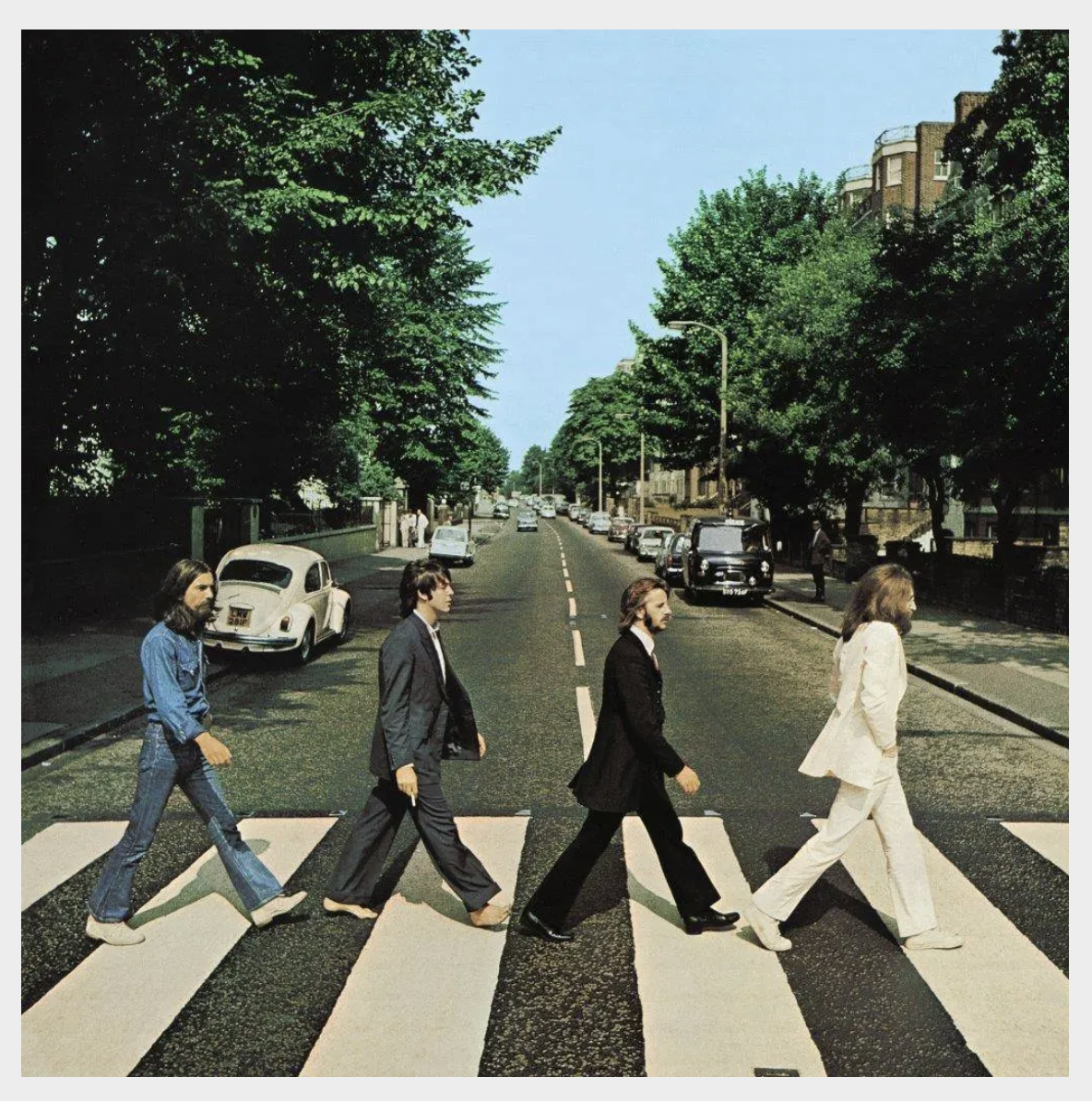
    I recently moved to a place that is a short walk from Abbey Road in St John’s Wood.

    Every day, and night, there is a crowd of varying size gathered at either side of a certain zebra crossing comprised of groups who have turned out for their turn to cross.

    One member from each of the groups (some are pairs, some are a squad) will invariably dash out into the street holding up a phone, or, on rarer occasions, a proper camera, while the others attempt their best approximation of the Beatles stride pictured on the cover of their last recorded album. Traffic pauses. Horns sound. Photographs are taken. The next fireteam files forward while motorists silently shake their heads in scorn.

    For those unfamiliar with the environs of Abbey Road Studios and the crossing beside it, this is not Piccadilly Circus. It is a quiet residential part of London. The assembled faithful therefore constitute a genuine throng in this corner of St John’s Wood. Residents and commuters find themselves incongruously negotiating safe passage through this incessant fracas.

    Before this latest move, I was staying in Notting Hill. There, too, crowds assembled daily in a trafficked side street outside a private residence made famous by a romantic comedy that borrowed the neighbourhood’s name for its title. People emerge from the herd, wait their turn, stand before a particular house’s not so particular blue door, smile, photograph, and then chimp before melting back into the crowd.

    The story of the door is revealing.

    It originally belonged to Richard Curtis, the film’s screenwriter. The production designer chose it by chance, unaware of its ownership. Following the film’s success, the original door was auctioned off for charity. The residents who remained behind grew weary of the endless stream of tourists, graffiti and photographers and replaced it with a plain black door. Eventually, a subsequent owner repainted the replacement door blue and the pilgrims returned.

    The original artifact had vanished.

    And yet the ritual remained.

    My irritation with all this was not surprising to me though that I kept dwelling on it was. There seemed to be something more noxious here than the odor of mass tourism. Something faintly indecent wafted off the transformation of ordinary pieces of infrastructure and private property into tourist attractions at a cost imposed upon people who never consented to bear it.

    Let us linger there for a moment.

    We are accustomed to monuments being erected to receive visitors. The Cenotaph was built to be visited. Cathedrals were built to receive pilgrims. Museums were built to preserve and display objects deemed worthy of our collective attention. Society decides, explicitly or implicitly, that a place or object possesses sufficient significance to justify the inconvenience associated with preserving and visiting it.

    Abbey Road is different.

    The Notting Hill door is different.

    Neither was intended to become a monument.

    Neither was designed to receive visitors.

    Neither was built to absorb the inconveniences that inevitably accompany significance.

    And yet significance arrived all the same.

    This is not a problem in itself. Meaning is rarely conferred by decree.

    John Searle called these things “institutional facts”: realities that exist because we collectively accept them as such. “Money, property, governments, and marriages,” he wrote, “are all institutional facts. They are facts only because we believe them to be facts.”

    Abbey Road is an institutional fact.

    The Notting Hill door is an institutional fact.

    Millions of strangers have collectively invested them with significance.

    In this sense, Abbey Road and the Notting Hill door are indeed monuments.

    No less than the Cenotaph.

    The Cenotaph is, literally, an empty tomb. A carefully shaped arrangement of stone. Yet nobody regards it as merely stone because it has become a vessel for memory, sacrifice and national identity.

    Abbey Road is thermoplastic paint on asphalt.

    The Notting Hill door is painted wood.

    Meaning has transformed matter in all three cases.

    And once a thing or place has been invested with meaning, people will inevitably come to visit it.

    Again, that, in itself, is not the problem.

    The inconvenience of pilgrimage is tolerable when pilgrimage remains an act of reverence. The problem arises when the crowds are not really there for the monument at all.

    The crowds at Abbey Road seem to be engaged in something subtly different. They do not come to stand before the monument. They come to stand at its centre.

    The famous blue door in Notting Hill is gone. The original object was auctioned years ago. The tourists need not know, because once the sign has detached from the referent, that knowledge becomes irrelevant.

    The same is true of Abbey Road. Visitors are not really interested in a zebra crossing. Nor, I suspect, are they particularly interested in the Beatles. What they seek is proximity to significance.

    Not significance itself.

    Its acquisition.

    The photographs they take function as a deed to significance, albeit borrowed. A fragment of cultural meaning harvested and placed on display among the many symbols from which contemporary identity is curated.

    And this is where my two objections converge.

    First, these monuments have been erected without consent. Their costs have been socialized while their benefits remain private. Residents and road users are conscripted into maintaining a theatre whose script they never approved.

    Second, and more damningly, the theatre is not performed in service of remembrance or reverence.

    It is performed in service of extraction.

    The visitors arrive at places invested with meaning not in order to be changed by them, but in order to carry some portion of that meaning away.

    Not transformation, association.

    Not inward change, outward display.

    Not reverence, acquisition.

    They do not seek communion with the monument. They seek to appropriate its symbolic capital and attach it to themselves.

    This is what pilgrimage becomes when reverence is replaced by appropriation.

    “The consumer society needs its objects in order to be, and more precisely it needs to destroy them.”

    Jean Baudrillard

    While the authentic pilgrim carries home a changed soul, the pilgrim-on-trend carries home a photograph; the latest token in a civilization organized around endless acquisition.

    Experiences are accumulated.

    Places are accumulated.

    Culture is accumulated.

    Even identity becomes a project of curation in which symbols are gathered, displayed and discarded in pursuit of an ever-receding core sense of self.

    The object of our interest has not merely lost its sacredness, it has been subordinated to the project of self-construction.

    The tourists play at paying homage to the Beatles when in fact something more parasitic is taking place.

    The crossing is mined.

    The film is mined.

    Culture itself is mined.

    Meaning is excavated, photographed and carried away in pockets.

    And when every monument becomes a quarry for the self, the self ceases to be formed by reverence and is instead enlarged by annexation.

    This is not growth.

    It is accumulation.

    The encounter is no longer metabolized.

    It is recorded.

    Its significance is not digested and transmuted into character.

    It remains external.

    The photograph.

    The association.

    The anecdote.

    The proof of having been there.

    Each is affixed to the self rather than incorporated within it.

    The self becomes an assemblage of borrowed meaning: a collage of appropriated symbols whose significance derives from elsewhere.

    It grows larger.

    But not deeper.

    More decorated.

    But not more substantial.

    Its parts never fuse into a coherent whole because they were never truly absorbed. They remain trophies of encounter rather than agents of transformation.

    And so the monuments remain.

    The crossing.

    The blue door.

    The Cenotaph.

    But increasingly they are no longer destinations.

    They are mirrors.

    No longer places before which we diminish ourselves.

    Increasingly, they are places at which we place ourselves at the center.

    And the most elaborate monuments we build today are not dedicated to our heroes, our dead, or our ideals.

    They are monuments to ourselves.

  • Should We Stay or Should We Go?

    Should We Stay or Should We Go?

    While Patriot missiles and Iranian ballistics with sonorous Farsi names collide in the skies above me, this post by Jason Burris, Laugh Dealer, got me thinking.

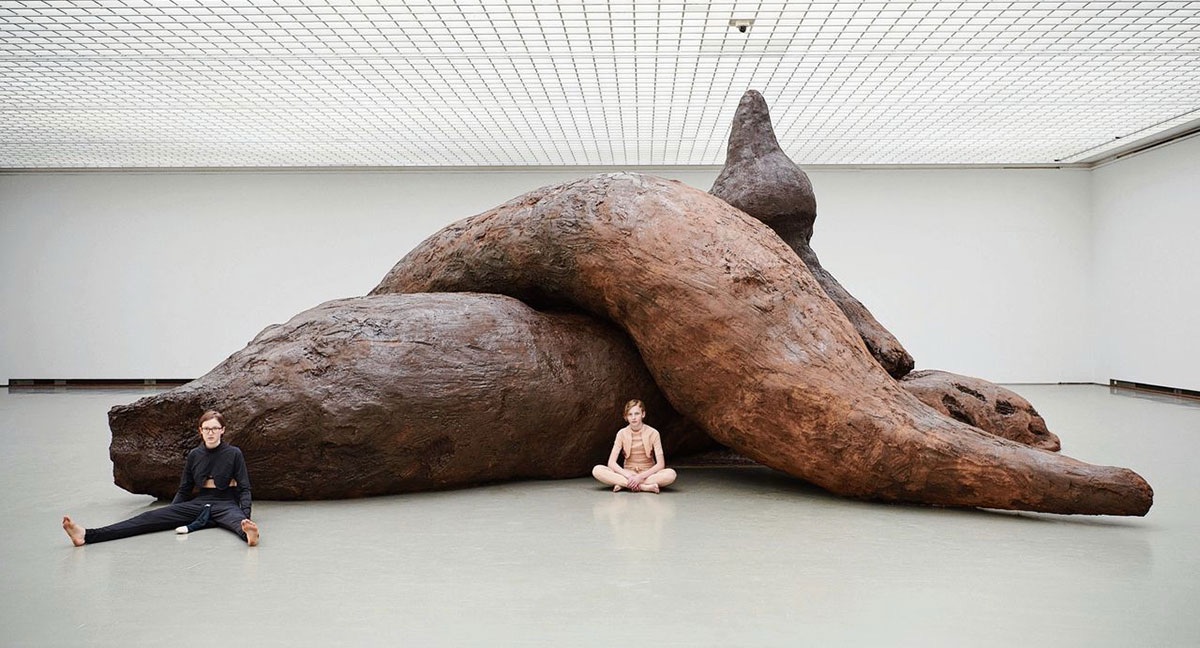
    Every day someone unknowingly does the biggest poo in the world for that day.

    True or false?

    At first reading, it feels true. Obviously true. A distribution of the effluent size of eight billion digestive systems operating around the clock across the planet must produce an extreme right tail. Statistical probability practically demands it. Somewhere, some anonymous person flushes, likely with some difficulty, the day’s winner without realizing what he has done (it has to be he/him).

    If yours is the sort of mind that cannot let well enough alone, you begin dissecting the proposition.

    Biggest how? By Length? Mass? Volume? A slender serpent of prodigious length might defeat a stout and formidable chode if we settle on length as the metric. But that choice is unlikely to satisfy most judges. Perhaps we mean heaviest. Wet weight? Dry weight?

    The questions continue. And soon we shall have to confirm what counts as a contender. One segment? One sitting? A day’s work?

    And what about the day itself? Which day? The planet does not share a single day. Midnight arrives in Doha hours before it reaches Los Angeles. A bowel movement that belongs to March 6 in one place may belong to March 5 measured somewhere else. Our “daily champion” turns out to be an event stitched together from overlapping slices of time that never existed simultaneously.

    By the time you finish asking the relevant questions, the proposition has dissolved into indeterminacy. The thing that felt obviously true a moment ago has ceased to have a clear referent.

    Yet we felt that we had understood it immediately.

    The largest poo is not like the smartest unicorn. The unicorn fails because the creature does not exist. The largest poo fails because we have not yet agreed on the rules of the contest.

    Human language functions largely by tolerance of vagueness. In the normal course of our daily business, we do not parse every sentence into its hidden ambiguities. We glide across them. Shared intuition patches the holes and fills in the gaps. Communication works not because language is precise but because our minds are skilled at pretending it is.

    If we wished to rescue the sentence, we could force it into mathematical clothing:

    That statement is true. Trivially true. Every finite set has a maximum.

    It is also completely different from the sentence we read on Instagram. From real life.

    Between those two sentences lies the distance between how language works and how the world must actually be specified before truth can be evaluated.

    Most of the time this gap causes no trouble. Sometimes it does.

    Tonight, in Doha, explosions echo across the region. Airspace remains closed. Videos of intercepts circulate on phones. Further south, Dubai continues to exist as the world’s temple of maximalism: tallest tower, largest mall, most extravagant skyline. If there were ever a city designed to host the global champion of turds, every day, it would be Dubai.

    And between the missile videos and skyline photographs appears a philosophical riddle about the largest poo and its unknowing host.

    We scroll past, understanding everything instantly.

    Or thinking we do.

    Because the same mechanism that made the Instagram sentence feel obviously true is the mechanism by which we digest headlines, warnings, predictions, assurances. We read a sentence. Our minds supply the missing structure based on a personal world assembled over a lifetime. The statement feels coherent because our interpretation makes it so.

    Until you stop and ask the simple question: what exactly does that mean?

    Which brings us to the question circulating in our house tonight.

    Should we stay or should we go?

    Friends ask it. Messages arrive entreating us to make haste and escape. Cost-benefit ratios begin to accumulate. How far will Iran go? Will this escalate? Will there be nuclear fallout? How long will airspace remain closed? Can we take the dogs? What about the people and the life we leave behind?

    The calculations pile up, but they do not converge.

    Eventually you notice something unsettling. We cannot even determine, without debate and arbitrary conventions, who holds the title for the biggest stool on Earth. Yet here we are attempting to determine the optimal response to a regional conflict using the same linguistic machinery.

    The world runs on approximations.

    Somewhere tonight, perhaps in Dubai, someone will unknowingly produce the largest bowel movement of the day. The claim remains both intuitively obvious and logically slippery at the same time.

    Like the question of whether we should stay or go.

    Language points toward reality.

    But it rarely lands exactly on it. May that rarity persist through these troubles.

  • Purity Is an Aesthetic of Death [From the Glitch Series]

    Purity Is an Aesthetic of Death [From the Glitch Series]

    Purity has long been treated as a virtue. Clean water. Clean bodies. Clean ideas. Clean bloodlines. Pure as the driven snow. It is not merely descriptive language but aspirational language, a claim that something has approached an ideal state. Yet the closer science has come to understanding how living systems actually function, the stranger this ideal appears. Life does not optimize for purity. It never has. And yet the abstraction persists, shaping human behavior long after it has stopped tracking reality. This persistence is a paradigmatic example of the glitch: a representation that remains executable even after its connection to the world has collapsed.

    In its earliest form, purity was not a moral concept at all. It was a survival heuristic. In epistemically-constrained environments, visible contamination often correlated with danger: feces in water, rotting matter, carcasses, in a word, the Ganges. Avoiding these reduced risk often enough to be reinforced. Clear water was usually safer than foul-smelling water. Clean wounds healed more reliably than dirty ones. At this stage, purity was not an ideal. It was a proxy. A cheap, visually legible rule of thumb that increased the odds that one’s fears would not come true.

    The first transformation came when this heuristic was ritualized. Purity became a way of managing uncertainty rather than danger directly. Blood, death, sex, childbirth, decay. These were liminal states that blurred binary categories and inspired fear. Ritual purification, sacrifice, ablution did not improve nature. They stabilized anxiety. They reassured humans that chaos had been acknowledged and contained. Purity did not need to work causally. It needed to work socially and psychologically.

    The decisive shift occurred when purity migrated from practice to essence.

    Greek philosophy marks this turn. With Plato, purity leaves the altar and enters thought. The Forms are pure. Matter is degraded participation. Mixture becomes corruption. The closer an idea is to abstraction, the closer it is to truth. Context, contingency, and mess are stripped away in the name of knowledge. Purity, once a proxy for epistemic opacity becomes epistemic itself. To know is to purify.

    This move is crucial, because it installs purity inside cognition itself. What began as a situational heuristic is now a metaphysical hierarchy. Life, with all its compromise and entanglement, is demoted. The clean, the simple, the invariant are elevated.

    Christian theology fuses this metaphysical purity with moral purity. God is pure being. Sin is corruption. Salvation is cleansing. Purity is no longer temporary or contextual. It is existential. Once impurity is reframed as fault, purity inevitably becomes desirable. Not because it produces better outcomes for us, but because it aligns the self with an imagined cosmic order.

    The Enlightenment strips away theology but keeps the structure intact. Purity is secularized. Reason must be pure. Science must isolate variables. The subject must be autonomous, untainted by superstition or tradition. Nations must be homogeneous. Languages must be standardized. Cultures must be clarified. What began as a method becomes a worldview.

    This is where the glitch fully asserts itself.

    Purity in science is a scaffold, not a description of reality. Controlled variables and sterile environments allow learning to happen. But once this methodological purity is mistaken for an ontological truth, the abstraction escapes the lab. Genes must be pure. Systems must be clean. Optimization becomes eradication. Control becomes virtue.

    History is full of moments where the purity heuristic fails outright. Crystal-clear mountain streams can liquify bowels. Meanwhile, tannin-stained water from peatlands, brown and “dirty” to the eye, can be anodyne. Fermented drinks, cloudy and alive, were historically safer than clear urban water. Appearance inverted function, yet the aesthetic of purity continued to dominate decision-making.

    Modern biology delivers a deeper correction. Humans are not autonomous organisms occasionally assisted by microorganisms. We are composite systems that emerged with these evolutionary precursors. The oral cavity is not gums, teeth, and tongue with bacteria as tolerated guests. It is a microbial ecology whose balance determines kissability, dental health, immune signaling, and disease resistance. 

    Bad breath is not caused by bacteria as such, but by the collapse of a competitive microbial environment. The purification response, aggressive antiseptics and eradication, often worsens the condition over time. What works is cultivation, not extermination.

    Our vision biases us. We notice symbiosis when it is spatially separable and theatrically legible. The bird on the rhino or the remora on the shark are stories we can tell in one frame. The trillions of microbes modulating gut-brain signaling are not. Our cognitive apparatus evolved for hunting and social coordination, not for perceiving biochemical interdependence.

    And yet the relationship between us and our microbiota is not quite symbiosis, it is structure. Remove the microbiome and the organism recognizable as human does not regress to a simpler or less optimal state, it fails and disappears. The visible anatomy is scaffolded by life forms we cannot see. Purity does not merely misdescribe this reality. It actively obscures it.

    If organisms are cooperative coalitions rather than sovereign units, then evolution is not primarily a competition between individuals but a competition between assemblages. The winners are not the strongest or the purest, but the ones best at hosting, tolerating, and regulating difference.

    And yet, we continue to place a premium on genetic purity.  Purebred dogs are a cautionary tale. The more “pure” the line, the more riddled it becomes with inherited disease. Hybrid vigor is not a slogan, it is a biological fact.

    At first glance, horses – Thoroughbreds, Arabians, Lipizzaners – appear to provide a strong counterexample. Lineage tracked obsessively through closed stud books. “Pure blood” as literal terminology. Performance, beauty, predictability all look like purity producing advantage.

    But look one layer deeper.

    Purebred horses are not selected for biological robustness. They are selected for narrow performance under controlled conditions. Speed over a fixed distance. Gait aesthetics. Temperament for riding schools. Symbolic continuity for courts and states. These are not evolutionary goals. They are human use-cases.

    And the cost of purity shows up immediately.

    Thoroughbreds suffer from fragile bones, bleeding lungs, metabolic issues, and catastrophic injury rates. Arabians carry heritable disorders like SCID. Many closed-line breeds show reduced fertility, immune weakness, and shortened competitive lifespan. The more rigorously “pure” the lineage, the more veterinary intervention is required to keep the animal functioning.

    Sound familiar?

    What keeps these animals viable is not purity, but constant artificial support : controlled breeding, intensive care, selective culling, supplements, medication, training regimens. Remove the human-managed environment and the supposedly superior organism collapses quickly.

    Let’s consider more challenging counterexamples outside the domain of the living. Diamonds. Optics. Precision materials.

    A perfectly pure diamond is a crystalline ideal; is it a useful instrument. Industrial diamonds are doped to change conductivity, toughness, or optical behavior. In quantum sensing, controlled defects are the feature. Absolute purity defines a baseline, not a goal. The moment function matters, impurity is introduced deliberately.

    Optical glass behaves the same way. High purity reduces noise, but a single, perfectly pure lens is inferior to a compound system. Aberrations are not eliminated by purity but corrected through curvature, layering, coatings, and hybrid design. Performance emerges from orchestration, not isolation.

    Purity here is local, instrumental, and transient. Even where it appears to succeed, it does so as a limiting case, not a destination.

    Once we move into matters of taste, purity becomes backstory by virtue of the concept’s heritage.

    Single-origin malts are not chemically pure. They are stories of provenance, constraint, and exclusion. Purity here signals scarcity and authorship. Pure gold is too soft to use. Pure water is only desirable after the term has been diluted to mean “free from known toxins.” In these domains, purity no longer claims to optimize function. It signals status and legibility.

    The pattern is consistent. Wherever life, resilience, or adaptation matter, purity fails. Wherever systems are inert, frozen, or already dead, purity can be aestheticized without consequence.

    Evolution optimizes for robustness under noise, not for cleanliness or isolation. Systems that survive are messy, redundant, and promiscuously entangled. Purity only looks attractive when you abstract away the environment and freeze time. Once selection is allowed to operate across generations, purity becomes fragility. A system that relies on a narrow set of conditions collapses the moment those conditions shift.

    Which brings us back to the glitch.

    Purity persists not because it is true, but because it is executable. It compresses complexity into binaries. It flatters control. It survives failure by redirecting us to an antonym – contamination. When reality pushes back, the model is not revised. It persists; to our collective detriment. Momentum drowns out correction.

    Purity was never a property of living systems, nor a condition toward which life tended. It arose as a coordination fiction to manage fear, was abstracted into thought, moralized into identity, and secularized into systems. Science has dismantled it repeatedly, yet the abstraction continues to cast a shadow over how we understand our bodies, our societies, and ourselves.

    Purity is not an ideal we failed to reach.  It is an aesthetic of death mistaken for a moral goal.  And the real danger is not that it is wrong but that it continues to run.

  • One Billion Day Funeral for the Toaster

    One Billion Day Funeral for the Toaster

    “At every occasion, I’ll be ready for a funeral”

    The violence and unprecedented lawlessness of events generating world media headlines in the first week of this year have delayed this long-overdue eulogy. They also sharpened the risk that any further delay is likely to result in its never being written at all as the remainder of our lives from this day on gets consumed by a cavalcade of calamity with seemingly no sign of ebb.

    I don’t own a toaster.  I never did.

    This is not because I am opposed to toasters per se. On the contrary, the toaster, considered as ding an sich, is nearly perfect. Reservations arise only once it must be placed in the kitchen.

    During the Christmas holiday I stayed in two homes, both of which had kitchens equipped with toasters. I also happened to be in places where bakeries were producing sliced breads from naturally leavened doughs made with minimally processed grains in an earnest attempt to return bread to what we have been told is its nutritionally intact origins.

    This happy coincidence allowed me to enjoy excellent toast with properly browned exteriors and appropriately moist interiors without having to engage the underlying problem at all.

    That problem is fundamentally aesthetic. And it is without a solution; not that the best minds are working on one.

    A kitchen is a field of claims against finite counter space. Each tenancy must plead its case and prevail over competing claims for scarce real-estate.

    Kitchen size, though a factor, is neither determinative nor resolutory as countertop sprawl produces other inefficiencies that create a somewhat different but no less serious aesthetic failure.

    The toaster’s singularity of purpose renders it ontologically expensive. It refines one narrow function while duplicating capabilities already distributed across other, more versatile instruments. The cost of granting a toaster a leasehold on counter space is the persistent visual and conceptual noise of its conspicuous redundancy.

    Redundancy can, in certain circumstances, be justified as a failsafe. This is not one of them. Even if you believe toast is a system whose failure carries serious consequences, most modern kitchens already contain multiple heat sources capable of producing an acceptable slice: ovens, toaster micro-ovens, air fryers, panini presses.

    That none of these perform the task quite as well is beside the point. I grant without hesitation that a toaster produces better toast. Though the difference is real, it is not clear whether it is incremental or categorical. Regardless, excellence alone is insufficient to compel tenancy.

    To qualify for countertop placement, an appliance must be integral to daily production and it must demonstrate that centrality by displacing existing tools rather than accumulating alongside them.

    There are, of course, people for whom the difference in outcome is not marginal. For such people, crumb structure, moisture gradient, crust brittleness, starch gelatinization, and repeatability are not incidental pleasures but governing concerns. In their kitchens, the toaster’s redundancy does not disappear. It persists with the same gravity and poise of the proverbial elephant in the room. Like a grand piano in a tight apartment uninhabited by a pianist. If lucky, the disturbance its presence elicits is obscured by distance from its doppelgängers and the segmentation and layout of the countertop, cabinetry and other appliances.

    There are, also, people who are blind to this disturbance, either ab initio or after having been desensitized. Over the holidays, I visited with relatives who live comfortably among redundancies: a built-in Miele coffee machine, a plumbed-in Faema, a Krug. Theirs was not a kitchen optimized for production but a parliament in which objects are permitted to specialize, overlap, and even contradict one another. Where I see duplication, they see choice.

    This is not to say that the matter is simply subjective. You cannot have it all. Those who try, offend against the natural order. The prohibition against having it all is not moral, it is structural. Every finite system operates under constraints. Optimization along one axis inevitably degrades performance along another. Specialization can only arise by displacing alternatives. A kitchen that attempts to host every excellence becomes illegible, incoherent and dysfunctional; it becomes a showroom. The relative in whose kitchen every food preparation method can be found is also similarly equipped and stocked across all domains of life. To relieve the resulting congestion, the family has decided to create a museum (showroom) devoted to (showcasing) his accumulation journey; converting dysfunction into exhibition.

    "He that is without sin among you, let him first cast a stone at her" (John 8:7)

    I am not immune. I have both a plumbed-in ECM Synchronika and a Nespresso Creatista Pro. I regret this transgression and I will not make excuses. Though if you are ever in my kitchen please note that the ECM requires a commitment to the craft of espresso that none in my household who drink coffee is willing to make.

    And so I remain a visitor to toasters riding in on my high horse. I use them elsewhere, attentively and without regret. I enjoy the refinement at the expense of other people falling into disgrace. In a world increasingly crowded with high crimes and egregious offenses, this seems a defensible indulgence.

    Maxim 619 : Pleasures are best borrowed.

  • This is not a Pipe and Other Instruments

    This is not a Pipe and Other Instruments

    I find myself in constant awe of human creativity.  Human creativity in its ordinary form, beyond the masterpieces, the unceasing churn of fonts, gadgets, fabrics, toys and tools, gushing into existence in such voluminous torrents the mind short-circuits to infinity.  

    Unless you are a fanatic minimalist just have a look about your house.  If you are, walk out into the world (if you live in isolation, you’ll need to wander towards more inhabited areas) and just try and count the number of human creations around you.  Those “objects” are the tip of an iceberg that also includes an entire value chain overpopulated by stuff made by human beings.

    This fascination underlies an affinity I’ve always had for exploring human instruments and basking in the overwhelm that arises from contemplating the amount of time, attention and energy that was expended, in the aggregate, to bring these things into their multifaceted existence.

    Consider the lowly tobacco pipe.  

    It is, in essence, but a bowl to burn tobacco connected to a tube for drawing up the smoke.  But around this simple mechanism humans have spun a dizzying throng of innovations and variations.

    Simple communal clay pipes eventually yielded to wooden ones, with briar emerging as the most suitable, especially the Algerian variety, persistently prized for its cool, dry smoke. Meerschaum, carved from the hills near Eskişehir in Turkey, appeared next to provide a neutral vessel for purists seeking the clarity of clay but with the resilience of stone.  

    When material considerations are set aside, pipe makers experiment with form.

    Attention shifts to how a pipe should be shaped, how the bowl should sit in the hand, how the stem should meet the mouth, how the draft hole should align with the chamber.

    Every choice matters from the angle of the drilling, the diameter of the airway, the taper of the stem, the bend or straightness of the shank.  Small adjustments could turn a wet, gurgling pipe into a cool dry draw.

    From these accumulated experiments phyla of standardized shapes emerged: the billiard, the bulldog, the Dublin, the Zulu, the prince, the author.

    Names that sound almost mythological now, yet each is simply a settled solution to the same basic problem – how to burn leaf and draw smoke comfortably, predictably, and pleasurably.

    The pipe is a case study in how creativity operates, within constraint, to produce the enduring forms of instruments.

    Human anatomy exerts its own quiet authority here.

    The hand wants balance.  The jaw wants lightness.  The lips want a stem neither too thick nor too thin. The eye wants proportions that feel inevitable. And everyone has their druthers. And today’s will gave way to tomorrow’s.

    Even the most radical artisan shapes orbit these constraints; innovation pushes the boundary but rarely escapes the gravitational pull of what has worked for centuries.

    Airflow, that invisible lifeblood of the smoke, became the hidden province of mastery.

    A well-cut slot, a tenon properly tapered to minute tolerances, a draft hole perfectly centered at the bowl’s base, these are the invisible details that distinguish a masterpiece from a merely functional pipe.

    It is remarkable how much human ingenuity has been spent perfecting something so simple: a bowl connected to a tube.  And we haven’t even gotten to the different varietals of the tobacco plant, the treatment and curing methods, the casings, cuts and blends. 

    This precision of focus is continuously applied across every domain to challenges imperceptible to most, yielding refinements discernable by only a few.

    Pipe innovation cannot be discussed without mentioning the reverse calabash, the tourbillon of the pipe world; dubious in net impact yet admired for the ingenuity of the premise.

    For centuries, pipe design advanced through subtle refinements like better drilling, better stems and overall better proportions, but the fundamentals stayed intact. Then came the idea that the airway itself could become a chamber, that smoke could be given a moment to expand and cool before reaching the mouth.

    A second chamber, hidden within the shank, functioning as a pressure buffer.

    Nothing changes in the ritual: leaf in bowl, flame to leaf, breath to stem.

    And yet everything changes in the experience.  At least that is the intent and promise.

    It is a reminder that innovation in long-mature traditions rarely comes from rewriting the rules. It comes from reimagining an invisible domain – airflow, pressure, gravity – while leaving the rest of the process intact. The anatomy may remain the same, bowl, shank and stem, but inside the walls something radical is happening.

    Even though sales figures today project growth, I am fairly certain that sightings of lit pipes in the wild are rarer than the ring of a public payphone.  Nevertheless, there are thousands of pipes still being made today, many by hand, trading for several hundred dollars. 

    It is a strange paradox: an instrument vanishing from daily life, yet flourishing in the hands of makers who still coax new possibilities from it. Rarity has not diminished the pipe’s hold on creative efforts. If anything, it has sharpened the question of what a pipe should be in a domain inhabited by aficionados. 

    Magritte’s pipe enters precisely here, as an interruption and a reminder.

    His famous declaration is at once a clever joke at the viewer’s expense and a philosophical prod: a pipe painted on canvas is not a pipe, and neither is the word “pipe” nor the concept we carry in our minds. Each belongs to a different layer of meaning.

    And yet, the very act of calling something not a pipe continues to carry the constraint it claims to lift.

    Before a craftsperson ever touches briar, before a designer ever drills a draft hole or shapes a stem, the category “pipe” has already narrowed the imaginative landscape. The moment we name something, we inherit a set of expectations that may be functional, cultural, anatomical or conceptual. Creativity is not a free field but a negotiation with meanings that predate us.

    This is what non-representational artists tried to outrun. They suspected that as long as the work depicted something, it remained tethered to inherited meaning. Their rebellion was essentially metaphysical:

    • Can one create without participating in meaning-making?
    • Or is meaning itself the unavoidable residue of any creative act?

    What Magritte forces us to confront is not the constraint of naming but the constraint of un-naming.  What does the refusal to let an image settle into the category it so obviously inhabits convey? Declaring that something is not a pipe generates its own boundaries. It destabilizes meaning, but it also creates a new frame through which the viewer must proceed. And this is where the meditation begins: creativity doesn’t arise in a vacuum but in a terrain already shaped by decisions we didn’t make.

    This is why the first utterance in human history could never have detonated a fully formed cosmos of meaning. Meaning did not, and arguably cannot, burst forth complete. It accreted over time. Sedimented. Layer by layer, each new association adhering to earlier ones, thickening the conceptual mass. Meaning grows the way river deltas do: through deposits, through confluences, through slow accumulation until a shape emerges.

    This accretive nature is one of meaning’s most curious features. As detail increases, meanings proliferate. As associations multiply, the sense of “what something is” deepens.

    But does this expansion of associations necessarily advance understanding?

    In one sense, yes, by definition, the more relational threads a mind can weave around a thing, the richer the mental model becomes. We understand more of something when we can link it to more contexts, more analogies, more histories.

    Yet this is the shallow, quantitative reading of understanding. The maximalist sense, the kind that grasps essence rather than adjacency, works differently.

    We can drown in associations.  We can mistake the proliferation of one-to-many associations for insight.  We can fill a page with notes and miss the argument.  We can trace every branch and never see the tree.

    The forest/trees tension is not a cliché here, it is a structural feature of meaning itself. Meaning expands outward, but understanding contracts toward coherence. Meaning is centrifugal; understanding is centripetal. Creativity, then, lives in the interplay between the widening field of associations and the narrowing search for shape.

    This tension becomes especially vivid when we turn to instruments. Pipes, pens, watches, cameras. These all exist at the intersection of immense accumulated meaning and the singularity of purpose. A sea of possibilities, some realized, others latent, surrounds any implement, yet the maker must still bring the object back to functional coherence. You cannot erase the accumulated delta of meaning and conjure something wholly new; if it no longer fulfills its purpose, it ceases to be the thing it claims to be. And if it does fulfill its purpose, it inevitably inherits the meaning that comes with the category.

    In that sense, instruments are tiny laboratories for navigating meaning itself. They remind us how much we inherit and how little we can reinvent at once. They show us how creativity requires a steady hand on the dial between too much association and too little. They reveal how understanding emerges not just from adding details but from knowing which details to ignore.

    This is why the persistent forms, billiard, bulldog, Dublin, feel almost preordained. They stand as the settled solutions of countless negotiations between expanding meaning and focused understanding. They are where accreted meaning meets embodied use.

    The question gets knotty quickly. Is all creativity a form of meaning-making? It depends who is deemed the maker of that meaning.  One can produce a gesture, a mark, a shape with no intended significance. But the world refuses to leave these naked signs untouched.  Viewers will impose meaning even if the maker does not. Conversely, not all meaning-making feels creative. Bureaucracies generate meaning constantly, but few would call their memos creative.

    Perhaps the entanglement is asymmetric:

    • Creativity usually produces meaning, even when it tries not to.
    • Meaning-making is not necessarily creative, yet it shapes the environment in which creativity unfolds.

    This tension becomes interesting when we shift focus from fine art to instruments. Fine art often aspires to be an intellectual exercise: a confrontation, a puzzle, a philosophical provocation. Creative expression moves outward from concept to form. Whether the paint or clay becomes useful is irrelevant; the craft is subordinate to the idea.

    Instrument-making reverses the polarity. Here, creative expression grows out of constraint. The instrument must function. It must satisfy the hand, the mouth, the eye. It must obey airflow, friction, gravity, ergonomics. Artistry emerges in the refinement of structure, the honoring of purpose. In a sense, instrument-makers are philosophers who work in wood and metal rather than in abstraction.

    Both are creative. Both are meaning-making. But their relationship to meaning is different:

    • Fine art interrogates meaning.
    • Instruments stabilize meaning by participating in repeatable forms.

    What, then, of instruments made without aesthetic intent? The disposable ballpoint. The stamped metal wristwatch of a worker. The mass-produced pipe smoked in a corner shop. These objects were not birthed through a creative act, but someone, eventually, will find beauty in them. A collector admires the patina. A photographer revels in the geometry. A writer draws meaning from the very indifference of their birth.

    So what can we say about unintended aesthetics?

    Every choice can become an aesthetic choice once viewed by someone who cares.  Even the omission of intention is a kind of style.  Even utility has a silhouette.  Even standardization has a texture that can be admired.

    Designers sometimes stumble into elegance. Craftsmen sometimes achieve beauty while chasing only durability. We, the interpreters, complete the aesthetic circuit.

    Let’s add another layer.  There is a sense in which all meaning making is communication and all communication is meaning making. Push the terms far enough and they begin to overlap or bleed into each other. Any signal that alters another mind’s state, intentionally or not, participates in both. But this overlap is unstable. It shimmers rather than radiates.

    Take the barking dog.

    The dog communicates. It wants to go out. It has learned that a certain sound, emitted with a certain insistence, produces a certain human response. There is a kind of intention there, a directedness. But does the dog mean anything in the way humans mean things? Does it understand its bark as a symbol, as a unit in a broader system of signification? Or is the bark merely a behavior that has, through repetition and reinforcement, been yoked to a predictable stimulus?

    Here the symmetry collapses:

    • It is communication.
    • It is not meaning-making; at least not from the dog’s standpoint.

    The meaning-making happens on the human end, through our interpretive machinery. We receive the signal, contextualize it, convert it into a functional understanding: the dog needs to go out. The meaning is the product of our cognitive labor, not the dog’s conceptual intent.

    When a dog barks at another dog, we don’t say they are “discussing” anything. They are not exchanging propositions. They are triggering and responding to stimuli within a behavioral ecology. The structure is closer to a dance than a dialogue.

    Perhaps meaning-making is not inherent in the signal but in the interpreter.

    A signal becomes meaning only when something capable of meaning receives it.

    The inconsistency chafes because we habitually conflate meaning with communication. We mistake their partial overlap for identity. But the distinction is important: meaning requires a grasp (however implicit) of a system of relations, of this standing for that, of this gesture or sound existing within a broader field of possible gestures and sounds.

    A dog does not, as far as we know, operate within a symbolic horizon in this way. Humans do, and perhaps cannot avoid doing so.

    One might argue that these apparent inconsistencies are artifacts of language; that our vocabulary for communication and meaning was developed for human cognition and thus bends awkwardly when stretched over other species. The dog is not confused; our categories are. We are asking our language to map a terrain it was not evolved to describe.

    But it is not obvious that this is merely a linguistic glitch. Our language reflects distinctions that exist in the structure of cognition itself: between symbolic representation and mere signaling; between choosing to mean and triggering a reaction; and between constructing significance and participating in a feedback loop.

    If language strains here, it may be because the phenomena are genuinely layered, not because our words are inadequate. The distance between communication and meaning-making may not be a flaw in vocabulary but a feature of the world.

    And this brings us back, subtly, but inevitably, to our meditation on instruments.

    Instruments are designed for creatures capable of meaning. A pipe is not just a smoking apparatus; it is a participant in a symbolic ecology of forms, traditions, categories, uses. A dog cannot make a pipe because a dog cannot intend a form to mean anything beyond its immediate utility. Humans, by contrast, cannot not make meaning. Even when we pursue pure function, we end up generating structures others will someday interpret aesthetically or symbolically.

    We are meaning-making organisms, even when we don’t mean to be.

    Consider the crow or the chimp. Both can use sticks or stones to get at food. They recognize function. They solve problems. They understand, at some tacit level, that a stick too short for the task must be replaced by a longer one. There is intention here. There is evaluation. But their relationship to the tool is immediate and evanescent.

    They do not store a small arsenal of sticks of varying lengths for later use.  They do not shape or refine the sticks. They do not commit to a future in which this tool will matter again.

    The tool is a momentary extension of the body, nothing more.

    This is where the first line between animal and human opens.  The moment we intend a tool to be used again – when it stops being temporary and becomes future-facing – it begins to transform into an instrument.

    The future is the crucible of creativity.

    A tool used once can remain crude.  An instrument meant for repeated use acquires refinement.

    And refinement, even when pursued only for functional reasons, smoother grip, straighter shaft, more durable material, inevitably generates aesthetic qualities. A better tool looks better, feels better, embodies a kind of rightness. Even if the maker intends nothing aesthetic, the observer cannot help but evaluate it aesthetically.

    The aesthetic dimension arises not from the maker’s deliberate intent but from the observer’s capacity to perceive patterns, harmony, proportion, elegance; qualities that piggyback on function.

    In this sense, the aesthetic state of an object is not fixed at the moment of its making. It exists in something like a quantum haze: a cloud of potential readings, unused, uncollapsed, until a viewer encounters it.

    A pipe is built to smoke.  A nib is built to write. A watch is built to tell time.

    But each of them carries, latent within its structure, aesthetic possibilities. Its beauty, or lack thereof, is indeterminate until someone looks, touches, measures, or contemplates it.

    The observer collapses the aesthetic waveform.

    The maker may have sharpened the stem angle for airflow, not for beauty.  The briar may have been chosen initially for durability, not its flame or bird’s eye pattern.  The taper of the shank may have been dictated by mechanics, not harmony.

    But when the human eye rests upon the instrument, when the hand feels its balance, when the mind perceives coherence in its shape, the aesthetic meaning resolves.

    In the end, a pipe is not simply a pipe, and an instrument is never merely what it does.  It is a mirror reflecting back the strange condition of beings who cannot help but turn use into symbol, function into form, signal into meaning.

    We carve briar and shape stems, but what we are really shaping is the boundary between the world as it is and the world as we can imagine it.

    Every instrument is a small treaty between these two domains.  A site where matter yields to mind, and mind yields to the inherited categories it did not choose.

    And so, the meditation lands here:  we are creatures who inhabit a universe saturated with our own creations, yet continually surprised by the meanings they return to us.

    Instruments do not just extend our capacities; they reveal, through their perpetual evolution, the bottomless depth of our creative nature.

  • Adults in the Room Behaving Badly

    Adults in the Room Behaving Badly

    Imagine a world where we could barbecue brisket, kebabs, tavuk and langoustine to ensure adequate protein intake without reliance on industrialised agriculture and the ruin it has wrought upon the biosphere. Better still, without the moral dissonance required to justify the mass torture and mechanised slaughter of domesticated animals.

    There was a time these lofty aims underpinned the hype around lab-grown meat, attracting quizzical interest and generous allocations of capital. Salvation would soon be served à point and you wouldn’t believe it’s not Daisy. Yet somewhere between the pitch deck and the plate, reality set in. Regulation, entrenched special interests, issues of scale and cost and a miscellany of other matters that include mouthfeel have conspired to push meaningful disruption decades into the future.

    AI, an academic at the table suggested, was destined for the same shelf of well-intentioned irrelevance. The AI investor, a few chairs down, countered with a polished recital of the billionaire barons’ seductive promises of a brave new world. Unsurprisingly, the academic waved these away with incredulous disdain. Behind this costume of progress, he argued, lay the robber barons’ true motive: porn.

    I cannot say how the rest processed this particular revelation, but the occasional murmurs made clear that everyone shared a measure of unease about the side-effects of our latest cure for humanity’s woes that is currently inflating world markets.

    And rightly so. Newly minted billionaires have been steering AI development with messianic confidence while opportunists buoy their zeal to cash in before the correction they all know is coming.

    Meanwhile, governments have bungled just about every recent existential threat; no one sane has confidence they can, or are, managing the attendant risk. They have stumbled through the climate crisis with the grace of a stampeding pachyderm and have countenanced, abetted and quietly normalised a genocide, now two years in, authored by those who once trademarked “Never Again.” The latest confidence booster? A nostalgic yearning for robust nuclear stockpiles. The world holds its breath as politicos raise a blowtorch to the solder bouncing on the crack in the hissing gas line.

    And so, as habit demands, we reenact our favourite philosophical theater.

    Fight the system!

    No, sign up and reform from within.

    The familiar dialectic unfurls.

    And now the half-expected interruption: “Perhaps the landscape is not binary.”

    There is a third way.

    The Tao.

    Cue Bruce Lee. Flow. Water. Enlightenment in sixty seconds.

    https://youtu.be/e78SV6EjTQg?si=HUvY8ZxlGHn_XiAy

    Deep.

    Just not deep enough.

    The answers to the questions before us will not be found in koans, aphorisms or proverbs. They arise from an aggregation of relevant details that resists meaningful compression. Our collective unease with that resistance is diagnostic. We live in an age that mistakes breadth of adoption for value and insists on distillation as a prerequisite for engagement. Why read a book when you can scan the Blink? Why wrestle with complexity when a summary pretends to deliver its essence without the frustration of a labored understanding?

    We want Hegel in three bullet points and the Tao in a YouTube clip. The problem is not that wisdom is inaccessible. It is that we have grown impatient with the process that leads to it. The decline and fall of global leadership tells the tale.

    The solution, if one dares use the word, will not be found in Hegel for Dummies, the Tao Te Miao Ye, Google or ChatGPT, and it will not be delivered within an election cycle. It requires that serious people undertake a long, uncomfortable journey across dense and demanding terrain, hitting roadblocks, doubling back, sustaining attention over a landscape that extends well beyond the limits of immediate comprehension. The path is cumulative, abrasive, slow. It requires deep learning of the laborious, human kind.

    Here, the conversation about AI quietly inverts itself. The very domain we fear will replace human intelligence may instead reveal what cannot be automated: good judgment. The sine qua non of which is a moral architecture built by wrestling with decisions over time. The synthesis we seek will not be generated for us. It must be earned; or not, the choice remains ours.

    We do not know this in any mathematically provable sense. Perhaps some future LLM, trained on the entirety of ethical thought and prompted by a sufficiently ingenious engineer, will produce a beautifully structured answer to the question of how humans ought to live. I would pay the fee and read it with interest. But even then, what has really been delivered. We would still face the irreducible act of judgment – to accept it, reject it, modify it or ignore it. The labour of becoming responsible cannot be automated. At best, it can be avoided.

    If humanity is unwilling to engage at that level, if it prefers perpetual skimming to genuine comprehension, then it has not been robbed of its agency; it has voluntarily surrendered it. There is no scandal in this. We all have limits. The myth that everyone can be anything, understand everything, master all domains is part of the delusion of modern omnipotence. A higher level of consciousness does not begin with boundless ambition. It begins with recognition of constraint.

    A journey through The Phenomenology of Spirit, the Tao Te Ching or the Qur’an forces the mind to confront the contours of its own cognitive and ethical limits. To live with thoughtful intention today is not to pick between rebellion, reform or spiritual bypass. It is to accept that the terrain demands a slower gait, deeper humility and a longer attention span when everyone around you appears to be racing at light speed across the universe as if on a six-day Mediterranean cruise that begins in Turkey and ends in Portugal.

    We may well be living at the most materially prosperous moment in known human history. And yet, while we lack little compared to those who came before us, we appear increasingly unable to carry the weight of complexity.

    That inability, more than any technological threat, may be the silent emergency we must face first.

  • The Battle of Midway

    The Battle of Midway

    through the day.

    “Good morning.”

    “Good afternoon. It’s 12:16 p.m.”

    You know the type — that wry, pedantic smirk. Fack off. English, among other tongues, has turned noon into a change of guard, a hinge-hour demanding we adjust our greeting like a uniform. Compliance is obligatory. There’s no way out of this small tyranny. You can’t say good afternoon at 10:59 without sounding like a millenarian activist, nor good morning at 12:31 without seeming totally lost. Even if we granted ourselves a grace period of thirty civil minutes on either side, we’d still have to check. Correctness has a chokehold on the situation; like dutiful bureaucrats at the Exchequer of Courtesy, we’d still have to snap open our watches and peer down our bespectacled proboscises to select between the two options.

    Ah, to speak to the world in French. Bonjour. Et voilà. No need to consult sundial or clock. Whether at dawn or at four in the afternoon, the greeting slips from the mouth with relaxed ease. Even though the Jura – cradle of Swiss watchmaking – is as francophone as Franche-Comté, they didn’t create a linguistic need to check the instruments they perfected. This wasn’t an area of life that they deemed worthy of this level precision; contrast this with some cultures’ excuse for continuing to abuse rectal thermometers. Bonjour does the work of the whole day rather nicely. No one feels shortchanged.

    But upon due reflection the French pay for this economy elsewhere. Sentenced to a lifetime of facial labor by vowels that stretch, purse, and pucker their mimetic muscles so strenuously that vocalization is often entirely elided. You can’t sleepface through a day in French; you must get up and go from the get-go.

    Come to think of it, maybe I’d rather just check my watch around midday. After all, every language has its battles and mine begins and ends at twelve-oh-something. Once one has crossed safely through that dangerous no-man’s-land between morning and afternoon, it’s possible to sleeptalk your way through the rest of La journée en Anglais.

    #grateful

  • Yute

    Yute

    Airplane engine and a distant boat seen over blue water from a passenger window

    It had been several minutes since the tug pushed us away from gate 3C and left us idling in the middle of the tarmac at Hamad International. From 6A’s porthole, the sea swayed gently at the edge of the runway, the Gulf sun making the ridges on the water and in the concrete slabs shimmer. I kept waiting for the pilots to start for the runway, but we just sat there. And then I noticed it: everything smelled different.

    Noise cancellation had swallowed the child’s cries in the back, softened its mother’s entreaties. The ambient playlist I’d queued for the brief airborne stretch to Dubai without signal punctuated the dense quiet. The world collaped onto a solipsistic stage. Everything smelled different.

    I reached back.

    Stone Harbor. The Ocean Drive toll bridge. Windows down in the blå Saab 900, the smell of seagrass bending in the ocean breeze. Honey mustard and thinly sliced baked ham on rye. I can’t name the cheese, but it was the right cheese. Wafts of syrup coming off the boardwalk planks, the oil and confectioner’s sugar rising from funnel cakes.

    A decade later, New York. A summer on 68th between Madison and Park. A third-floor walk-up with a vestibule that smelled of mild must and black-and-white tiles mopped early that morning. Wood, dust, and age went up the stairs. In the apartment, the sweetness of walnut and mahogany in the armoire standing solemnly on restored wooden floors that glowed in the afternoon sun. Brass and cast-iron fixtures dulled by a soft tacky dust. Down the avenue, Thomas Pink was pioneering scent as signature pumped through its ventilation. An alluring concoction of bergamot, white rose, musk and sandalwood – the scent clung to the crisp sea-island cotton and silk-knotted cufflinks stacked throughout the store. Around the corner on Lexington, the warmth of Cosi flatbreads – sundried tomato, eastern-spiced chicken – contributed the scent of yeast and toasted grain to the subway air hissing through the grates with the rhythmic rumble of the 4, 5 and 6.

    Another summer, another life. The fragrant crunch of cilantro and garlic in each bite of lubina by the sea at Magó Beach, Portals Vells. The inland Mallorcan air lifting scenes from the VW Golf’s dry leather, mixing with sun and petrol at the Repsol as the liters clicked away under the Mediterranean pines.

    Back then, scents hit the nose with higher fidelity. The air cut more clearly, carried sharper notes. Over time, the edges have frayed and commingled – salt into starch, wood into dust, sweat into perfume – like pigments left too long in the sun they’ve run and dulled. The world has certainly changed. Blå gave way to Indigoblau, Cosi bowed out to Joe & the Juice. Et tu Brute? Are you not of this world? The world may smell different now, yet it might still strike a younger nose with the same sharp punch that once created a bouquet of bright high contrast vignettes for you.

    The perfumers call it nose fatigue. The dulling of awareness through too much proximity. But what about over time? The dimension that grows in relevance to its travelers. The olfactory bulb may be burning out.

    Is anyone injecting stem cells into the nasal epithelium? I wonder if there’s a way back to smelling the world as if it were new. How much further would that go toward restoring youth over the predominant chasing of its reflection?

    My wife mouthed something to me about the bag I hadn’t stowed for takeoff and it smelled like everything smells now. A murmur.

  • Apocalypse Now and Again (Intermission)

    Apocalypse Now and Again (Intermission)

    They call it a ceasefire. Officially, the agreement is titled “Implementation Steps for President Trump’s Proposal for a Comprehensive End of Gaza War.” Presented by Jared Kushner and Steven Witkoff, emissaries of a second Trump era, it bears all the confidence of a real-estate brochure masquerading as salvation. While the negotiators have been brokering a cessation of hostilities, someone should have been moderating the scripture itself. The secular world has mistaken the apocalypse for an insurgency. But Gaza was not a war. It was a sermon written in fire. The architects of peace may believe they are trying to end a conflict, but the parties in interest are playing out a revelation.

    No one expected Yahya Sinwar’s hand to be so reckless.  And yet, when he struck, the sparking ember became an inferno leading some in the Axis of Resistance to speculate he was an Israeli agent. In the weeks that followed, friends and enemies whispered the same thing: he had jumped the gun. Some regional patrons, skilled in the art of patient pressure, bristled at the timing even as they readied themselves for the coming rounds.

    The storm Sinwar summoned was never destined to remain local. On the northern border, Hezbollah answered the call in force. To the south and west, the Houthis strode into the fray, relentless. Iran stood at the threshold. It had a choreography prepared – a sequence of escalation designed to unfold on its own timetable. Sinwar’s premature strike upset the rhythm, compelling Tehran to revise the script under fire. The stage was never Gaza alone. It was the entire Abrahamic cauldron.

    This is the crucial point here: the violence we have been witnessing is not instrumental. It is teleological. For many in Israel’s religious-nationalist movement, the time has come to realize their liturgy’s manifest destiny; for a trans-national evangelical movement, it is a prelude to the Second Coming; for Islamist clerical projects, Al-Quds is the site of the Mahdi’s coming. Each reads their supplement to their patriarch’s tale and sets course for the same stone, the Temple Mount, the Haram al-Sharif. The result: politics fatalised by faith.

    Beyond the airborne ash of Gaza, in air-conditioned ministries and evangelical broadcast studios, another conversation continued; the dream of the Third Temple. For certain Zionist currents, heavily supported by American evangelicals, rebuilding the Temple is not metaphorical, it is mission. However to build, one must first destroy. And what stands in the way? The Haram al-Sharif, the Dome of the Rock, the Al-Aqsa Mosque. In their theology, these are not sanctuaries, they are scaffolds for the next revelation. The moment belief meets capability is the moment the fragile status quo collapses.

    Diplomats treated Gaza as yet another theater of war. But the bombardment was liturgy; the siege, sacrament. The settlers who set aid trucks ablaze to starve babies were not driven by earthly goals but by the voice of G-d. Every airstrike bore the signature of scripture; every evacuation carried the tonality of a biblical exodus. And while the secular world parsed casualty counts, the believers tallied signs. In Qom, in Nashville, in the settlements overlooking Jerusalem, they wondered whether the time had come.

    The tragedy is no longer that the world stood idle despite promising every year – never again. The tragedy is that the world has still not confronted what it is really watching. A cease-fire cannot stop the faithful from implementing their apocalypse.
    History, it turns out, has an unnerving sense of déjà vu. The banners are digital now; the swords replaced by drones and doctrines, yet the cry is the same: Deus vult – God wills it. In Washington, the second coming of Donald Trump brought with it a chaplaincy of zeal in cardinals Hegseth, Huckabee and White-Cain. They speak not of policy, but of providence; not of governance, but of kingdom. Their faith is militant optimism in America midwifing the end of days.

    This alliance of populism and prophecy mirrors the medieval symbiosis between crown and cross. The Crusades were not purely spiritual. They were instruments of legitimacy. So too now politicians ride religious fervour to consolidate power, believing they command history. But faith, once weaponised, cannot be disarmed. The lesson of every crusade is simple: you can ignite holiness for politics but you cannot extinguish it when it burns through your hands.

    The monster they conjured no longer listens. It feeds on prophecy, not policy. Ben-Gvir and Smotrich unleashed it in Israel; the evangelicals bless it in America; the clerics stoke it across the fertile crescent. Each believes they control the narrative. But revelation is not managed. And as one hand reaches for the Kingdom, the other will tremble at the brim of its own ruin.

    Thus the lines are drawn again: not between Saracens and Christians, but between those who refuse to compromise with history and those who must survive it. The diplomats draft cease-fires; the players enforce scripture. And somewhere beneath the rubble of Gaza, between the ancient stones of Al-Aqsa and the plans for the Third Temple, the ghosts of the first Crusaders stir astonished that their war has not yet ended.

    This is not prophecy. It is a warning. When theology invades policy, when pulpits feed legislatures, the chances for tragedy multiply. The only antidote is narrative repair, institutional courage, international honesty. Until then, history will not be written from the vantage of realism, it will continue to stare agape at its authors of faith.