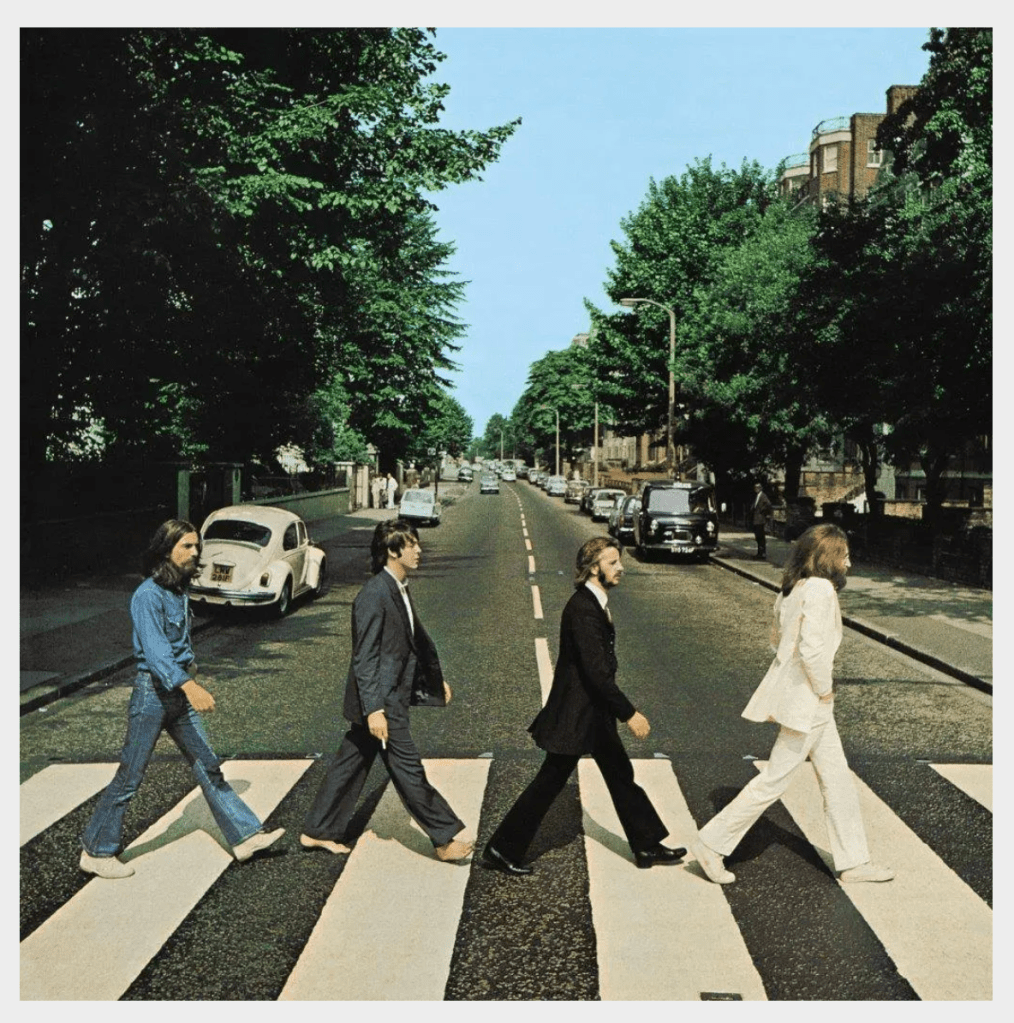
I recently moved to a place that is a short walk from Abbey Road in St John’s Wood.
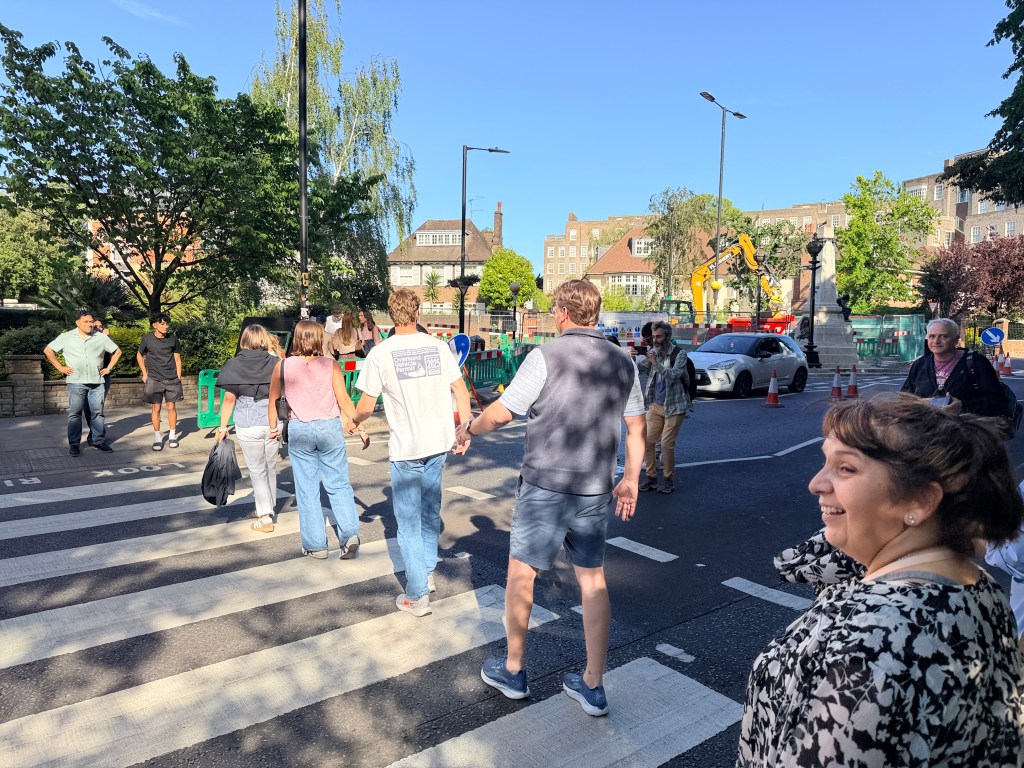
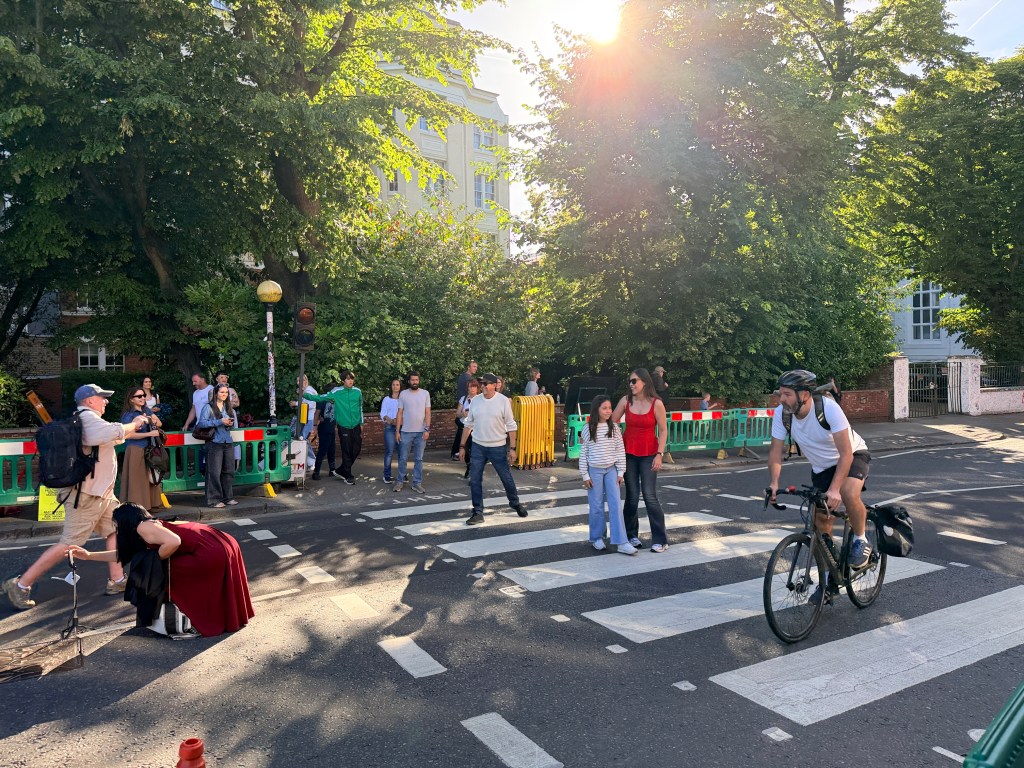
Every day, and night, there is a crowd of varying size gathered at either side of a certain zebra crossing comprised of groups who have turned out for their turn to cross.
One member from each of the groups (some are pairs, some are a squad) will invariably dash out into the street holding up a phone, or, on rarer occasions, a proper camera, while the others attempt their best approximation of the Beatles stride pictured on the cover of their last recorded album. Traffic pauses. Horns sound. Photographs are taken. The next fireteam files forward while motorists silently shake their heads in scorn.
For those unfamiliar with the environs of Abbey Road Studios and the crossing beside it, this is not Piccadilly Circus. It is a quiet residential part of London. The assembled faithful therefore constitute a genuine throng in this corner of St John’s Wood. Residents and commuters find themselves incongruously negotiating safe passage through this incessant fracas.
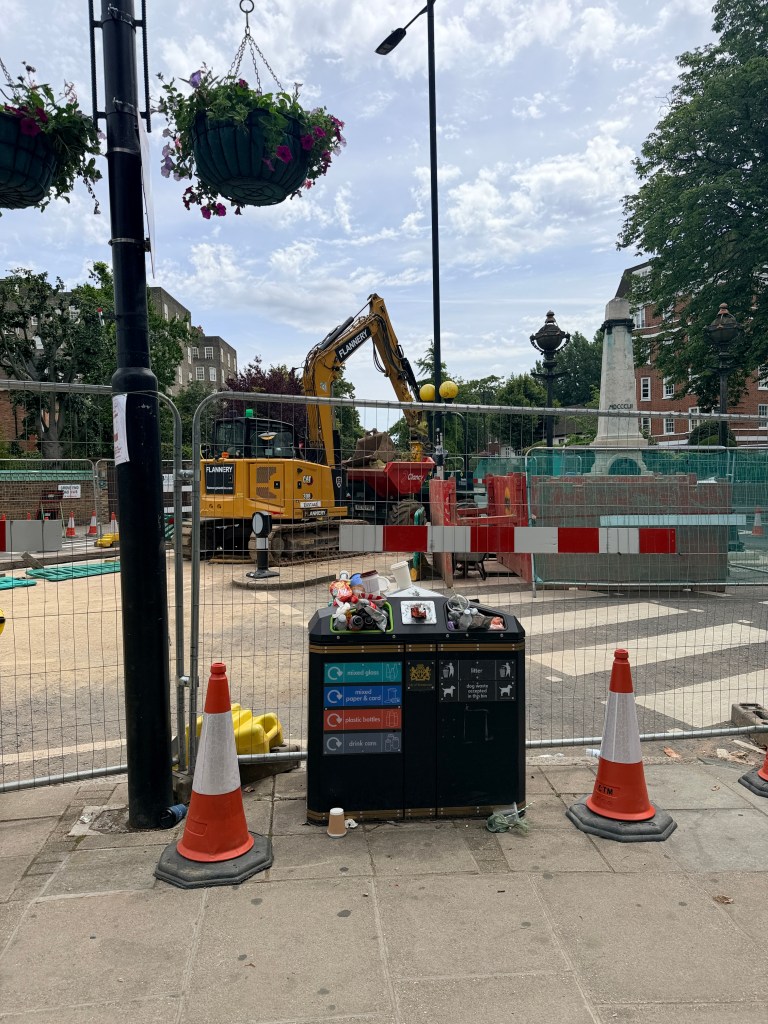
Before this latest move, I was staying in Notting Hill. There, too, crowds assembled daily in a trafficked side street outside a private residence made famous by a romantic comedy that borrowed the neighbourhood’s name for its title. People emerge from the herd, wait their turn, stand before a particular house’s not so particular blue door, smile, photograph, and then chimp before melting back into the crowd.
The story of the door is revealing.
It originally belonged to Richard Curtis, the film’s screenwriter. The production designer chose it by chance, unaware of its ownership. Following the film’s success, the original door was auctioned off for charity. The residents who remained behind grew weary of the endless stream of tourists, graffiti and photographers and replaced it with a plain black door. Eventually, a subsequent owner repainted the replacement door blue and the pilgrims returned.
The original artifact had vanished.
And yet the ritual remained.
My irritation with all this was not surprising to me though that I kept dwelling on it was. There seemed to be something more noxious here than the odor of mass tourism. Something faintly indecent wafted off the transformation of ordinary pieces of infrastructure and private property into tourist attractions at a cost imposed upon people who never consented to bear it.
Let us linger there for a moment.
We are accustomed to monuments being erected to receive visitors. The Cenotaph was built to be visited. Cathedrals were built to receive pilgrims. Museums were built to preserve and display objects deemed worthy of our collective attention. Society decides, explicitly or implicitly, that a place or object possesses sufficient significance to justify the inconvenience associated with preserving and visiting it.
Abbey Road is different.
The Notting Hill door is different.
Neither was intended to become a monument.
Neither was designed to receive visitors.
Neither was built to absorb the inconveniences that inevitably accompany significance.
And yet significance arrived all the same.
This is not a problem in itself. Meaning is rarely conferred by decree.
John Searle called these things “institutional facts”: realities that exist because we collectively accept them as such. “Money, property, governments, and marriages,” he wrote, “are all institutional facts. They are facts only because we believe them to be facts.”
Abbey Road is an institutional fact.
The Notting Hill door is an institutional fact.
Millions of strangers have collectively invested them with significance.
In this sense, Abbey Road and the Notting Hill door are indeed monuments.
No less than the Cenotaph.
The Cenotaph is, literally, an empty tomb. A carefully shaped arrangement of stone. Yet nobody regards it as merely stone because it has become a vessel for memory, sacrifice and national identity.
Abbey Road is thermoplastic paint on asphalt.
The Notting Hill door is painted wood.
Meaning has transformed matter in all three cases.
And once a thing or place has been invested with meaning, people will inevitably come to visit it.
Again, that, in itself, is not the problem.
The inconvenience of pilgrimage is tolerable when pilgrimage remains an act of reverence. The problem arises when the crowds are not really there for the monument at all.
The crowds at Abbey Road seem to be engaged in something subtly different. They do not come to stand before the monument. They come to stand at its centre.
The famous blue door in Notting Hill is gone. The original object was auctioned years ago. The tourists need not know, because once the sign has detached from the referent, that knowledge becomes irrelevant.
The same is true of Abbey Road. Visitors are not really interested in a zebra crossing. Nor, I suspect, are they particularly interested in the Beatles. What they seek is proximity to significance.
Not significance itself.
Its acquisition.
The photographs they take function as a deed to significance, albeit borrowed. A fragment of cultural meaning harvested and placed on display among the many symbols from which contemporary identity is curated.
And this is where my two objections converge.
First, these monuments have been erected without consent. Their costs have been socialized while their benefits remain private. Residents and road users are conscripted into maintaining a theatre whose script they never approved.
Second, and more damningly, the theatre is not performed in service of remembrance or reverence.
It is performed in service of extraction.
The visitors arrive at places invested with meaning not in order to be changed by them, but in order to carry some portion of that meaning away.
Not transformation, association.
Not inward change, outward display.
Not reverence, acquisition.
They do not seek communion with the monument. They seek to appropriate its symbolic capital and attach it to themselves.
This is what pilgrimage becomes when reverence is replaced by appropriation.
“The consumer society needs its objects in order to be, and more precisely it needs to destroy them.”
Jean Baudrillard
While the authentic pilgrim carries home a changed soul, the pilgrim-on-trend carries home a photograph; the latest token in a civilization organized around endless acquisition.
Experiences are accumulated.
Places are accumulated.
Culture is accumulated.
Even identity becomes a project of curation in which symbols are gathered, displayed and discarded in pursuit of an ever-receding core sense of self.
The object of our interest has not merely lost its sacredness, it has been subordinated to the project of self-construction.
The tourists play at paying homage to the Beatles when in fact something more parasitic is taking place.
The crossing is mined.
The film is mined.
Culture itself is mined.
Meaning is excavated, photographed and carried away in pockets.
And when every monument becomes a quarry for the self, the self ceases to be formed by reverence and is instead enlarged by annexation.
This is not growth.
It is accumulation.
The encounter is no longer metabolized.
It is recorded.
Its significance is not digested and transmuted into character.
It remains external.
The photograph.
The association.
The anecdote.
The proof of having been there.
Each is affixed to the self rather than incorporated within it.
The self becomes an assemblage of borrowed meaning: a collage of appropriated symbols whose significance derives from elsewhere.
It grows larger.
But not deeper.
More decorated.
But not more substantial.
Its parts never fuse into a coherent whole because they were never truly absorbed. They remain trophies of encounter rather than agents of transformation.
And so the monuments remain.
The crossing.
The blue door.
The Cenotaph.
But increasingly they are no longer destinations.
They are mirrors.
No longer places before which we diminish ourselves.
Increasingly, they are places at which we place ourselves at the center.
And the most elaborate monuments we build today are not dedicated to our heroes, our dead, or our ideals.
They are monuments to ourselves.

 SEÑOR - The Blog