
SEÑOR

Dispatches from the gap between how the world works and how we pretend it does.

Category: Philosophy & Ideas

Philosophical explorations, big ideas, and essays on consciousness, meaning, knowledge, and the human condition.

  • The Buddha at the Back of the Room

    The Buddha at the Back of the Room

    A masochist’s mantra that began as a battle cry in a Ghanaian martial arts film.

    I recently read an interview with Durba Mitra, a feminist historian at Harvard, on her new book The Future That Was: A History of Third World Feminism Against Authoritarianism. The book recounts how, in the years following the UN’s International Women’s Year in 1975, women from the decolonising world began articulating an intellectual tradition that challenged colonialism, patriarchy and authoritarianism not as a queue of grievances but as a single interlocking system of power. Theirs was not Western liberal feminism translated into darker complexion, it was a different diagnosis altogether, and therefore demanded different remedies.

    And then, gradually, in the way these things happen when they are put to work rather than when they are crushed, their vocabulary was digested. Development agencies, UN frameworks and gender-and-development programmes absorbed their language while quietly excreting the structure of thought that had given it meaning.

    Or, to employ a different metaphor, the architecture they had designed was progressively renovated by institutions that retained the facade while altering the load-bearing walls. The Future That Was is an attempt to recover the women who conceived that architecture from a particular kind of disappearance: not forgetting, which would at least be honest, but the subtler process by which a radical vision survives only after its foundations are buried and built over.

    Reading this, I found myself thinking about Elissar. A few days earlier, a friend had been telling me about the musical she is writing. Her subject is the founder of Qart Hadasht, the city Rome would later call Carthage, known to most, if at all, by her Greek name, Dido; known to herself, as Elissar or whatever name her own people spoke before their language became a scholarly reconstruction and their archives ash.

    The conceit my friend has chosen is deceptively simple. The curtain rises not on Elissar’s flight from Tyre nor the founding of her city, but on her funeral. Only then does the story begin. From that point onward, the audience retraces the path that led there, watching each decision accumulate toward an ending whose significance it already understands, even as the characters remain oblivious to it.

    There is something profoundly unsettling about that reversal. Ordinarily we experience life from within, moving uncertainly toward an ending we cannot see. History, by contrast, is almost always encountered in reverse. We know how Carthage ends. We know how revolutions end. We know, or think we know, what becomes of the slogans, the manifestos, the founding acts, the roads taken in youth and then mythologised by people who were not there. Looking backwards, necessity begins to masquerade as inevitability. We mistake outcomes for destinies and forget that, for those living them, every ending was once merely one possibility among many.

    Consider what we actually know about Elissar, which is considerably less than one might expect for a figure of such historical and literary consequence. The surviving accounts come almost entirely from future adversaries of her people: Greek and Roman historians who recorded her story after Carthage had been annihilated, its libraries destroyed or dispersed, its population enslaved or scattered, its fields allegedly salted into permanent sterility. Even that last image, the salting of the earth, has become one of those historical details whose symbolic usefulness has outlived the evidence for it. Carthage is the sort of civilization that reaches us through the sentences of others. The city lost; the victors’ metaphors endured.

    The narrative preserved in Justin’s epitome of Pompeius Trogus gives us the outline of something remarkable: a Tyrian princess whose brother, Pygmalion, murdered her husband Acerbas to seize the treasury and consolidate his power; who escaped with followers, ships, and what remained of the fortune; who landed on the North African coast and negotiated for land; who, in the famous ox-hide story, cut the hide into strips to claim more territory than the local ruler had imagined offering; and who founded a city that would become, for several centuries, the dominant power of the western Mediterranean. There are variants and uncertainties, as there always are when legend and history are braided around a missing archive.

    Some traditions suggest that the father named both children as heirs and that Elissar’s claim was not merely sentimental but dynastic. What survives officially of Tyre’s succession gives us Pygmalion as king. The co-regency, if there was one, is missing. The absence may mean nothing. It may mean everything.

    Virgil creates an account of a different personage. He gives Elissar to Aeneas, as Dido, a woman who loves a Trojan hero and curses him when he leaves, because she is useful to the epic he is composing. Augustus required a mythic prehistory for Rome, and Rome required a memory of Carthage that made its own wars appear not merely strategic but fated. Dido’s dying curse, calling down an unnamed avenger upon the race of Aeneas, served that purpose with impeccable economy. Virgil’s Roman readers understood immediately that the avenger was Hannibal. Her death provided the emotional origin story for a geopolitical rivalry. Carthage’s founder was drafted into the service of her conquerors’ mythology, not because Virgil misunderstood her but because he understood exactly what he needed her for. The fact that she is genuinely moving in the Aeneid, that readers have wept for her across two thousand years, does not alter what she was recruited to do. It rather proves the point.

    In the older tradition, Aeneas does not appear. Elissar’s death there is a political act. The local chieftain Iarbas, from whom she had obtained the land on which Carthage stood, demands that she marry him or face war. The demand is not merely conjugal ; it is jurisdictional. It is a claim upon the city through the body of its founder. If she accepts, Carthage survives by surrendering its sovereignty. If she refuses, the city she has built may be destroyed before it can defend itself. She tells her people she needs time to prepare a ceremony in honour of her dead husband. She builds a pyre. She climbs it. She kills herself.

    The conventional telling draws our attention to the woman as wife and away from her as queen, inviting us to read a constitutional crisis as a private tragedy. But the actor here is not contending with romantic despair. This is someone, who happens to be a woman, confronted with two unacceptable choices who invents a third one that neither party had offered. She preserves the city by removing the pretext for its destruction. She preserves her fidelity to Acerbas by refusing to replace him. She preserves, perhaps, her own authority by refusing to let her body become the instrument through which the city is absorbed into another man’s sovereignty.

    Now whether we should call this courage or its opposite is a question the sources decline to answer, and one I cannot settle for myself. I only know that Virgil’s version is the ancient equivalent of the Harlequin romance. A woman dies because a man leaves her. Never mind the rather more pressing matter of preserving a city founded by exiles who had entrusted their lives, their fortunes and their future to you.

    That deflation is what linked her, in my mind, to Mitra’s women. Women act. Later systems explain what their actions meant. A founder becomes a lover. A political death becomes a romantic one. A body that refused incorporation is incorporated into the literature of the power that destroyed the city she founded. Mitra’s Third World feminists did not face the same fate, but they faced a recognisable mechanism. They produced a way of understanding power, only to watch its language become available to institutions that did not share its original commitments. Their terms survived. The grammar changed.

    This is where the title of Mitra’s book begins to burn rather than merely describe. The future that was. Not the future that failed, which would be sad enough, nor the future that never came, which would be merely elegiac. The future that was suggests something more difficult: a future that existed as an intellectual and political possibility before being converted into a past. The women she studies were not simply defeated by patriarchal authoritarianism. They were, in a sense, succeeded by institutions that learned to speak in their language while meaning something else. To be forgotten is one fate. To be preserved under altered terms may be worse, because it allows the world to congratulate itself on remembering while ensuring that what is remembered no longer threatens it.

    Several weeks earlier, on a flight home, I had watched Kerouac’s Road: The Beat of a Nation, a documentary about Jack Kerouac and the generations of seekers who have followed in his wake. The film moves between archival Kerouac and an array of inheritors: actors who rode motorcycles across America after reading the book, a fashion designer who credits the Beats for his Dior collections, a cultural critic who wonders what the road might have looked like with James Baldwin in the passenger seat. Each of them has taken something from Kerouac and made it mean what they needed it to mean. The film treats this as evidence of his reach. The possibility that it is also a description of what destroyed him is not one the documentary finds it necessary to explore.

    The man who wrote the great American hymn to motion spent the final decade of his life watching strangers appropriate that hymn for purposes he found baffling and, eventually, contemptible. He drank against it. He appeared on William F. Buckley’s Firing Line in 1968, inebriated and raging at a hippie musician for building a career on tearing things down. He had become the reluctant saint of a movement whose politics, aesthetics and self-congratulation he increasingly despised. He moved back in with his mother in Florida. He died at forty-seven from internal haemorrhaging brought on by cirrhosis.

    The common explanation is that Kerouac could not handle success. This may not be entirely wrong, but it is too small. Plenty of people cannot handle success. What seems more interesting is to explore why? His success placed him in the position of being interpreted by his adherents in a way that made repudiation impossible. Every objection he made was folded back into the myth. If he complained about the hippies, that merely proved he was complicated. If he drank, it became tragic evidence of his intensity. If he recoiled from the counterculture, the recoil could be treated as another scene in the drama of the prophet undone by the movement he inspired. There are forms of admiration from which no escape is possible because they metabolise objection as confirmation.

    The film is itself an example of what it cannot see. The admirers it assembles are building on Kerouac’s story, extending it into their own lives, using it as a framework for their own searches. The myth that escaped him in his lifetime continues to escape him in ours. He would have hated the film, almost certainly, which the film would probably find touching. That is the cruel genius of canonisation. It can turn resistance into texture. It can transform disgust into pathos. It can make even the subject’s refusal of the story into one of the story’s most charming features.

    What connects Mitra’s women, Elissar and Kerouac is not tragedy exactly, and not simply the corruption of ideals by institutions, which is the obvious reading and too consoling to be accurate. In each case, a foundational act generated an alluring story that became, over time, separable from the person or people who originated it, and into which others stepped to build what they required; with a large enough audience’s approval. Elissar’s founding of Carthage escaped into Rome’s origin mythology. Third World feminism’s intellectual tradition escaped into the bureaucratic vocabulary of international development. Kerouac’s search escaped into a counterculture he regarded as a misreading, and then into a documentary that treats his objections as one of his more poignant contradictions. The authors were not simply defeated. They were succeeded. Something was built on what they built, without their consent, and the something bore their name while serving other purposes.

    One sees this pattern with such frequency that it begins to feel less like betrayal than like a structural feature of human life. It is perhaps especially visible in founding stories, because founding stories are always written twice: once by those who make the crossing, raise the walls, declare the covenant or plant the flag, and again by those who inherit the result and need it to mean something. A people fleeing violence can become a power that administers violence. A movement formed against domination can acquire the habits of domination once it has territory, law and archives. A critique of empire can become an institution that grades the empire’s former subjects against administrative indicators.

    This is not hypocrisy in the simple sense. It is more disturbing than hypocrisy, because what supplants the founder’s story is not a betrayal that fails but a betrayal that succeeds. The institution functions. The myth travels. The city stands. It is precisely because Carthage prospered, because development agencies expanded their reach, because a generation found themselves in Kerouac’s book, that the founders became unnecessary to what they had founded. Dispensability is the reward for having built something that lasts.

    This is where today’s political soul-searching becomes unavoidable. American settlers pushing westward, Israeli communities describing themselves through the language of return and survival, Phoenician colonists negotiating with Amazigh chieftains for a coastal hill in what is now Tunisia: these are not equivalent cases, and any argument that depends on treating them as equivalent should be distrusted. But they do share a formal problem.

    Arrival must be narrated as necessity. Occupation must be translated into destiny, refuge, providence, reclamation or law. The people who arrive must tell a story in which their presence is justified, and the story almost always becomes more coherent as the people displaced by it become less audible. What begins as a solution to one people’s vulnerability can become the source of another’s. The solution does not fail because it is insincere. It fails because it succeeds well enough to acquire power.

    Elissar’s death, in the older version, is therefore not an antique curiosity but a political grammar still intelligible to us. She stands at the hinge between refuge and sovereignty. Her body is the point at which a city’s survival is to be converted into another man’s authority. The demand made of her is not merely to marry but to ratify, with her person, a settlement in which the founding act is absorbed into a pre-existing power. Her suicide refuses the translation. It is a terrible refusal, and perhaps not one we should admire too quickly. Yet it exposes something that later, softer versions obscure: the founder’s body and the city’s sovereignty were not separate problems. The politics entered through intimacy, as it so often does.

    The friend writing the musical is working through what Elissar’s life and death meant, what it says about a woman who built a world that eventually outran her authority over it. One might wonder, without any unkindness, whether she is also working through something closer to home: what it means to be someone’s daughter, someone’s heir, someone whose future has been narrated by people with their own interests in how that story ends. Elissar, after all, was also that. She refounded herself. Whether the musical will clarify what Elissar’s story actually was, or whether it will become the most recent vehicle by which her story is made to mean something other than itself, is a question opening night alone will not resolve. It may not even be the right question. Perhaps retelling is never a recovery of the original so much as an admission that the original can no longer defend itself.


    I found myself thinking of this again, improbably, in relation to peptides. Everyone appears to be taking something now, or considering taking something, or consulting someone who knows which protocol everyone else is taking. The language is familiar: optimization, recovery, longevity, performance, biomarkers, sleep architecture, inflammation, metabolic flexibility. I am not immune to the appeal. Quite the opposite. And the appeal is not unfounded. People are sleeping better, recovering faster, moving through their days with an energy they had quietly stopped expecting. The interventions are working, which is the problem, or at least the beginning of it.

    Because when something works, the question of what it is working at the expense of becomes harder to ask and easier to dismiss. Who decided what counts as improvement? Which measurements are being privileged, and which forms of deterioration have been made difficult to see because they fall outside the selected dashboard? If energy improves but anxiety worsens, if recovery accelerates but sleep becomes dependent on a stack of interventions, if longevity becomes a project so elaborate that life itself is reorganised around its extension, what exactly has been optimised? Quantification is not the opposite of ideology. It is often ideology’s most efficient costume, because once a value has been converted into a metric it can pretend to have escaped argument. The founders of this particular movement, whoever they were, would recognise the trajectory.

    This is not an argument against peptides, any more than Mitra’s book is an argument against reports, or the story of Elissar an argument against settlement or Kerouac’s ruin an argument against travel. It is an argument against allowing an intervention to become sovereign over the problem it was meant to address. The most dangerous solutions are not the ones that fail. Failure is instructive and often clarifying. The dangerous ones are those that work well enough to be inherited, abstracted, systematised and repurposed until the original need disappears beneath the procedures created to meet it. At that point the solution remains, sometimes in impressive institutional form, but the question it was meant to answer has moved elsewhere.

    By this point an unwelcome figure had begun appearing at the back of the room. He was not in Mitra’s interview. He was absent from the legends of Carthage. Kerouac circled him, borrowed from him, drifted near him and then retreated into Catholic grief, American rage and alcohol. He has little to say about peptides, though one suspects he would understand the craving they answer. The Buddha does not enter this argument as a solution. He enters as an irritation.

    His irritation lies in the fact that he does not ask whether the road, the city, the movement, the institution or the protocol has been properly designed. He asks what in us keeps demanding that any of them finally hold. The world changes, the self changes, the object of desire changes, and yet we insist on building as though the thing built could secure us against alteration. That does not mean one should build nothing. The cheap version of Buddhism, the one dismissed by those who require enemies more than interlocutors, imagines detachment as withdrawal and compassion as sedation. The harder version asks what it would mean to act without needing the action to become a monument to the actor.

    I am not sure I believe this. Or rather, I believe it intermittently, which may be the only honest way I believe anything that competes with my instincts. Camus would say to build anyway, to recognise the absurdity of the enterprise and persist without appeal. Nietzsche would say that the hunger to create, to impose form, to make something of the chaos, is not a mistake but the very sign of life. The Buddha, standing quietly behind both of them, would ask whether their answers still leave the self intact as the hidden beneficiary of the drama. None of them has resolved for me the problem of what to do when your ideas are institutionalised, your story is drafted into someone else’s epic, or your myth turns up in a documentary making thoughtful remarks about the American spirit.

    Elissar was, in some traditions, deified after her death. The people of Carthage worshipped the founder as a goddess, or perhaps later identified her with Tanit, for as long as the city endured. The city endured until 146 BCE, when Rome burned it. After that, the goddess, the city, the records and the library disappeared together, while Virgil’s Dido survived. The curse survived. Hannibal survived as Rome’s nightmare and later as history’s admired enemy. What did not survive was Elissar’s own account of what she had made, why she made it, and whether dying upon the pyre was an escape, a refusal, a sacrifice or the last act of sovereignty available to her.

    Perhaps every solution that matters is destined to escape in this way. It enters the world to answer one problem and is inherited by people trying to solve another. That may not be failure, exactly. It may be the only form of survival history permits. Still, I cannot shake the unease that something essential is lost when an idea remains legible only after its foundations have been infilled, when a city survives only through the literature of its destroyers, when a road remains open only because the man who paved it has become one more landmark beside it. We keep building anyway, which may be courage, vanity, delusion, necessity or merely habit. The Buddha waits at the back of the room, neither applauding nor condemning, while the rest of us continue arguing about whether a foundation has been betrayed because another structure stands above it, or whether this is what foundations were always for.
  • Monuments to Ourselves

    Monuments to Ourselves

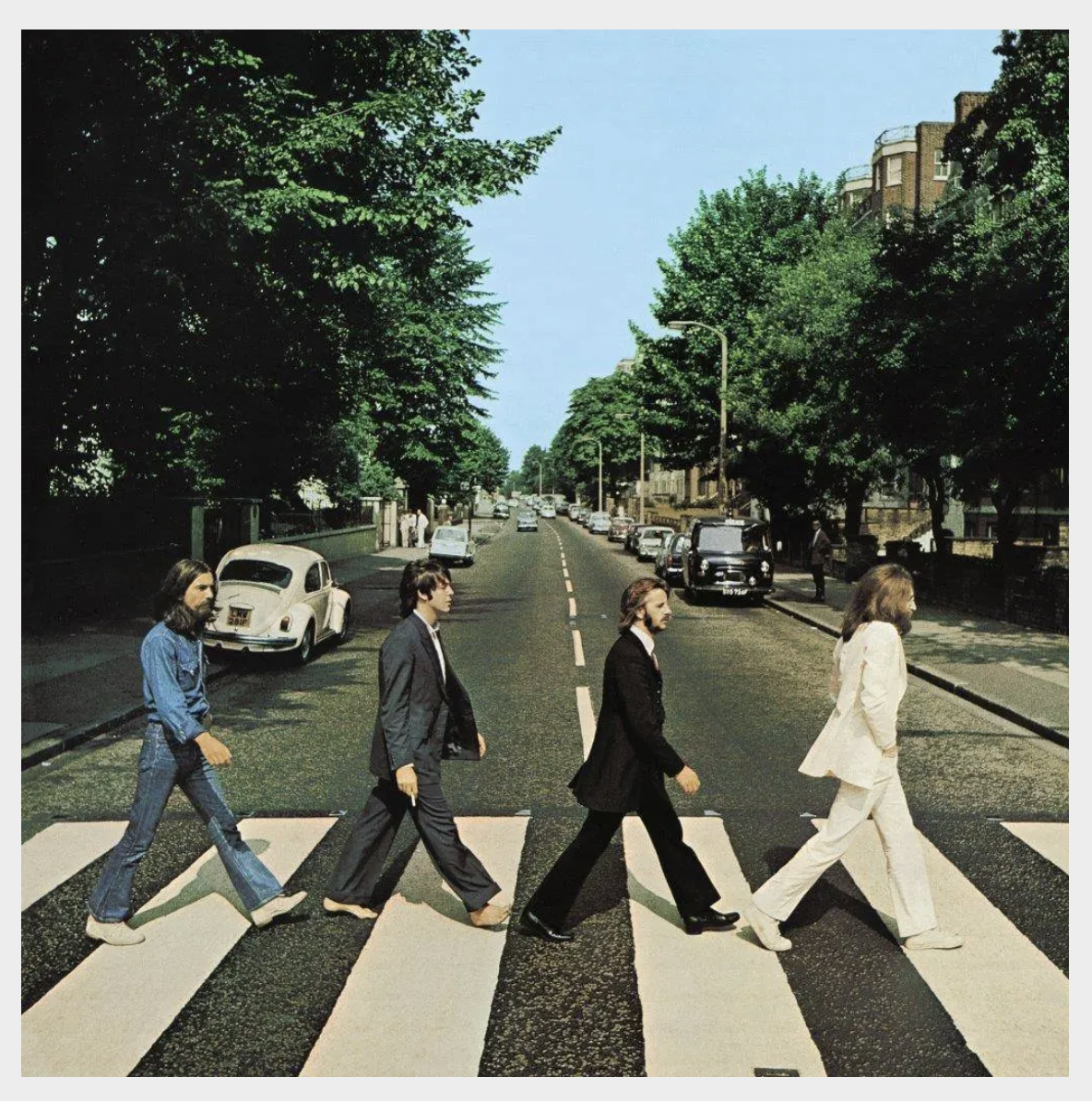
    I recently moved to a place that is a short walk from Abbey Road in St John’s Wood.

    Every day, and night, there is a crowd of varying size gathered at either side of a certain zebra crossing comprised of groups who have turned out for their turn to cross.

    One member from each of the groups (some are pairs, some are a squad) will invariably dash out into the street holding up a phone, or, on rarer occasions, a proper camera, while the others attempt their best approximation of the Beatles stride pictured on the cover of their last recorded album. Traffic pauses. Horns sound. Photographs are taken. The next fireteam files forward while motorists silently shake their heads in scorn.

    For those unfamiliar with the environs of Abbey Road Studios and the crossing beside it, this is not Piccadilly Circus. It is a quiet residential part of London. The assembled faithful therefore constitute a genuine throng in this corner of St John’s Wood. Residents and commuters find themselves incongruously negotiating safe passage through this incessant fracas.

    Before this latest move, I was staying in Notting Hill. There, too, crowds assembled daily in a trafficked side street outside a private residence made famous by a romantic comedy that borrowed the neighbourhood’s name for its title. People emerge from the herd, wait their turn, stand before a particular house’s not so particular blue door, smile, photograph, and then chimp before melting back into the crowd.

    The story of the door is revealing.

    It originally belonged to Richard Curtis, the film’s screenwriter. The production designer chose it by chance, unaware of its ownership. Following the film’s success, the original door was auctioned off for charity. The residents who remained behind grew weary of the endless stream of tourists, graffiti and photographers and replaced it with a plain black door. Eventually, a subsequent owner repainted the replacement door blue and the pilgrims returned.

    The original artifact had vanished.

    And yet the ritual remained.

    My irritation with all this was not surprising to me though that I kept dwelling on it was. There seemed to be something more noxious here than the odor of mass tourism. Something faintly indecent wafted off the transformation of ordinary pieces of infrastructure and private property into tourist attractions at a cost imposed upon people who never consented to bear it.

    Let us linger there for a moment.

    We are accustomed to monuments being erected to receive visitors. The Cenotaph was built to be visited. Cathedrals were built to receive pilgrims. Museums were built to preserve and display objects deemed worthy of our collective attention. Society decides, explicitly or implicitly, that a place or object possesses sufficient significance to justify the inconvenience associated with preserving and visiting it.

    Abbey Road is different.

    The Notting Hill door is different.

    Neither was intended to become a monument.

    Neither was designed to receive visitors.

    Neither was built to absorb the inconveniences that inevitably accompany significance.

    And yet significance arrived all the same.

    This is not a problem in itself. Meaning is rarely conferred by decree.

    John Searle called these things “institutional facts”: realities that exist because we collectively accept them as such. “Money, property, governments, and marriages,” he wrote, “are all institutional facts. They are facts only because we believe them to be facts.”

    Abbey Road is an institutional fact.

    The Notting Hill door is an institutional fact.

    Millions of strangers have collectively invested them with significance.

    In this sense, Abbey Road and the Notting Hill door are indeed monuments.

    No less than the Cenotaph.

    The Cenotaph is, literally, an empty tomb. A carefully shaped arrangement of stone. Yet nobody regards it as merely stone because it has become a vessel for memory, sacrifice and national identity.

    Abbey Road is thermoplastic paint on asphalt.

    The Notting Hill door is painted wood.

    Meaning has transformed matter in all three cases.

    And once a thing or place has been invested with meaning, people will inevitably come to visit it.

    Again, that, in itself, is not the problem.

    The inconvenience of pilgrimage is tolerable when pilgrimage remains an act of reverence. The problem arises when the crowds are not really there for the monument at all.

    The crowds at Abbey Road seem to be engaged in something subtly different. They do not come to stand before the monument. They come to stand at its centre.

    The famous blue door in Notting Hill is gone. The original object was auctioned years ago. The tourists need not know, because once the sign has detached from the referent, that knowledge becomes irrelevant.

    The same is true of Abbey Road. Visitors are not really interested in a zebra crossing. Nor, I suspect, are they particularly interested in the Beatles. What they seek is proximity to significance.

    Not significance itself.

    Its acquisition.

    The photographs they take function as a deed to significance, albeit borrowed. A fragment of cultural meaning harvested and placed on display among the many symbols from which contemporary identity is curated.

    And this is where my two objections converge.

    First, these monuments have been erected without consent. Their costs have been socialized while their benefits remain private. Residents and road users are conscripted into maintaining a theatre whose script they never approved.

    Second, and more damningly, the theatre is not performed in service of remembrance or reverence.

    It is performed in service of extraction.

    The visitors arrive at places invested with meaning not in order to be changed by them, but in order to carry some portion of that meaning away.

    Not transformation, association.

    Not inward change, outward display.

    Not reverence, acquisition.

    They do not seek communion with the monument. They seek to appropriate its symbolic capital and attach it to themselves.

    This is what pilgrimage becomes when reverence is replaced by appropriation.

    “The consumer society needs its objects in order to be, and more precisely it needs to destroy them.”

    Jean Baudrillard

    While the authentic pilgrim carries home a changed soul, the pilgrim-on-trend carries home a photograph; the latest token in a civilization organized around endless acquisition.

    Experiences are accumulated.

    Places are accumulated.

    Culture is accumulated.

    Even identity becomes a project of curation in which symbols are gathered, displayed and discarded in pursuit of an ever-receding core sense of self.

    The object of our interest has not merely lost its sacredness, it has been subordinated to the project of self-construction.

    The tourists play at paying homage to the Beatles when in fact something more parasitic is taking place.

    The crossing is mined.

    The film is mined.

    Culture itself is mined.

    Meaning is excavated, photographed and carried away in pockets.

    And when every monument becomes a quarry for the self, the self ceases to be formed by reverence and is instead enlarged by annexation.

    This is not growth.

    It is accumulation.

    The encounter is no longer metabolized.

    It is recorded.

    Its significance is not digested and transmuted into character.

    It remains external.

    The photograph.

    The association.

    The anecdote.

    The proof of having been there.

    Each is affixed to the self rather than incorporated within it.

    The self becomes an assemblage of borrowed meaning: a collage of appropriated symbols whose significance derives from elsewhere.

    It grows larger.

    But not deeper.

    More decorated.

    But not more substantial.

    Its parts never fuse into a coherent whole because they were never truly absorbed. They remain trophies of encounter rather than agents of transformation.

    And so the monuments remain.

    The crossing.

    The blue door.

    The Cenotaph.

    But increasingly they are no longer destinations.

    They are mirrors.

    No longer places before which we diminish ourselves.

    Increasingly, they are places at which we place ourselves at the center.

    And the most elaborate monuments we build today are not dedicated to our heroes, our dead, or our ideals.

    They are monuments to ourselves.

  • Purity Is an Aesthetic of Death [From the Glitch Series]

    Purity Is an Aesthetic of Death [From the Glitch Series]

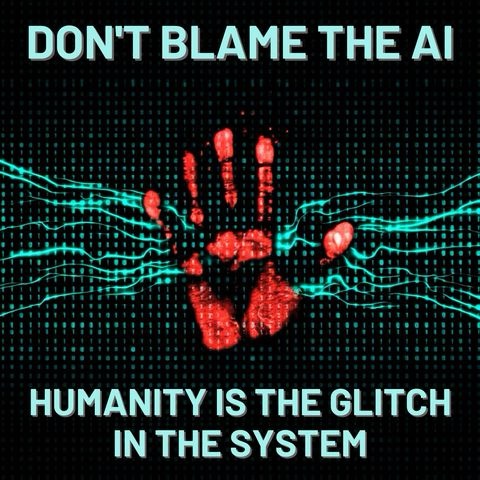
    Purity has long been treated as a virtue. Clean water. Clean bodies. Clean ideas. Clean bloodlines. Pure as the driven snow. It is not merely descriptive language but aspirational language, a claim that something has approached an ideal state. Yet the closer science has come to understanding how living systems actually function, the stranger this ideal appears. Life does not optimize for purity. It never has. And yet the abstraction persists, shaping human behavior long after it has stopped tracking reality. This persistence is a paradigmatic example of the glitch: a representation that remains executable even after its connection to the world has collapsed.

    In its earliest form, purity was not a moral concept at all. It was a survival heuristic. In epistemically-constrained environments, visible contamination often correlated with danger: feces in water, rotting matter, carcasses, in a word, the Ganges. Avoiding these reduced risk often enough to be reinforced. Clear water was usually safer than foul-smelling water. Clean wounds healed more reliably than dirty ones. At this stage, purity was not an ideal. It was a proxy. A cheap, visually legible rule of thumb that increased the odds that one’s fears would not come true.

    The first transformation came when this heuristic was ritualized. Purity became a way of managing uncertainty rather than danger directly. Blood, death, sex, childbirth, decay. These were liminal states that blurred binary categories and inspired fear. Ritual purification, sacrifice, ablution did not improve nature. They stabilized anxiety. They reassured humans that chaos had been acknowledged and contained. Purity did not need to work causally. It needed to work socially and psychologically.

    The decisive shift occurred when purity migrated from practice to essence.

    Greek philosophy marks this turn. With Plato, purity leaves the altar and enters thought. The Forms are pure. Matter is degraded participation. Mixture becomes corruption. The closer an idea is to abstraction, the closer it is to truth. Context, contingency, and mess are stripped away in the name of knowledge. Purity, once a proxy for epistemic opacity becomes epistemic itself. To know is to purify.

    This move is crucial, because it installs purity inside cognition itself. What began as a situational heuristic is now a metaphysical hierarchy. Life, with all its compromise and entanglement, is demoted. The clean, the simple, the invariant are elevated.

    Christian theology fuses this metaphysical purity with moral purity. God is pure being. Sin is corruption. Salvation is cleansing. Purity is no longer temporary or contextual. It is existential. Once impurity is reframed as fault, purity inevitably becomes desirable. Not because it produces better outcomes for us, but because it aligns the self with an imagined cosmic order.

    The Enlightenment strips away theology but keeps the structure intact. Purity is secularized. Reason must be pure. Science must isolate variables. The subject must be autonomous, untainted by superstition or tradition. Nations must be homogeneous. Languages must be standardized. Cultures must be clarified. What began as a method becomes a worldview.

    This is where the glitch fully asserts itself.

    Purity in science is a scaffold, not a description of reality. Controlled variables and sterile environments allow learning to happen. But once this methodological purity is mistaken for an ontological truth, the abstraction escapes the lab. Genes must be pure. Systems must be clean. Optimization becomes eradication. Control becomes virtue.

    History is full of moments where the purity heuristic fails outright. Crystal-clear mountain streams can liquify bowels. Meanwhile, tannin-stained water from peatlands, brown and “dirty” to the eye, can be anodyne. Fermented drinks, cloudy and alive, were historically safer than clear urban water. Appearance inverted function, yet the aesthetic of purity continued to dominate decision-making.

    Modern biology delivers a deeper correction. Humans are not autonomous organisms occasionally assisted by microorganisms. We are composite systems that emerged with these evolutionary precursors. The oral cavity is not gums, teeth, and tongue with bacteria as tolerated guests. It is a microbial ecology whose balance determines kissability, dental health, immune signaling, and disease resistance. 

    Bad breath is not caused by bacteria as such, but by the collapse of a competitive microbial environment. The purification response, aggressive antiseptics and eradication, often worsens the condition over time. What works is cultivation, not extermination.

    Our vision biases us. We notice symbiosis when it is spatially separable and theatrically legible. The bird on the rhino or the remora on the shark are stories we can tell in one frame. The trillions of microbes modulating gut-brain signaling are not. Our cognitive apparatus evolved for hunting and social coordination, not for perceiving biochemical interdependence.

    And yet the relationship between us and our microbiota is not quite symbiosis, it is structure. Remove the microbiome and the organism recognizable as human does not regress to a simpler or less optimal state, it fails and disappears. The visible anatomy is scaffolded by life forms we cannot see. Purity does not merely misdescribe this reality. It actively obscures it.

    If organisms are cooperative coalitions rather than sovereign units, then evolution is not primarily a competition between individuals but a competition between assemblages. The winners are not the strongest or the purest, but the ones best at hosting, tolerating, and regulating difference.

    And yet, we continue to place a premium on genetic purity.  Purebred dogs are a cautionary tale. The more “pure” the line, the more riddled it becomes with inherited disease. Hybrid vigor is not a slogan, it is a biological fact.

    At first glance, horses – Thoroughbreds, Arabians, Lipizzaners – appear to provide a strong counterexample. Lineage tracked obsessively through closed stud books. “Pure blood” as literal terminology. Performance, beauty, predictability all look like purity producing advantage.

    But look one layer deeper.

    Purebred horses are not selected for biological robustness. They are selected for narrow performance under controlled conditions. Speed over a fixed distance. Gait aesthetics. Temperament for riding schools. Symbolic continuity for courts and states. These are not evolutionary goals. They are human use-cases.

    And the cost of purity shows up immediately.

    Thoroughbreds suffer from fragile bones, bleeding lungs, metabolic issues, and catastrophic injury rates. Arabians carry heritable disorders like SCID. Many closed-line breeds show reduced fertility, immune weakness, and shortened competitive lifespan. The more rigorously “pure” the lineage, the more veterinary intervention is required to keep the animal functioning.

    Sound familiar?

    What keeps these animals viable is not purity, but constant artificial support : controlled breeding, intensive care, selective culling, supplements, medication, training regimens. Remove the human-managed environment and the supposedly superior organism collapses quickly.

    Let’s consider more challenging counterexamples outside the domain of the living. Diamonds. Optics. Precision materials.

    A perfectly pure diamond is a crystalline ideal; is it a useful instrument. Industrial diamonds are doped to change conductivity, toughness, or optical behavior. In quantum sensing, controlled defects are the feature. Absolute purity defines a baseline, not a goal. The moment function matters, impurity is introduced deliberately.

    Optical glass behaves the same way. High purity reduces noise, but a single, perfectly pure lens is inferior to a compound system. Aberrations are not eliminated by purity but corrected through curvature, layering, coatings, and hybrid design. Performance emerges from orchestration, not isolation.

    Purity here is local, instrumental, and transient. Even where it appears to succeed, it does so as a limiting case, not a destination.

    Once we move into matters of taste, purity becomes backstory by virtue of the concept’s heritage.

    Single-origin malts are not chemically pure. They are stories of provenance, constraint, and exclusion. Purity here signals scarcity and authorship. Pure gold is too soft to use. Pure water is only desirable after the term has been diluted to mean “free from known toxins.” In these domains, purity no longer claims to optimize function. It signals status and legibility.

    The pattern is consistent. Wherever life, resilience, or adaptation matter, purity fails. Wherever systems are inert, frozen, or already dead, purity can be aestheticized without consequence.

    Evolution optimizes for robustness under noise, not for cleanliness or isolation. Systems that survive are messy, redundant, and promiscuously entangled. Purity only looks attractive when you abstract away the environment and freeze time. Once selection is allowed to operate across generations, purity becomes fragility. A system that relies on a narrow set of conditions collapses the moment those conditions shift.

    Which brings us back to the glitch.

    Purity persists not because it is true, but because it is executable. It compresses complexity into binaries. It flatters control. It survives failure by redirecting us to an antonym – contamination. When reality pushes back, the model is not revised. It persists; to our collective detriment. Momentum drowns out correction.

    Purity was never a property of living systems, nor a condition toward which life tended. It arose as a coordination fiction to manage fear, was abstracted into thought, moralized into identity, and secularized into systems. Science has dismantled it repeatedly, yet the abstraction continues to cast a shadow over how we understand our bodies, our societies, and ourselves.

    Purity is not an ideal we failed to reach.  It is an aesthetic of death mistaken for a moral goal.  And the real danger is not that it is wrong but that it continues to run.

  • Executable Error: Why We Are a Glitch That Will Not Go Galactic

    Executable Error: Why We Are a Glitch That Will Not Go Galactic

    I recently wrote about the Earth as an anomaly of abundance: a planet bursting with color, texture, chemistry, and gratuitous detail, adrift in a universe otherwise dominated by emptiness, repetition, gas giants, gravitational fields, and uniform stone. Against a cosmological backdrop that seems to favor scale over subtlety and uniformity over nuance, Earth reads almost as an error. An unusual indulgence. A place where variation was not merely allowed but overproduced.

    Reading The Little Book of Aliens over Christmas brought that peculiarity back to the fore. Why this cornucopia of heterogeneity at all, when the universe appears perfectly content with vastness, simplicity, and silence?

    And that’s not even the half of it!

    For from within this already improbable concentration of diversity has emerged something even more disruptive. Humans. Products of this planetary excess ourselves, we have become multipliers rather than mere participants. We do not simply inhabit complexity. We accelerate it, recombine it, aestheticize it, abstract it, and detach it from the narrow channels of survival that govern almost everything else that lives.

    We do not just eat. We cook. We reduce, season, ferment, double-boil.

    We do not just move. We dance, tumble, perform contortionist feats for no reason other than to test what a body can do.

    We do not just communicate. We theorize, narrate, fictionalize, argue about arguments, and write books asking who is asking the question.

    This excess is not incidental. It is differentiating.

    And it is what makes our trajectories incalculable.

    The universe, of course, is not short on unpredictability. It is saturated with it. Weather systems, turbulent flows, evolutionary paths, orbital mechanics, radioactive decay. Entire disciplines exist to catalogue how small differences cascade into large effects. The three-body problem is the canonical example: three masses, obeying simple laws, producing trajectories so sensitive to initial conditions that long-term prediction collapses.

    But there is a ceiling to this chaos.

    No matter how erratic the orbits become, the bodies remain bodies. Gravity remains gravity. Energy is conserved. The unpredictability is real, but it is confined. The system explores an enormous space of possibilities, but that space is fixed in advance. Nothing qualitatively new can happen. It is simply too numerous to compute.

    Human beings break this pattern.

    What humans do, as far as we can tell, nothing else in the universe does in quite this way. We produce representations of reality that remain causally effective even after they cease to accurately represent it. The distinction is the system’s high tolerance of error.

    In most living systems, signaling is tightly coupled to survival outcomes. When a signal stops working, it quickly loses influence.

    If an ant colony lays a pheromone trail that no longer leads to food, ants stop following it. The chemical signal dissipates because it is no longer reinforced. No deliberation is required. Feedback is immediate. Error collapses.

    The same principle holds inside organisms. Regulatory signals coordinate processes like metabolism, growth, and immune response. When a signaling pathway consistently misfires, it is selected against. Either the system corrects, or the organism fails to reproduce. Persistent error does not become governing instruction.

    Across biological systems, the pattern is consistent. Signals that stop tracking reality stop mattering. Feedback is tight. Correction is fast. False states die early.

    Human symbolic systems are different.

    We have built forms of representation that remain executable even when they stop tracking reality. Laws, ideologies, markets, doctrines, and institutional norms do not automatically decay when they misalign with the world. They can persist, scale, and command action long after their descriptive accuracy has failed.

    Money continues to circulate even when it no longer corresponds to real productivity or value, reorganizing labor and resources according to prices that everyone knows are distorted. Borders, little more than lines inherited from past conflicts or colonial cartography, still determine who may live, move, work, or die where, despite bearing no relation to geography, ecology, or culture. Ideologies survive failed predictions and mounting evidence, not by improving their explanatory power, but by doubling down on enforcement, identity, and exclusion. In each case, the representation no longer describes the world; it instructs it. And because the instruction is embedded in institutions, contracts, habits, and expectations, it continues to act even after its claim to accuracy has quietly expired. Meaning continues to act long after reality has stopped consenting.

    The representation itself has no intrinsic power. Ink does nothing beyond our atmosphere. Sound waves dissipate almost immediately. A paragraph does not bend spacetime. Representations return to the world through us. We allow descriptions of the world to stand in for the world, and then we act as if the substitution were seamless. Once enough of us do this together, symbols acquire force. Not physical force, but normative force. The power to obligate, to prohibit, to justify, to mobilize.

    This is not randomness in the physical sense. It is causality mediated by interpretation. And once interpretation becomes causal, unpredictability escapes its natural boundaries.

    Physical systems amplify causes within domains whereas human symbolic systems propagate causes across domains.

    A fluctuation in mass affects motion. A fluctuation in belief affects psychology, coordination, production, violence, and memory, often in that order and sometimes all at once.

    This is why human unpredictability feels categorically different. Not larger. Not noisier. Unbounded in kind.

    In the current zeitgeist, it is tempting to call this difference consciousness. But that is too crude. Whales are conscious. Octopuses are intelligent. Dolphins communicate, remember, and play. None of this, on its own, ruptures the universe.

    The glitch is not consciousness itself. The glitch is representational intelligence whose errors remain executable.

    Once symbolic representations are externalized, stored outside the body, transmitted across generations, enforced normatively, and allowed to persist despite misalignment, something stranger than unpredictability emerges. The future becomes constituted by the very act of imagining it. Human systems do not simply evolve according to natural forces, they re-describe themselves mid-flight and then obey the description.

    Recent news offers a nearly laboratory-grade demonstration of this fact. 

    “Dear Jonas: Considering your Country decided not to give me the Nobel Peace Prize for having stopped 8 Wars PLUS, I no longer feel an obligation to think purely of Peace, although it will always be predominant, but can now think about what is good and proper for the United States of America. Denmark cannot protect that land from Russia or China, and why do they have a “right of ownership” anyway? There are no written documents, it’s only that a boat landed there hundreds of years ago, but we had boats landing there, also. I have done more for NATO than any other person since its founding, and now, NATO should do something for the United States. The World is not secure unless we have Complete and Total Control of Greenland. Thank you! President DJT”

    Greenland did not change. Its ice did not move. Its geology did not shift. The US military bases stationed there have existed for decades. The treaties governing sovereignty, basing rights, and collective defense were already in force. NATO’s legal architecture did not dissolve overnight. The strategic logic of the Arctic has been understood, documented, and war-gamed for years.

    Nothing material happened. And yet an entire continent recalibrated.

    Emergency consultations were convened. Alliance assumptions were stress-tested. Scenarios that had lived quietly in policy papers were dragged into daylight. Dissolving NATO, reconstituting security guarantees, forming new alignments. Not café chatter. Actual meetings in the halls of power.

    Not because reality changed, but because its interpretation did. The bases remained. The treaties held. The command chains stayed intact. But trust is not a clause, expectation is not an article and belief is not stored in hardened bunkers. Peoples’ mental states about the US President’s was enough to mobilize a continent’s people around the issue. 

    But while belief is extraordinarily effective at starting things, it is notoriously poor at stopping them.

    This asymmetry may explain a quieter paradox. Despite extraordinary advances in knowledge, technology, and coordination, we remain morally rudimentary. Our capacity to imagine, coordinate, and act scaled exponentially. Our capacity to absorb consequences and revise norms scaled linearly. Moral systems evolve through feedback, and feedback arrives too late when executable error moves this quickly.

    Environmental degradation makes this painfully clear.

    There is no mystery about the mechanisms. The models are robust. The harms are documented. The actors are named. The incentives are criticized. The future damage is widely understood. And yet the trajectory continues.

    This is not because no one knows. It is because the world was rearranged under earlier representations, and those arrangements now constrain action even after the representations changed. Energy systems, supply chains, employment, debt, food production, and political legitimacy were built on assumptions that no longer hold. Those assumptions have expired. The structures remain.

    The story updated.

    The rails did not.

    Here, belief does not fail to initiate action. It fails to reverse it. Each corrective signal is absorbed, translated into mitigation language, efficiency gains, offsets, pledges, and timelines. Adjustments occur at the margins while the core motion persists. Not because people do not care, but because stopping would destabilize systems that now sustain billions of lives.

    Delayed consequences explain how such systems begin. But delay alone no longer explains why they persist. Persistence is explained by path dependence. Once matter is in motion at scale, correction arrives after irreversible commitments have already been made.

    Time sharpens this asymmetry. It runs only one way. Systems do not disassemble back into neutral components, as though constructed from Lego bricks. Every action leaves imprints elsewhere: in infrastructure, in institutions, and most persistently in the representational layer itself.

    We did not become unethical (though some certainly are), we became powerful before we became corrigible.

    This reframes the Fermi paradox.

    The question is no longer simply “Where is everybody?” but “What kind of intelligence would still be around to be seen?”

    Discovering bacteria or even complex life elsewhere would barely register culturally. We are not looking for life. We are looking for intelligence that endured. If representational intelligence is a genuine glitch, the question is not whether it can arise elsewhere, but whether it can persist long enough to spread across the universe. There are reasons to doubt it can.

    The window between representation becoming executable and representation becoming reliably self-correcting may be narrow and unstable. Civilizations may acquire the power to act on their stories long before they acquire the capacity to restrain them.

    Executable error is also structurally self-amplifying. Systems that tolerate prolonged misalignment between representation and reality accumulate irreversible commitments. Infrastructure, energy dependence, institutional inertia, and ecological degradation compound faster than symbolic revision can unwind them. Steering lags execution. Overshoot becomes likely.

    And natural constraints ultimately reassert themselves. Symbolic systems do not float free of thermodynamics. They depend on energy flows, material substrates, ecological stability, and planetary limits. Narratives do not power grids. Ideology does not replace calories. At scale, physics wins.

    Taken together, this suggests that representational intelligence may be common enough to arise, but rare in its ability to stabilize. Not because it is malicious or foolish, but because the combination of abstraction, delayed correction, and irreversible action is difficult to hold in equilibrium for long.

    The evidence of this instability is not abstract. It is written into the record of human history. Enslavement justified as destiny. Genocide framed as necessity or divine command. Poverty maintained amid unprecedented wealth and waste, defended by economic abstractions that treat deprivation as signal rather than harm. In each case, a representation ceases to describe the world and begins to govern it. The story becomes executable, translated into law, policy, violence, and habit, and it continues to operate long after its moral, empirical, or material basis has collapsed. These are not lapses of reason. They are what happens when meaning is allowed to act faster than correction.

    The ideology that produced the atomic bomb is harder to name, and more dangerous for that reason. It is not hatred or supremacy, but the belief that calculability confers legitimacy, that technological possibility implies obligation, and that existential risk can be managed through abstraction. Nuclear deterrence converts extinction into a variable in a model and calls the result stability. It is an executable representation whose failure cannot be corrected, only realized. Here, meaning does not merely outrun correction; it abolishes it.

    The glitch does not need to be rare. It only needs to be brief for the Universe to stay quiet.

    Executable error is powerful enough to rearrange worlds, but too unstable to export itself reliably.

    The universe may be quiet not because intelligence is rare, but because intelligence that allows meaning to act faster than correction eventually invents something it cannot survive. Glitch.

  • One Billion Day Funeral for Birthdays

    One Billion Day Funeral for Birthdays

    I’m Done With Birthdays

    Not ageing. Not candles or cake. Not even the marking of time. Birthdays themselves. Or rather, birthday celebrations as they have become: bloated, indiscriminate, and rolled out at scale with all the thoughtfulness of a software update.

    The problem isn’t just scale. It’s philosophical. At some point a ritual stops meaning anything because it is asked to mean too much, too often, for too many people. That point, for birthdays, has already been crossed.

    I am fifty-two. At this age, birthdays are no longer awaited events. They are ambient noise. Every day it is someone’s birthday. Someone in my orbit, anyway. A colleague. A nephew. A friend. A dear friend of a dear friend.

    Social media has expanded those orbits and turned up the volume. Birthdays once required memory. Or at least effort. Now they arrive as prompts, alerts, and pre-written messages. You are not asked to care; you are asked to comply. One tap. Job done.

    The group chat is where whatever sincerity remains in birthday felicitations goes to suffocate. One person notices first. They announce it. The rest pile in, not out of joy but out of obligation. Nobody wants to be the one who said nothing. Silence here is no longer neutral; it is treated as a pointed act.

    The result is not celebration. It is signalling. A ritual designed for intimacy has been repurposed for broadcast, and in the process rendered weightless.

    Which means the rules need revising.

    New Rule: Birthdays may only be celebrated by people who would notice your absence if you failed to show up to dinner. Ordinary dinner. On a weekday. Anyone outside this category is not being rude by staying silent. They are simply complying with the Social Contract, as amended hereby.

    Expectations to the contrary should be actively resisted. Acts performed in service of such expectations should be discouraged, then quietly stamped out. This is not vindictive. It is preventive. The most effective way to change expectations is to deprive them of oxygen.

    Group acknowledgements should be abolished outright. Well-wishers must act privately, if at all. You do not stand up in a restaurant and shout “happy birthday” at the person you are dining with, then turn expectantly to the surrounding tables to follow suit. Carbon-copying one’s thoughtfulness is not kindness; it is performance.

    WhatsApp, in its next iteration, should simply remove any community or group member who wishes another a happy birthday, whether by word, gif, emoji, or sticker. This, incidentally, is exactly the sort of thing artificial intelligence ought to be doing by now.

    If this sounds excessive, consider the trajectory we are on. Life-extending peptides and proteins are already proliferating. Longevity is accelerating. Soon enough, centenarians will spend the better part of their remaining years wishing people happy birthday. Entire afternoons will be lost. Global productivity will crater and civilization, as we know it, will buckle under the weight of so-called good intentions.

    Like any currency issued without restraint, birthday wishes have collapsed through inflation. Their abundance has rendered them worthless.

    This New Rule should therefore be adopted without delay. Failing that, more severe measures may become unavoidable. History suggests that humanity corrects excess either voluntarily or catastrophically. It would be a shame if something as trivial as birthdays were what finally pushed us toward the latter.

  • One Billion Day Funeral for the Toaster

    One Billion Day Funeral for the Toaster

    “At every occasion, I’ll be ready for a funeral”

    The violence and unprecedented lawlessness of events generating world media headlines in the first week of this year have delayed this long-overdue eulogy. They also sharpened the risk that any further delay is likely to result in its never being written at all as the remainder of our lives from this day on gets consumed by a cavalcade of calamity with seemingly no sign of ebb.

    I don’t own a toaster.  I never did.

    This is not because I am opposed to toasters per se. On the contrary, the toaster, considered as ding an sich, is nearly perfect. Reservations arise only once it must be placed in the kitchen.

    During the Christmas holiday I stayed in two homes, both of which had kitchens equipped with toasters. I also happened to be in places where bakeries were producing sliced breads from naturally leavened doughs made with minimally processed grains in an earnest attempt to return bread to what we have been told is its nutritionally intact origins.

    This happy coincidence allowed me to enjoy excellent toast with properly browned exteriors and appropriately moist interiors without having to engage the underlying problem at all.

    That problem is fundamentally aesthetic. And it is without a solution; not that the best minds are working on one.

    A kitchen is a field of claims against finite counter space. Each tenancy must plead its case and prevail over competing claims for scarce real-estate.

    Kitchen size, though a factor, is neither determinative nor resolutory as countertop sprawl produces other inefficiencies that create a somewhat different but no less serious aesthetic failure.

    The toaster’s singularity of purpose renders it ontologically expensive. It refines one narrow function while duplicating capabilities already distributed across other, more versatile instruments. The cost of granting a toaster a leasehold on counter space is the persistent visual and conceptual noise of its conspicuous redundancy.

    Redundancy can, in certain circumstances, be justified as a failsafe. This is not one of them. Even if you believe toast is a system whose failure carries serious consequences, most modern kitchens already contain multiple heat sources capable of producing an acceptable slice: ovens, toaster micro-ovens, air fryers, panini presses.

    That none of these perform the task quite as well is beside the point. I grant without hesitation that a toaster produces better toast. Though the difference is real, it is not clear whether it is incremental or categorical. Regardless, excellence alone is insufficient to compel tenancy.

    To qualify for countertop placement, an appliance must be integral to daily production and it must demonstrate that centrality by displacing existing tools rather than accumulating alongside them.

    There are, of course, people for whom the difference in outcome is not marginal. For such people, crumb structure, moisture gradient, crust brittleness, starch gelatinization, and repeatability are not incidental pleasures but governing concerns. In their kitchens, the toaster’s redundancy does not disappear. It persists with the same gravity and poise of the proverbial elephant in the room. Like a grand piano in a tight apartment uninhabited by a pianist. If lucky, the disturbance its presence elicits is obscured by distance from its doppelgängers and the segmentation and layout of the countertop, cabinetry and other appliances.

    There are, also, people who are blind to this disturbance, either ab initio or after having been desensitized. Over the holidays, I visited with relatives who live comfortably among redundancies: a built-in Miele coffee machine, a plumbed-in Faema, a Krug. Theirs was not a kitchen optimized for production but a parliament in which objects are permitted to specialize, overlap, and even contradict one another. Where I see duplication, they see choice.

    This is not to say that the matter is simply subjective. You cannot have it all. Those who try, offend against the natural order. The prohibition against having it all is not moral, it is structural. Every finite system operates under constraints. Optimization along one axis inevitably degrades performance along another. Specialization can only arise by displacing alternatives. A kitchen that attempts to host every excellence becomes illegible, incoherent and dysfunctional; it becomes a showroom. The relative in whose kitchen every food preparation method can be found is also similarly equipped and stocked across all domains of life. To relieve the resulting congestion, the family has decided to create a museum (showroom) devoted to (showcasing) his accumulation journey; converting dysfunction into exhibition.

    "He that is without sin among you, let him first cast a stone at her" (John 8:7)

    I am not immune. I have both a plumbed-in ECM Synchronika and a Nespresso Creatista Pro. I regret this transgression and I will not make excuses. Though if you are ever in my kitchen please note that the ECM requires a commitment to the craft of espresso that none in my household who drink coffee is willing to make.

    And so I remain a visitor to toasters riding in on my high horse. I use them elsewhere, attentively and without regret. I enjoy the refinement at the expense of other people falling into disgrace. In a world increasingly crowded with high crimes and egregious offenses, this seems a defensible indulgence.

    Maxim 619 : Pleasures are best borrowed.

  • What Occam’s Razor Can’t Cut

    What Occam’s Razor Can’t Cut

    Occam’s Razor is one of those ideas that slipped out of philosophy and wandered into popular culture, shedding its actual meaning along the way. Ironically, the very process that made it famous – simplifying it for wider distribution – also hollowed it out. It’s journey towards accessibility stripped away nuance leaving something simple, catchy, and completely unmoored from the principle it represents. What survives is not a tool of reasoning but a slogan. A distortion of how the world works masquerading as wisdom: the comforting belief that truth sits on the surface, that the simplest explanation deserves our loyalty, that complexity is inherently suspicious. The Razor has been simplified past the point of usefulness. What should help us determine the more likely scenario has become a signpost pointing towards the improbable.

    The real principle, the one William of Ockham actually intended, is more modest in scope: when two explanations account for the same evidence, prefer the one that relies on fewer unlikely assumptions. That’s it. It’s a bookkeeping rule, not a metaphysical claim. It tells you nothing about whether the world is simple or whether simple explanations are somehow closer to truth. On its journey from monastery to meme, this epistemic scalpel bloated into a bludgeon against inconvenient depth by well-intentioned simplifiers. Simplicity became dogma, complexity denounced as heresy.

    Dragged into discussions about political events, intelligence failures, assassinations, coups, or institutional misconduct, this evolution of Occam’s Razor turns into a cudgel used to beat back any explanation that dares to illustrate the real structure of human behavior. The public version of the Razor demands that messy events get tidied up, that human motives be singular, that multiple actors cannot possibly coordinate without immediately collapsing into farce. If something contains layers or contradictions or unexplained fragments, it must be false. Truth, apparently, is razor thin and linear.

    But nothing in human affairs is linear. The Razor was designed for the closed world of competing scientific models, not the open jungle of state power, security bureaucracies, political incentives, and institutional survival instincts. And yet we routinely apply it to situations where the evidence available to the public is asymmetrical, filtered, or deliberately withheld. We pretend to compare “simple” and “complex” explanations as if they were built from the same raw materials, when in fact one of them is built from fragments and the other from official press memos. It is an illusion of parity.

    The caricature of a “conspiracy theory” that Occam’s Razor supposedly dismantles is almost always the same: a group of people, perfectly coordinated, pre-planning every step of history like a bank heist. This version deserves mocking. It requires too many improbable assumptions, too much foresight, too much competence, too much unity of purpose. Shave it away. It collapses under its own theatricality.

    But real conspiracies, the ones that fill the documented record of modern governance, are nothing like that. They are not designed. They accrue. They emerge from half-truths, guarded conversations, unshared reports, shifted incentives, truncated investigations, and quiet understandings between people who suddenly discover that their interests overlap. They do not begin in smoke-filled rooms; they begin when someone realizes it’s safer to hide a detail than to disclose it. Then someone else discovers that their own safety now depends on protecting the person who hid it. Coordination does not need to be planned when self-preservation does the job automatically.

    Watergate wasn’t a heist-film plot; it was improvisation layered on top of panic. Iran-Contra wasn’t a master plan; it was a string of ad hoc decisions stitched together after the fact. MK-ULTRA, COINTELPRO, the CIA renditions program, the Afghanistan Papers, the Sackler opioid fraud were not choreographed. They were bureaucratic organisms drifting toward certain outcomes, driven by incentives rather than blueprints. The complexity wasn’t the conspiracy, the complexity was the institution.

    And yet, when these things are discussed publicly, Occam’s Razor is invoked as if it applies cleanly. As if the truth should be simple, and if it isn’t, the simplicity of the official story should carry the day. But official stories are not simple because reality is simple; they are simple because complexity has been filtered out. Investigators often work with pre-curated evidence. Key witnesses are unreachable. Access is limited. Documents arrive redacted. Questions are framed in advance. Mandates are narrow. Agencies protect themselves. Politicians protect optics. And once the report is drafted, simplicity is not a reflection of truth but a reflection of how much has been removed.

    And this dynamic is visible in our own moment. Take the assassination of Charlie Kirk: the official timeline, the weapon mechanics, the sequence of movements, the shifting FBI statements; the pieces sit uneasily together, as if trimmed to fit a pre-shaped outline. Or take 9/11, where the initial, highly compressed narrative of “a handful of cave-dwelling jihadists” executing a flawless, multi-pronged operation became the dominant frame before much of the forensic and structural analysis had even begun. In both cases, the public is presented with a version of events that feels linear not because the events themselves were linear, but because the machinery of crisis response, national security, and political communication produces linearity as a byproduct. The simplicity of these accounts is not the simplicity of reality; it is the simplicity of an event passed through filters that include security restrictions, classified evidence, reputational incentives, bureaucratic shielding, and the pressures that accompany large-scale public trauma.

    This is why leaks and whistleblowers always sound fragmented. They do not see the entire picture; they see the corners of one. They see the redacted portions, the locked rooms, the restricted files, the inexplicable decisions taken above their pay grade. Their testimony is jagged precisely because the conspiracy, if we must keep using that word, is not planned. It is assembled piecemeal by people who are often improvising without full knowledge of what others are doing.

    Occam’s Razor assumes equal access to the same evidence. It assumes transparency, independence, and open inquiry. But political reality is built on managed access, selective disclosure, and institutional self-interest. In such an environment, the Razor does not cut away implausibility; it cuts away the parts of the story we are not permitted to see. It rewards the version that has already been simplified for us and penalizes the version that attempts to account for the missing pieces.

    The tragedy is that a principle meant to minimize unnecessary assumptions has been hijacked to fly past relevant albeit abstruse evidence. It is asinine to assume that power behaves innocently, that institutions reveal more than they conceal, that the official version of events should win by virtue of its minimalism or tidiness. Complexity, as much as we may want to avoid it, is everywhere.

    If there is a correction to be made, it is this: Occam’s Razor is a tool of parsimony, not a doctrine of truth. It cannot tell us how reality operates. It cannot adjudicate events shaped by secrecy. It cannot slice through layers of curated complexity and declare the simplest remaining story to be the most probable. The world does not owe us simplicity. And when we demand it, when we treat neatness as a filter for evidence, we end up confirming the bias. If there is a razor to be used here, it is not the one that cuts away complexity. It is the one that cuts away naiveté.

    And if any single case exposes just how flimsy the popular version of Occam’s Razor really is, it’s the story of Ahmad al-Sharaa aka Abu Muhammad al-Jawlani. It is an example that would leave the bloated, sloganized Razor blunted on the cutting board. A man once carrying a ten-million-dollar U.S. bounty walks into the White House as a diplomatic guest to be sprayed by the President of the United States with cologne and praised as a partner. The folk-Razor cannot filet this meaty morsel. It cannot compute the shift. It cannot model the turn. It collapses under the weight of an event that violates its purported one-dimensional logic of “simple explanations.”

    But, once again, the world is not simple. And the Jawlani episode is not an exception; it is a glimpse of the rule. The naive interpretation is that this must have been planned all along: the United States created the Taliban, the CIA funded ISIS, therefore everything unfolds according to a hidden script. But this, too, is a misunderstanding; the mirror image of the Razor’s simplification, just in a darker costume. The truth is not that this is how real power behaves: through emergent negotiation, shifting alliances, and people reassessing their bets at every turn. No blueprint. No omniscient director. Just overlapping interests and the instinct for advantage.

    Jawlani’s transformation from wanted man to welcomed guest is not a conspiracy. It is a case study in realpolitik stripped of its pretenses. A demonstration of how quickly today’s irreconcilable enemy becomes tomorrow’s conditional ally once incentives rotate and geopolitical context mutates. It is not the illuminati Order revealing itself; it is Contingency wearing a tie.

    This is the world Occam’s Razor cannot parse. Not because the Razor is wrong, but because we have misused it so badly that it blinds rather than reveals. If we are going to dissect events like this, we need a different instrument entirely, one that can fillet open these frankensteins, not slice away their complexity. It needs to allow us to examine the connective tissue of incentives, opportunities, blind spots, miscalculations, and shifting interests. A razor suited not for parsimony, but for reality.

  • Household Thermodynamics: The 2nd Law

    Household Thermodynamics: The 2nd Law

    You’ve just stumbled out of bed, slowly emerging from the dark syrup of sleep, your mind a fogged window. In the hall or kitchen stands someone who’s been awake for hours, upright, caffeinated, and burning conversational octane at a high rpm. They greet you with that buoyant, easy cheer that can only radiate from a warm engine. You answer in fits with nods or syllabic fragments, and instantly everyone in the vicinity, save the severely autistic, perceives the imbalance.

    Among civil strangers this scene seldom unfolds. The rules of engagement of polite company force the sleepy to accelerate into a higher gear. But among those known to one another, these rules fall away, and the laws of physics take over. The relative silence of the retort creates a vacuum abhorred by nature. The cheerful one presses on, their words now propelled less by goodwill than by suction. The newly awakened resists, shrinking further into stillness, and the interaction spirals with lightness turning to friction, affection to annoyance.

    Viewed as conversation, the exchange looks like a failure. One person overreaches, the other withdraws, and goodwill curdles into irritation. Seen through physics, nothing is wrong at all. Energy is merely moving as it must from the warmer body to the cooler, from motion toward rest. What feels, in human terms, like miscommunication is in natural terms a return to balance.

    If we borrow the language of physics:

    ΔH (heat differential) → Q (energy transfer)

    Energy flows along the gradient because it must; not from will or temperament, but from the universe’s bias toward equilibrium. Resistance creates friction and friction its own heat. In the end, both bodies settle near the same temperature, either both cooling or combusting. The system will be balanced.

    I’ve lived on both sides of this equation: as a son, being talked at before language had returned to me; and as a father, unable to stop myself from provoking that same bleary resistance. Vows to break the cycle notwithstanding, we must all obey the laws of Nature.

    In the end, it isn’t about mood but momentum. The cheerful can’t help radiating; the groggy can’t yet absorb. The exchange plays out until the system settles, as all systems do, back toward balance, one cooling, the other warming, both natural, both human.

  • First Thoughts: Myths at the Dawn of Consciousness (Introduction)

    First Thoughts: Myths at the Dawn of Consciousness (Introduction)

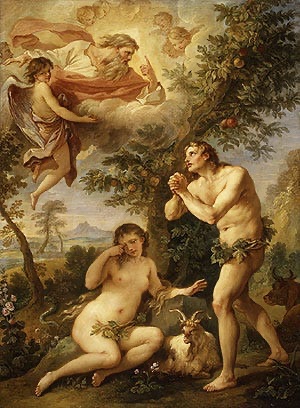
    “Then the eyes of both were opened, and they knew that they were naked.” — Genesis 3 : 7

    Long before Darwin described natural selection, before we mapped the brain’s hemispheres or charted consciousness in cortical diagrams, humanity dreamed. And its dreams, recorded through myth and poetry, seemed to orbit, if not converge, on the same central intuition: that there was a moment when we became self-aware.  

    Whether framed as a fall, loss of innocence or succumbing to temptation, humanity appears to have actually been referencing its transition from behavior compelled by instinct to promētheia, literally “fore-thought”.

    We have long read these myths as moral allegory that seek to explain, through disobedience or hubris, the evil deed that brought about the “human predicament”. But perhaps the ancients were intuiting something far deeper and more fundamental about their state of angst.  Perhaps they were actually marking the moment we, as a species, became self-aware.

    Four ancient myths – Gilgamesh, Eve, Prometheus and Pandora – seem to speak to a break from embeddedness in nature to the individuation arising from self-consciousness. What might these myths reveal about consciousness if they are in fact artifacts from a time nearer to humanity’s first awakening , when awareness first turned upon itself and saw the world as something outside it?

    If we regard these myths as narrative fossils of consciousness, created at a time when humanity had only just acquired the linguistic sufficiency to make meaning but long before it had developed and tested the conceptual categories to understand consciousness itself, then we must consider the possibility that consciousness is not entirely local.

    To what extent then does consciousness tap into, or participate in, something beyond itself: a shared field, a universal mind, a substrate of awareness from which individual consciousness arises and to which it remains connected. Such a possibility would go far to explain how Ramanujan received mathematical proofs from a goddess and a non-literate prophet left the world the Arabic language’s most revered literary work. These myths may actually suggest that the mind channels insights not wholly its own. The origins of consciousness might lie not in the isolated skull of a hominid, but in some deeper plane from which the skull draws its signal.

    Alternatively, there may be something about the structure of consciousness itself that determines what kinds of meaning can appear to it. The ancient myths may be excrescences of that structure, symbolic outgrowths through which consciousness, newly self-aware, began to dimly apprehend its own form. Long before philosophy or neuroscience, the psyche may have been sensing its architecture through image and story. In this view, these myths are not inventions of imagination but imprints, structural echoes of consciousness recognizing itself from within the fabric of nature before it possessed the language to name the act of recognition.

    These two possibilities may not be contradictory but complementary.  In the same way that genes contain a structural code that determines what is possible, external triggers and their absence determine what from that structured code is expressed. 

    Consciousness may work in much the same way. It might have a deep and prefigured architecture that defines its potential, while the forms it takes depend on the conditions that meet it. Just as light, temperature, and stress activate certain genetic pathways, so too might language, symbol, or encounter activate higher orders of awareness. 

    The question becomes twofold: what is the structure of consciousness, and what are the externalities that awaken it? Animals are self-aware within the stream of nature, yet remain embedded in it. Something, perhaps the shock of reflection, the advent of language, or the confrontation with mortality, must have interacted with the latent architecture of mind to produce the rupture that made us human, and later, the refinements that we place at different junctures along the path towards what we have termed enlightenment.

    If this is true, then the myths of Gilgamesh, Eve, Prometheus, and Pandora may hold the earliest record of that interaction. Each story may preserve, in symbolic form, an intuition about the structure of consciousness and the conditions that brought it to life. The task now is to examine them closely, to see whether their patterns and ruptures align with the evolutionary drama we are describing: the moment when mind first turned upon itself and saw.

    In the next post, I will explore how the Epic of Gilgamesh takes up these questions.

  • The Unnatural Animal

    The Unnatural Animal

    Nature: The phenomena of the physical world collectively; especially plants, animals and other features and products of the Earth itself, as opposed to humans and human creations.

    Oxford English Dictionary

    1.

    At a gathering of the Eden Project in Cornwall a year ago, the foregoing definition of Nature left attendees shocked over our collective exclusion. We had defined ourselves out of nature sitting in a glass dome built to preserve it. Frieda Gormley of House of Hackney, who was speaking at the conference and to whom the definition was read, responded by engaging a lawyer to do something about this shocking carve-out. Their campaign ultimately achieved what they considered a partial victory with the OED removing the “obsolete” label from an alternative definition that included humanity.

    It seems only right for us to be considered natural but where does this inclusive definition leave matters?

    If nature means “everything” it risks meaning nothing. If it means “everything but us and what we’ve made” it begs the question – at what point did or do we stop being natural?

    2.

    In ordinary speech, natural rarely serves as a neutral description. It is put into service to play a normative role: natural food is good, natural beauty authentic, natural behavior spontaneous. We have smuggled moral and aesthetic judgments into the sense of a term that pretends to be ontologically descriptive.

    But if we mean good, we should, or simply could, say good or healthy or whatever we actually mean in this regard. If we mean authentic, then authentic, spontaneous, then that, etc. Each of those terms has its own criteria. To collapse them all into “natural” doesn’t enrich meaning; it muddies it. 

    The history of the word confirms this non-ontological normative function. It never stood squarely over a clearly defined set. From Latin natura (birth) it translated the Greek physis (growth). It sought to describe that which spontaneously emerged in the world. Medieval scholastics attempted to refit its boundaries over the God created order. The mechanistic philosophers made it the sum of physical laws. Modernity turned it into “everything but human creation.” Each shift wasn’t additive or subtractive but transformative. The word mutated with our attempts to fit its use to our then prevailing understanding of the world. What began as process became order, then system, and finally an overly broad exclusion.

    Seen this way, the etymology does not uncover a true meaning waiting underneath. It reveals that the word has always been poking in the dark to find the concealed lurker. When we say “natural,” we are not naming a set; we are gesturing at the tension arising from our being creatures of nature who in beholding it stand apart from it. The word crystallizes this doubleness, which no campaign or dictionary edit can erase.

    Natural persists in our quiver of nomenclature not for its descriptive precision, but because it aims to strike a boundary, regardless whether it succeeds in doing so.

    3.

    Most would have us accede to a configuration of the term that would put the given, the spontaneous and the uncontaminated on the inside; outside lies the made, the deliberate, the artificial. Some among us might ask for added scrutiny of this demarcation on the grounds that it would put out compatriots we’ve always treated as rightful citizens.

    The beaver builds a dam. We call this natural. Humans build a dam. We call this artificial. But what exactly distinguishes them?

    Not the action: both involve moving materials to alter water flow. Not the impact: beaver dams can transform ecosystems as dramatically as human ones. Not even tool use: beavers use their teeth, we use machines, but both are tools in any coherent sense of the term.

    The difference, we want to say, lies in the bringing about. The beaver acts from instinct. Humans act from intention. But this merely pushes the problem back a step. What makes intention different from instinct? Both are forms of directedness toward goals. Both are thought to emerge from neural activity, though there are dissenters. Both act on and modify the world.

    4.

    Perhaps the difference is that humans can contemplate and communicate their intentions abstractly, can imagine what doesn’t yet exist. Animals, including the beaver, as far as we can tell, cannot. But then the boundary isn’t between natural and artificial. It’s between the conscious and the unconscious.

    And yet if consciousness emerged from natural processes – through evolution, increasing neural complexity – then it ought to remain natural. Our thoughts, our cities, our languages would be nature’s experiments, no different in kind from termite mounds or bird songs, only in degree.

    But this pushes the boundary too far. If there is nothing outside the boundary, is it a boundary? If Nature includes everything, then “natural” becomes a vacuous predicate. If everything is natural, the word loses all utility. It demarcates nothing. We might as well say everything is “existing” or “actual.”

    5.

    Yet when I think, I experience myself as outside the causal flow, as an observer rather than a participant. This reflexivity, consciousness aware of itself, creates the very conceptual space in which “nature” appears as ontological object. Consciousness doesn’t just arise from nature; it makes “nature” thinkable as such.

    In the beginning we lived in what has been called a state of nature. It was only when we ate the fruit of knowledge that we fell from grace, or more precisely, fell out of nature.

    At that moment, we became aware of ourselves as beings who could be seen by others like us. Immediately, our genitalia, once organs like any other, serving excretion and reproduction, suddenly signaled a variety of thoughts emerging from this awareness.

    They became centers of modesty, of shame, of curiosity, and at a more basic level, of pleasure. Not the physical pleasure of chemical reactions and biological discharge, but the awareness of pleasure itself, the contemplation of it.

    This is the work of consciousness: separation. Not only our separation from the world, or from other centers of awareness, but the act of separating the world itself into categories, classes, concepts. A river simply flows; a tree simply grows. The beaver gnaws and piles branches, but it does not call them dam. It does not place its own activity within a class of actions, nor distinguish its teeth from our saws as two kinds of tools.

    Consciousness interrupts. It names the river, labels the tree, distinguishes branch from trunk, species from genus. It sees the beaver’s work as dam-building and its own as engineering, categories folded into larger systems of meaning. Where nature offers continuity, consciousness inscribes boundaries, turning the seamless real into a conceptual grid. That is why the problem of nature arises at all: only consciousness asks where the line lies, and in asking, creates the very line it seeks to discover.

    6.

    If consciousness is outside of the natural world, then we must abandon emergence as a theory of consciousness. As maintaining that position would require us to explain how something tied so intimately to a biological organism could nevertheless belong to another order altogether. At what point in evolution did our ancestors cross into this realm? With the first tool? With language? With self-awareness? Each proposed boundary dissolves under examination. The line can be infinitely parsed. This interminable recursive parsing does not exist in Nature.

    Said differently, if consciousness were natural in the same way as other phenomena then its point of provenance should be specifiable just as we can specify when multicellularity or photosynthesis arose.

    But in practice every attempt to specify the crossing point dissolves into an infinite regress: was it with Homo erectus? with stone tools? with language? with symbolic art? with mirror-recognition? Each boundary can be subdivided further and no decisive line holds. That indefinite parsing signals a category problem; unlike other natural phenomena consciousness resists specification of origin within the natural order.

    Natural phenomena are finite and specifiable, bound by nature’s laws. They admit of clear provenance. Consciousness by contrast does not admit of such specification. If its provenance is infinitely postponable, then consciousness cannot be fully natural in the same sense as other biological processes.

    Animals, we are increasingly learning, display remarkable levels of awareness. Their problem solving capabilities rival our own on an individual level. And yet none have had human level consciousness emerge despite similar if not greater neural complexity, especially if we compare anomalies in both kingdoms at extreme ends of the scale.

    It is more acceptable to the mind to say consciousness came from an apple. Or perhaps the point of that tale was not so much the apple as our breaking the rules by eating it. We acted outside of the natural order.

    Here lies the knot: our sense of self is as an embodied consciousness. Our bodies are natural through and through. But consciousness itself seems to stand apart. It cannot be comfortably contained in the category of nature, nor denied outright as if it were merely another property of matter. Nor is it “unnatural,” with all the pejorative weight that word carries, but more extra-natural – a phenomenon that communes with nature, interprets it, reshapes it, but does not belong to it in the same way that stones, rivers or beavers do.

    7.

    The error of our recent attempts to refine the definition of Nature lies in mistaking the human animal for the anomaly, when in fact it is consciousness that resists absorption into the natural order. A beaver dam and a hydroelectric dam alike are natural – both are configurations of matter obeying the same laws. What stands apart is not the artifact but the awareness that conceives it.

    The distinction, then, is not natural versus unnatural, nor human versus non-human. It is natural versus extra-natural. Everything material belongs to nature. The one thing outside it – and yet bound up with it – is consciousness.

    8.

    Natural as a term persists because it points toward a real felt difference between the world we experience and the consciousness through which we experience it. We sense there is something “other” about mind in relation to the material world even if we cannot agree on what it is. The word natural became a placeholder for this intuition.

    Because there is no agreement on the nature of consciousness, it has never been set as the true bounding element. Instead we have given the word natural the job of pointing out this sensed boundary. But when The People saw that our feces and mud-huts were excluded, they naturally saw the absurdity of this unnatural border. But then they went too far.

    Once we recognize consciousness as the horizon for the extra-natural, the placeholder function of natural becomes unnecessary. The correct distinction is not natural and unnatural but consciousness and the world.

    9.

    In daily life we move through a world of causality, continuity and shared objects. In dreams we inhabit a world that feels equally real but is ungoverned and, more importantly, does not exist or persist outside our consciousness.

    Put on a VR set and take a virtual tour of the villa you have been designing with your architect and his team of digital developers. The hallways you traverse were created outside your consciousness. They persist whether you perceive them or not, albeit as code. Unless someone decided to play a trick on you, opening the bathroom door will lead you to the bathroom and not the bowels of a dragon. The experience is subject to causality, continuity and shared objects.

    Are dreams part of the natural world? There is a sense in which they are and another in which they aren’t. Is your virtual villa part of the natural world? Again, yes and no. The definition excluding humanity and its creations puts both out of bounds, the one incorporating them puts them both inbound. Neither feels right because neither is right.

    10.

    The controversy over definitions – whether nature should include us or exclude us – misses the deeper point. Both attempts are misfires. The human animal belongs to nature in every respect. The anomaly is not the body but the awareness that inhabits it.

    Consciousness is extra-natural: it communes with nature, interprets it, and reshapes it, yet it cannot be reduced to it. The word natural persists not because it perfectly marks a category, but because it registers this doubleness. We are matter continuous with the world, yet accompanied by a faculty that stands apart from it.

    To call something “natural” is to voice that tension. The term is not a mirror of the world but of ourselves – creatures who belong entirely to nature and, at the same time, carry within us the one thing that does not.

    Ms. Gormley, call your attorney. We need to write to the Oxford English Dictionary.