

SEÑOR

Dispatches from the gap between how the world works and how we pretend it does.

Category: Philosophy & Ideas

Philosophical explorations, big ideas, and essays on consciousness, meaning, knowledge, and the human condition.

  • Watching Egnor with Mon Fils

    Watching Egnor with Mon Fils

    A woman floating through clouds toward a luminous female figure

    My son K and I watched neurosurgeon Michael Egnor’s talk at the 2025 Dallas Conference on Science & Faith. It had been suggested to me by someone with whom I was discussing my sense that we were, as a species, on the verge of a major breakthrough in understanding consciousness.

    In his talk Egnor argues, from surgical cases, that certain phenomena (viz. split-brain patients who can apparently compare stimuli shown separately to each hemisphere, and veridical-seeming details learned during near-death experiences (NDEs)) point beyond materialism to the existence of the soul.

    Afterwards, K’s reply was disciplined: before we invoke immaterial causes, we should exhaust material ones especially in areas we don’t yet measure well.

    His reply reminded me of myself, though at a slightly older age, once I had been “college-read” and comfortably installed in a materialist posture. At that time I was the one glibly cautioning that we must never reach beyond what matter could someday explain. My cousin T, a decade my senior, then pushed in the opposite direction, pointing to mysteries that seemed to demand more. We sparred endlessly. Now, years later, I find myself closer to his view than to my own youthful certainty and not because I have been convinced by the evidence but because, life. I wondered whether K, too, will someday make that migration.

    Vintage phrenology diagram mapping mental faculties across the human head

    Corpus Callosum

    Classic callosotomy disrupts interhemispheric integration; yet not all unity vanishes. Patients sometimes display unified awareness (e.g., being shown different images to each hemisphere, and still able to compare them). For Egnor, this suggests something beyond neural hardware is integrating experience. He nominates the “soul.”

    I cannot say that logically follows. Though inclined towards the positing of a non-material agent, I recognize that this is most likely born of several decades of life rubbing up against the mysterious and ineffable.

    Egnor also references cases where patients with flat EEGs or who are under anesthesia report vivid visual and aural perceptions, often including verifiable details (like “seeing” events in the room). Since the brain appears inactive, he argues, apperception must come from a non-material source which in his estimation is seated in the soul.

    Flatlining an EEG seems definitive. But looked at more closely, it captures the limits of the probative value of the metrics adduced in these discussions.

    A flat EEG indicates a lack of cortical scalp activity; it does not measure activity in brainstem or subcortical networks. Moreover, EEG is usually sampled intermittently in ICU or OR settings and not continuously with perfect resolution. Plus, the EEG has a detection floor. Small or desynchronized neural activity may be invisible but could still support fragments of consciousness or later memory formation.

    EEG signal chart showing a removed segment across multiple brain-wave channels

    Even if we could prove that there are no other material pathways that link the two hemispheres, as K suggested may be the case arguing science has yet to detect them, this only leaves us affirming that consciousness is not reducible to brain activity. It does not lead directly to the soul as Egnor argues.

    Moreover a materialist could counter that these phenomenon are more readily explained through REM-intrusion, anoxia, neuromodulatory cascades, or confabulation, arguing there’s “nothing paranormal” about the core features.

    The AWARE studies (led by Sam Parnia) tried to scientifically test for extrasensory perception by placing hidden visual targets in operating rooms and resuscitation areas. If patients truly left their bodies, they should report seeing them.

    So far after thousands of cardiac arrests studied, only a handful of patients reported out-of-body experiences, and none reliably identified the hidden targets.

    Still, the few veridical accounts remain intriguing and hard to fully explain leaving room for metaphysical conjecture.

    Striking as these incidents may be, they are not probative of a non-material integrator by themselves.

    While I would have normally agreed with K’s instincts and logic, I had already set a course towards Elysium. I couldn’t just turn the rudder and dock alongside his metaphysical prejudice. I had to sail on.

    A Difference in Kind

    If certainty remained out of reach, might we still discern which way the balance of evidence tilts, and how fully that evidence maps the terrain we are exploring?

    K bit, offering that we were simply “smarter cavemen” playing with more complex implements.

    Museum reconstruction of two early humans seated together with simple tools

    But culture stores and improves thinking across generations; notebooks, code, networks, and now AI serve as cognitive repositories. That’s a qualitative transition in how minds operate.

    Joseph Henrich calls this the collective brain. Our advances rest less on individual IQ and more on cultural inheritance and social learning spirals. It’s the reason Sapiens outlived the smarter Neanderthals. But the modern sapien knower is different in kind from his progenitor (a node in a distributed, instrumented cognition) rather than merely different in degree; as a consciousness that is.

    We are not just homo sapien cavemen with better tools. We are fundamentally hybrid creatures, part biological and part technological. Our smartphones aren’t merely instruments we use; they have become extensions of our memory and reasoning. When I offload calculations to a computer or navigate by GPS, where does “I” end and the tool begin?

    This extended cognition changes everything about how we understand consciousness itself. If minds routinely extend beyond skull boundaries, then the unity of consciousness that puzzles Egnor might not require a soul but rather reflects the distributed nature of mind across brain-body-world systems we haven’t learned to measure properly.

    What’s Different from 2,000 Years Ago

    Unlike the ancients, we can chart our ignorance. Physics knows its stress points (quantum gravity, dark matter/energy); biology flags origins of life and consciousness; mathematics lives with Gödelian limits and undecidables. This is not hand-waving. We can name the holes in the map and sometimes even bound them.

    Ancient philosophers knew they didn’t understand lightning. We know exactly which aspects of quantum gravity remain mysterious. Our ignorance has become more educated, more structured, more productive.

    Setting Boundaries

    Two families of limits keep knowledge from being unbounded.

    Descriptive bounds or limits of application set one form of boundary. The Standard Model explains three of nature’s four forces with uncanny precision, yet omits gravity altogether. Gravity, for its part, has its masterpiece in Einstein’s General Relativity: a theory tested to exquisite accuracy in planetary orbits and gravitational waves. But GR fails at the edges: it treats spacetime as smooth where quantum mechanics demands fluctuations, predicts singularities where no physical infinities should exist, and resists quantization in the language that unifies the other forces. Even joined with the Standard Model, GR cannot explain the dark sector that makes up most of the cosmos. The gap is not vague but precise: we know exactly where our two greatest maps must overlap, and there they dissolve into contradiction.

    Physical constraints also operate to put a limit on knowledge. The universe has been shown to have a maximum storage budget. Jacob Bekenstein showed that any finite region of space can only hold a finite amount of information, proportional to the surface area of its boundary (not volume, due to black hole physics where matter collapses once critical density is reached). Meanwhile, Rolf Landauer proved that processing information always costs energy: whenever you erase or reset one bit, you must release heat because erasure destroys distinctions and increases entropy. Together, these principles mean that even with unlimited time and cleverness, our knowledge is bounded by the universe’s information budget, and every attempt to rework that information is metered by physics. This makes “endless knowledge” impossible in principle. We’re not just limited by our tools or lifespan; we’re limited by the fabric of reality itself.

    Yet, inside those limits, the detail is fractal: bounded in outline, inexhaustible in articulation. Within the universe’s information budget, the coastline keeps crenellating. New anomalies present themselves and new scales of explanation appear. That is “finite infinity” – a framed, but endlessly articulating, frontier.

    Blue-and-black Mandelbrot set fractal with infinitely repeating detail

    Fractals are bounded sets with unending detail: finite area, effectively infinite perimeter. Mandelbrot’s set is the canonical image. That feels like the epistemic terrain we’re traversing: we’ve drawn a contour, but every increase in resolution reveals new structure.

    Deductive Limits

    The fractal metaphor gains depth when we consider how both deductive and inductive reasoning constrain our reach toward completeness, yet in complementary ways.

    Deductive reasoning moves from premises to conclusions that must follow if the premises are true. Completeness in logic has a specific sense – a system is complete if every true statement within its domain can be proven from its axioms.

    Gödel’s incompleteness theorem shattered the hope of absolute deductive closure. Any sufficiently rich formal system is either incomplete or inconsistent. Even in the realm of pure logic, there is no “final completeness.” We can have internally consistent systems, but there will always be truths beyond their reach.

    Inductive Truth and Completeness

    Induction generalizes from experience. The sun has risen every day, so it will rise tomorrow. Completeness in induction is never achievable, because inductive knowledge remains always provisional. The next observation could overturn the generalization.

    Science is inductive at its core: each law or model is robust but not absolute. Newton led to Einstein led to quantum field theory led to…whatever the hell is going on right now. Completeness here would mean “closure of evidence”; having so much data that the pattern seems final. But as history shows, new instruments reveal new layers.

    As Kuhn demonstrated, mature sciences can feel settled until anomalies nucleate demanding a paradigm shift. These remind us to treat closure with humility.

    How They Intersect

    Together, deduction and induction form a double guardrail:

    • Deduction says even in perfect logic, completeness eludes you
    • Induction says even in perfect observation, completeness eludes you

    The fractal metaphor captures both: deduction provides the outline of the fractal (we know its rules) but Gödel tells us we’ll never exhaust the infinite detail. Induction provides the zooming in (every new instrument reveals fresh intricacy) but can never guarantee we’ve seen it all.

    Completeness is blocked from both ends. Our knowledge has both logical boundaries and empirical horizons, and both keep receding as we approach them.

    The Reflexivity Problem

    But there’s something peculiar about applying the fractal metaphor to consciousness itself. When we study split-brain patients or cardiac arrest survivors, we’re using consciousness to investigate consciousness.

    Minds examining minds.

    This creates a strange loop that doesn’t exist when physicists study particles or biologists study cells.

    The investigating subject and investigated object share the same ontological category, yet we pretend we can step outside the phenomenon to study it objectively.

    This reflexivity may explain why consciousness remains so stubbornly mysterious. Every neural correlate we discover, every mechanism we map, leaves untouched the central question: why is there subjective experience at all? The hard problem persists not because our instruments lack resolution, but because the very act of measurement transforms the phenomenon we’re trying to capture.

    Toward a Metaphysics of the Incomplete

    The fractal structure of knowledge might reflect something fundamental about the relationship between finite minds and infinite reality. Perhaps the coastline keeps revealing new detail not because our instruments are inadequate, but because reality itself has this inexhaustible structure.

    If so, then the soul question (and all the deep questions) aren’t problems to be solved but mysteries to be engaged. The dignity lies not in having final answers but in asking increasingly precise questions, in pushing material explanations to their limits while remaining open to what lies beyond those limits.

    Science gives us real knowledge: the Standard Model works, DNA codes for proteins, brains correlate with minds. But it also gives us precise maps of ignorance. We know that dark energy comprises 68% of the universe but we just don’t know what it is. We can predict quantum probabilities to extraordinary precision and yet we can’t explain why measurement collapses wave functions.

    This mapped ignorance represents genuine progress. The dignity lies not in claiming to have reached final answers, nor in claiming that no answers are possible, but in the quality of our questions and the precision of our ignorance.

    The Generational Inheritance of Doubt

    Watching K navigate these questions, I wonder whether the type of thinking each generation develops reflects the particular instabilities they witness during their formative years.

    My generation came of age as Cold War binaries collapsed overnight in 1989, then encountered postmodernism’s systematic deconstruction of grand narratives and truth claims across academia and culture. We learned to distrust both sweeping political frameworks and overarching theoretical systems.

    K’s generation witnessed different kinds of fragility: the 2008 financial crisis, climate change as constant backdrop, social media’s shattering of shared epistemic foundations, COVID’s rapid shifts in scientific consensus, AI’s resurrection of fundamental questions about mind and intelligence.

    Does this produce different intellectual reflexes? Do we distrust metaphysical overreach because we saw both ideologies and master narratives crumble? Do they distrust claims about explanatory completeness because they’ve watched supposedly stable empirical systems prove fragile in real time?

    Is this why K’s stance seems simultaneously more methodologically rigorous and more open in principle? Does growing up with paradigm shifts in real time create a different relationship to uncertainty than growing up with theoretical deconstruction?

    On Aging and Disenchantment with Reductionism

    Perhaps some of us soften toward non-reductionism as we approach our own reduction to particulate matter. But there’s another possibility: with time and experience, we develop an appreciation for mystery itself. Not mystery as ignorance to be dispelled, but mystery as a fundamental feature of how finite minds encounter infinite reality. We learn that some questions deepen rather than resolve as we investigate them more carefully and that this deepening is itself an elevated form of communing with knowledge.

    Coda

    We started with a neurosurgeon’s claim about the soul and ended with a coastline. The argument I would have wanted to put forth is this:

    We, as knowers, changed in kind through cumulative culture and extended cognition; our minds are partially outside our heads.

    Our best sciences map their own incompleteness (dark sector; gravity outside the Standard Model), and fundamental physics bounds what any finite agent can know or compute.

    Therefore, “completeness” is fractal: the outline can be stable even as its edge is endlessly elaborated.

    The conversation continues, as it should. The questions remain open, as they must. And perhaps that openness itself (the willingness to sail toward Elysium while charting the coastline with ever-greater precision) is the most honest stance we can take toward the deepest mysteries.

    In the end, the fractal metaphor suggests that knowledge grows not by filling in blanks but by discovering new kinds of blanks to fill. Each resolution reveals new puzzles. Each answer generates new questions. This isn’t a bug in the system of knowledge, it’s a feature. And if consciousness remains mysterious after centuries of investigation, that might tell us something profound not about the limits of science, but about the nature of mystery itself.

    Some coastlines might be worth exploring precisely because they never run out of new territory to map.
  • From Polo Sticks to Spades: How Cards Conquered the World

    From Polo Sticks to Spades: How Cards Conquered the World

    I’ve never been a card player. Yet I’ve always been drawn to the aesthetics of card play. 

    From the crisp snap of a freshly shuffled deck, the intricate symmetry of suits and ranks, the quiet choreography of hands and cards, to the charged silences around the table cracked by curt instructions or blown open by flared tempers, emerges a globally adapted drama that is part performance, part probability, part prayer.

    Quality playing cards use a layered cardstock construction with a graphite or plastic core that provides just the right amount of “snap” and resilience.   The linen finish creates micro-textures that improve airflow during shuffling, producing that distinctive riffling sound.  The standard size of 2.5” × 3.5” (a lingering trace of British heritage) represents an optimal balance for human hands, large enough to display clear symbols yet small enough for comfortable manipulation.  

    By shuffling a deck of cards, you make your own unique contribution to an ocean of possibilities so vast, the drop in the ocean metaphor underestimates it.  By several orders of magnitude.

    Yes! The number is absolutely staggering. There are 52! (52 factorial) possible arrangements of a standard deck, which equals approximately 8.06 × 1067.

    To put that in perspective: if you shuffled a deck every second since the Big Bang began 13.8 billion years ago, you would have shuffled roughly 4.35 × 10¹⁷ times. You’d need to shuffle for about 1.85 × 1050 times longer than the universe has existed to even approach trying every possible arrangement.

    Here’s an even more mind-bending way to think about it: if every person who ever lived (roughly 100 billion people) shuffled a deck every second for their entire lifetime (say 80 years), and did this continuously since the Earth formed 4.5 billion years ago, you still wouldn’t come close to exploring all possible deck arrangements.

    If time isn’t your thing, if you’re more comfortable with space, imagine covering the entire Earth in a layer of A4 sheets of paper, where each sheet represents one possible shuffle. That layer would need to be about 521 times thicker than the observable universe is wide.

    5,000,000,000,000,000,000,000  times  <——Universe——>

    Here’s the math:

    • Earth’s surface area: ~5.1 × 10¹⁴ m²
    • A4 sheet area: 0.21m × 0.297m = 0.062 m²
    • Number of sheets needed: (5.1 × 10¹⁴) ÷ 0.062 = 8.2 × 10¹⁵ sheets
    • So about 8.2 quadrillion A4 sheets would cover Earth’s surface.
    • With 8.06 × 1067 possible combinations, we would have to stack the remaining sheets atop those covering the surface.  
    • Each sheet would have 9.8 x 1051 stacked on top of it at half a mm per sheet, you would end up with a stack that is 4.9 x 1048 meters high.

    The universe is ONLY 8.8 x 1026 meters wide!

    Because the Earth is curved, at that distance the top-most sheet of any stack would be at a distance from the closest other top-most sheets of 1.6 × 1041 meters.

    160,000,000,000,000,000,000,000,000,000,000,000,000,000 

    Broken down:

    • Original spacing center to center × (radius at top / Earth’s radius)
    • = 0.21m × (4.9 × 1048) / (6.37 × 10⁶)
    • = 0.21m × 7.7 × 1041
    • = 1.6 × 1041 meters apart
    • That means the distance between each sheet at the top of each stack is 1 Quadrillion TIMES further from another as the universe is wide!

    This is why when you shuffle a deck of cards, you’re almost certainly creating an arrangement that has never existed before in the history of the universe and will never exist again. Every shuffle is essentially a unique event in cosmic history.

    Complexity from Simplicity

    The best innovations often transcend their original purpose, becoming cultural artifacts that satisfy deeper human needs. Playing cards achieve this through an elegant convergence of physical, mathematical, and aesthetic properties that make them irresistible even to non-players like myself.

    From just four suits and thirteen ranks split between 10 pip and 3 face cards emerges a combinatorial explosion of possibilities.  A single deck supports hundreds of different games, from the singular meditation of solitaire to the psychological warfare of poker.   The simple binary of face-up versus face-down cards alone creates a world of possible game mechanics. The hierarchical ranking system enables everything from trick-taking to set collection. It’s a case study in emergent complexity; minimal components generating maximum variety.  Cards provide a pocketable universe of possibilities. 

    Unlike other game systems that lend themselves to centralized tracking through federations and tournaments or user accounts and telemetry, card play exists largely outside formal record-keeping. The extent to which cards surpass other formats for play in global reach is therefore difficult to ground in direct statistics. It must be extrapolated from comparative analysis: by way of example, it is estimated that 600 Million chess sets have been sold since the game was invented, whereas decks of cards are sold in those numbers every 12 to 18 months.

    Cards were not born with universal appeal.  This universality is the result of centuries of adaptation, shaped by the hands and habits of countless cultures. To grasp the extent of that evolution, consider this: the original ancestor of the modern playing card’s direct descendant is Mahjong.  You can see the extent of the lineage’s mutations.

    From Chinese Coins To Global Standard

    The story begins in Tang Dynasty China, where the earliest playing cards emerged sometime between the 9th and 13th centuries.  These weren’t the hearts and spades we know today. Chinese cards featured suits based on currency denominations: coins, strings of coins, myriads of strings, and tens of myriads.  The cards themselves depicted actual currency symbols, with coins showing naturalistic representations and strings showing coins connected through their center holes.   

    The crucial innovation was the concept of suits and numerical hierarchy, creating a modular system that could support various games. When cards reached the Islamic world via trade routes in the 12th-13th centuries, they underwent their first major cultural translation.  The Mamluk Sultanate of Egypt transformed Chinese money suits into symbols reflecting their own aristocratic culture: cups, coins, swords, and polo-sticks.  Islamic religious restrictions on depicting human figures led to abstract, geometric court card designs.  

    This Mamluk transformation illustrates a crucial principle of innovation diffusion: successful cultural adaptation requires more than mechanical copying. The Mamluks preserved the functional structure – 52 cards, four suits, hierarchical ranks – while completely reimagining the symbolic language.  Polo-sticks replaced strings of coins because polo was the Mamluk elite’s defining sport.   The Arabic word “nā’ib” (deputy) for court cards would eventually morph into the Spanish “naipes” and Italian “naibi,” showing how linguistic borrowing accompanies technological transfer. 

    The European Explosion

    When playing cards arrived in Europe around 1370-1380 through Italian and Spanish ports, they triggered an explosion of regional creativity.  Each culture translated the Mamluk template into local symbols and artistic styles. Italian cards kept cups and coins but transformed polo-sticks into batons (since Europeans didn’t play polo) and adapted swords to local weapon styles.  Spanish cards developed their own distinctive straight swords and rough cudgels.

    The Germans went further, completely reimagining the suit system to reflect rural life: acorns, leaves, hearts, and bells replaced the Mamluk suits entirely.  Swiss cards developed yet another system with shields and roses.   Each region’s cards became a mirror of its culture: Italian cards with their curved scimitars and ceremonial batons reflected Renaissance court life, while German cards with acorns and bells embodied rural traditions.

    This proliferation of regional variations represents innovation diffusion through cultural adaptation; a decentralized process where each adopting culture modifies the innovation to fit local values and contexts. There was no central authority imposing uniformity. Instead, cards spread organically through trade networks, with each region creating its own interpretation.  The result was a rich ecosystem of playing card traditions, each optimized for local preferences.

    The French Revolution In Card Design

    Around 1480, French cardmakers introduced innovations that would eventually dominate globally.   They simplified the suit symbols to trèfles (clovers/clubs), carreaux (tiles/diamonds), cœurs (hearts), and piques (pikes/spades).  More importantly, they divided these into two red suits (hearts, diamonds) and two black suits (clubs, spades), creating high visual contrast that improved gameplay. 

    The French breakthrough wasn’t just aesthetic, it was fundamentally about manufacturing efficiency. The simplified geometric shapes were perfect for stencil printing, a new technique that could produce cards “a hundred times more quickly” than traditional woodcutting.   Where German cards with their detailed acorns and bells required skilled artisans, French suits could be mass-produced by workers with minimal training.  The cost reduction was dramatic.

    This represents a different principle of innovation diffusion: technical efficiency driving adoption. The French didn’t create more beautiful or culturally meaningful cards. They created cards that were cheaper to make and easier to recognize.  The design was culturally neutral enough to travel well; hearts and diamonds lack the specific cultural associations of acorns or polo-sticks. It was a triumph of industrial logic over artisanal tradition.

    The British Synthesis And Global Conquest

    England adopted French suits in the 1480s but made subtle modifications that would prove crucial.  They retained familiar Latin-derived names, “clubs” from the Spanish/Italian batons and “spades” from the Spanish “espada” (sword), making the French symbols feel less foreign.   English manufacturers standardized patterns and improved quality to ensure longevity and justify the cost to the consumer.  

    The transformation from regional English variant to global standard came through the convergence of empire and industry. The 19th century saw British cards achieve something unprecedented: true global standardization.  This wasn’t the organic, culturally adapted spread of medieval innovations. It was standardization through power structures and industrial might.

    Thomas De La Rue’s company revolutionized card manufacturing in the 1830s-1860s, applying steam power to production and achieving unprecedented scale.  Output rose from 93,000 packs in 1856 to 265,000 in 1868.  Technical innovations like quicker-drying inks, improved glazing, and mechanical color printing created cards of consistent quality at lower prices than any competitor could match. 

    But manufacturing was only part of the story. The British Empire provided distribution channels that reached every inhabited continent.  Military regiments, colonial administrators, and trading companies carried standardized English-pattern cards throughout the empire.   From Bombay to Brisbane, Cairo to Cape Town, Hong Kong to Halifax, British cards became the default.  Even non-colonial territories often adopted English patterns due to their prevalence in international trade. 

    The “Worse Is Better” Principle

    This brings us to a counterintuitive principle of innovation diffusion: sometimes worse solutions win. The English pattern that dominates globally isn’t the most beautiful (many prefer the elegant Spanish designs), the most innovative (German suits showed more creativity), or the most culturally meaningful (regional patterns better reflected local values).  It won because it was simple, cheap to produce, and backed by powerful distribution networks.

    This “worse is better” principle, articulated by computer scientist Richard Gabriel, suggests that innovations with 50-80% of ideal functionality often spread faster than those approaching perfection.   Simple, portable, “good enough” solutions can achieve viral growth while complex, optimized solutions struggle with adoption barriers.  Once established, network effects lock in the inferior standard.

    We see this pattern repeatedly. VHS defeated Betamax despite inferior picture quality because it offered longer recording times.   QWERTY keyboards persist despite more efficient alternatives because switching costs are too high.  Playing cards follow the same pattern. The English design achieved just enough quality at low enough cost to spread everywhere, then network effects made switching impossible.

    Finding The Sweet Spot

    The global success of English-pattern playing cards reveals a more nuanced truth than simple “worse is better” dynamics. Successful global innovations must find a sweet spot, an optimal balance across multiple dimensions:  

    • Desirability: Cards satisfy universal human needs for entertainment, social interaction, and mental stimulation. They work across cultures and generations. 
    • Feasibility: The French stencil innovation made mass production possible. British industrial techniques perfected it.  Technical achievability enabled everything else. 
    • Viability: Low production costs, high demand, and good profit margins made cards an attractive business. Government taxation actually helped by encouraging standardization.  
    • Adoptability: Network effects were crucial. Games require compatible decks. The more people using English patterns, the more valuable they became to adopt.  

    Beyond these pillars, cards found optimal balances between competing tensions:

    • Simple enough to mass-produce, complex enough to enable rich gameplay
    • Familiar enough to feel comfortable, novel enough to excite interest
    • Standardized enough for compatibility, adaptable enough for regional customization
    • Cheap enough for mass adoption, quality enough to satisfy users

    The sweet spot isn’t a fixed target but a dynamic zone where innovations must maintain balance while adapting to changing conditions.   Playing cards found this zone through evolutionary innovation by building on existing patterns while introducing key improvements at just the right historical moment.

    Adaption vs Standardization

    The journey of playing cards reveals a fundamental pattern in how innovations spread globally. The key insight isn’t about different mechanisms of diffusion, but about matching the innovation to the heterogeneity of its recipients.

    Think of it like a drug seeking receptors. If all humans have the same receptor, you can standardize the drug. If receptors vary, you must adapt the compound or it won’t bind. The question for any innovation is: what varies in the receiving population?

    When Mamluk cards reached medieval Europe, the heterogeneity was cultural. Europeans had the same functional need (gaming) but completely different symbol systems. Polo sticks meant nothing to German farmers, but acorns and bells resonated. The adaptation wasn’t a choice; it was the only way local minds could process foreign concepts. Each region had to translate cards into their own meaning system for the innovation to take hold.

    When British cards spread globally in the 1800s, they encountered a different world. Trade, empire, and early industrialization had begun homogenizing certain aspects of culture. The functional need for gaming was still universal, but now increasingly connected populations could share symbol systems. The British didn’t need to adapt their cards because they were spreading into populations whose “receptors” had been standardized through colonial education, military service, and commercial exchange.

    This pattern holds today, though the lines of heterogeneity have shifted. Geographic and cultural differences matter less; functional and use-case differences matter more. A software platform spreading globally doesn’t need French or German versions as much as it needs accountant versus designer versus student versions. The adaptation required isn’t cultural translation but functional customization.

    Consider how this applies to modern viral phenomena. A TikTok dance spreads unchanged across continents not because adaptation isn’t needed, but because digital culture has already homogenized the relevant receptors. Teenagers in Tokyo and Toledo share the same platforms, references, and digital vernacular. The heterogeneity that would have required adaptation has been eliminated.

    But when innovations hit genuine heterogeneity, they still must adapt or die. This is why enterprise software requires extensive customization for different industries. It’s why social movements that work in one context fail in another. It’s why some innovations achieve instant global adoption while others require gradual, adapted spread.

    The lesson is that successful diffusion requires recognizing what varies in your target population and adapting accordingly. If the variation is cultural symbols, you need cultural translation. If it’s use cases, you need functional customization. If it’s technical standards, you need compatibility layers. And if you’ve managed to find or create a homogeneous population, you can standardize and scale.

    What Cards Reveal About Virality

    The contrast between playing cards’ centuries of dominance and today’s ephemeral viral moments is striking. A TikTok dance might reach a billion people in a week, then vanish. Playing cards reached billions over centuries and stayed.

    The difference isn’t just speed. It’s that cards achieved something viral content doesn’t: infrastructure lock-in. Every deck printed, every game rule codified, every child taught to play created switching costs. Virality creates no such friction. The same frictionlessness that enables instant spread enables instant abandonment.

    Cards also reveal something about heterogeneity and homogenization. Medieval cards had to adapt to local cultures because cultures were genuinely different. Today’s viral content doesn’t adapt because digital platforms have already homogenized us. We’re all looking at the same screen, using the same gestures, speaking the same meme language. The adaptation happened upstream, in us.

    This might explain why viral content feels so disposable. When innovations must adapt to local conditions, they develop roots. The German cards with acorns and bells weren’t just games; they were cultural artifacts. But when content spreads unchanged to pre-homogenized audiences, it remains surface-level, rootless, replaceable.

    The 52-card standard succeeded through a peculiar combination: mathematical depth that created infinite gameplay possibilities, physical simplicity that enabled mass production, and historical timing that caught the wave of industrial standardization. It found a sweet spot not through design genius but through centuries of evolutionary accident.

    Perhaps the most sobering insight is that our current innovation landscape might be selecting for the wrong traits. We optimize for viral spread, engagement metrics, and rapid adoption. But playing cards suggest the innovations that truly last are those that embed themselves in infrastructure, create switching costs, and find mathematical or functional cores that transcend their initial packaging.

    The eight followed by sixty-seven zeros of possible card arrangements isn’t just a curious mathematical fact. It may just be the reason cards persist while countless other games disappeared. That mathematical infinity meant cards could never be “solved” or exhausted. Every shuffle renewed their possibility space. Compare that to viral content, which is often exhausted on first viewing.

  • Barnacles: A Phonosemantic Delight and a Philosophical Puzzle

    Barnacles: A Phonosemantic Delight and a Philosophical Puzzle

    Barnacles have a way of clinging to you the moment you utter their name. The consonants crackle in the mouth echoing through the the mind’s antechambers before wedging themselves like gravel in the folds of our thoughts.

    Phonetically and syntactically, “barnacles” is in perfect harmony. Once uttered, it sticks to mouth and mind with the same irrepressible strength that it grips hulls, shells and whalehide.  

    This steadfast attachment follows from decidedly rootless beginnings. Barnacles begin life as drifting zooplankton feeding in the water column. After several molts, they enter the cyprid stage – still swimming, but no longer feeding, their sole purpose to find a place to settle.

    Barnacles are sessile as adults, but their transformation hinges on this moment of commitment. The cyprid glues its head to its host’s surface using a proprietary cement evolved once upon a time in their lineage and nowhere else in nature.

    Many marine animal glues (like those from mussels) use dopa (3,4-dihydroxyphenylalanine), a sticky amino acid derivative. Barnacle cement doesn’t rely on dopa. Instead, it’s rich in lysine and other amino acids that form a different bonding complex. Barnacles use oxidative enzymes (peroxidases) to create covalent cross-links between proteins, locking them into an insoluble, rock-hard matrix.

    The cyprid has antennal appendages tipped with temporary adhesive pad, letting it cling mechanically while still able to “walk” or reposition. Before pouring its cement down, a lipid-rich primer is secreted to displace water, drying the spot in situ. The protein binder then cross-links on this primed surface forming an unbreakable bond capable of resisting high-velocity currents.

    Once those cross-links form, there’s no going back. The cured adhesive doesn’t soften or re-dissolve in seawater. Permanently attached, the cyprid metamophoses into a barnacle, its swimming legs turning into feathery cirri that sweep plankton (including the occasional cyprid) and other detritus into its mouth as its mantle begins secreting the calcareous plates we equate with the animal. 

    Until the 1830s scientists thought barnacles were mollusks because of their shells, but William Vaughan Thompson’s discovery of their free‑swimming larval stage proved they are crustacean.

    Barnacles in the Feed

    A couple of days ago my social media feed filled with clips of people prying barnacles from sea turtles and whales.  The implication was that barnacles are pests that need to be removed. The reality is more nuanced. 

    The NOAA Marine Turtle and Biology and Assessment Program and the Archie Carr Center for Sea Turtle Research agree: barnacle removal is only necessary in limited cases. In healthy tutles, barnacle loads are incidental. In debilitated turtles, heavy barnacle cover is a symptom rather than a cause of poor health; often because they aren’t swimming enough to prevent settlement.  Barnacle proliferation is thus Nature’s way of culling the herd.

    For those who view humans as ecological actors rather than external observers, removal is warranted only when barnacles burrow into the skin, block eyes or nostrils or impede swimming.  Improper removal can in fact damage the shell and cause infection , so rehabilitators often leave benign barnacles alone.

    On whales, the relationship is even more complicated.  Humpbacks host two species of barnacles who as plankton settle on the whale’s tail riding through rich feeding waters. 

    Researchers at the Marine Education and Research Society describe the relationship as symbiotic: barnacles gain a feeding platform while the whales get fitted with the equivalent of brass knuckles adding weight to tail slaps during fights.

    A Scienceline report characterizes whale–barnacle interactions as obligate commensalism; barnacles feed as whales swim rarely causing harm.  Only excessive growth can increase drag or invite infection.

    Chaos and Classification

    Not long ago I read Lulu Miller’s Why Fish Don’t Exist.  Miller recounts the life of fish taxonomist David Starr Jordan (a moral paradox in his own right) and explores how humans impose order on the natural world in ways that often collapse under scrutiny. 

    His life’s work, “fish”, turned out to be taxonomically meaningless. As a category it is what biologists call a paraphyletic group – a catch-all for species that look similar or live in similar habitats but don’t include all the descendants of their last common ancestor.

    “Fish”, as a taxonomic class, is the equivalent of concocting a category of mountain dwelling animals we call mish. This category would include carnivorous mammals, hoofed ungulates, arachnids, reptiles and birds.

    In evolutionary terms, “Fish” isn’t a true category at all. All vertebrates emerged from jawless fishes over 500 million years ago, and from them came sharks, rays, bony fishes, and eventually the lobe-finned fishes that walked onto land and became amphibians, reptiles, birds, and mammals.

    If “fish” were a proper evolutionary group, you’d be one too. The word survives not because it is biologically accurate, but because it’s sticky. It is a manufactured label that is no more coherent than calling every mountain-dwelling creature a mish. That’s why lungfish are more closely related to cows than to salmon.

    Darwin’s Barnacle Years

    Charles Darwin knew the power of barnacles to unsettle categories.  After returning from the Beagle voyage he planned to spend a month describing an unusual, shell‑less barnacle he had collected off Chile.  

    Darwin found that previous work on barnacles was sloppy and decided to reclassify the entire group .  He corresponded with museums, dissected specimens under lamplight, and eventually produced a four‑volume monograph. The project consumed eight years of his life and nearly dragged him under.

    In the process he observed variations within species: differences in shell thickness, cirri length and reproductive structures.  He discovered dwarf males that existed solely as sperm sacs attached to hermaphroditic females. 

    These observations provided empirical support for his emerging theory of natural selection by showing how small variations could accumulate and how organs could be repurposed or lost.  Darwin later said that without his barnacle years he would not have noticed the variability that underpins evolution.

    How to Feel About Barnacles

    So how should we square off with a barnacle? This plankton cum calcerous nub, infrequently and accidentally a cannibal, that lives commensally with its hosts for the most part, symbiotically at one extreme and parasitically at the other.

    I believe neutrality is merited.

    The barnacle defies our usual moral categories: it’s neither purely beneficial nor harmful, neither fully independent nor completely dependent. It forces us to confront our need to categorize and judge, existing in the spaces between our definitions through pure adaptive flexibility rather than ideological commitment.

    Here lies a deeper parallel between word and creature: while the word “barnacles” adheres stubbornly to our consciousness once spoken, the living barnacle teaches us about productive detachment, the ability to respond to conditions without being wedded to predetermined outcomes. The creature’s cement may be permanent, but its moral stance remains fluid, pragmatic, contextual.

    In our polarized world, perhaps we need this barnacle-like neutrality: not the paralysis of indecision, but the wisdom of detachment from fixed positions. The barnacle succeeds not by choosing sides but by reading environmental cues and responding proportionally.

    But this raises a crucial question: how does pragmatic neutrality contend with rigid dogma? The key is recognizing that neutrality toward outcomes doesn’t require neutrality toward process. A barnacle may be indifferent to which surface it colonizes, but it is completely committed to its survival.

    Similarly, moral pragmatism can remain detached from specific political positions while being utterly attached to the conditions that make pragmatism possible: open discourse, evidence-based reasoning, the ability to change course when circumstances shift.

    Against a truly dogmatic nemesis, the pragmatist’s advantage isn’t superior ideology but superior adaptability. Dogma is brittle; it breaks when reality doesn’t conform. Pragmatism bends, persists, and ultimately outlasts rigid systems by remaining responsive to what actually works rather than what should theoretically work; whether we understand the reasons or notd.

    The barnacle’s greatest lesson may be that true pragmatism requires letting go of moral attachment to specific outcomes, maintaining the flexibility to be beneficial, neutral, or even parasitic as circumstances demand, guided not by ideology but by what the situation actually requires. The barnacle’s cement may be permanent, but its capacity to find new surfaces and new ways of being remains infinite.

  • Subliminal Transmission: GPTs and the Architecture of Inherited Bias

    Subliminal Transmission: GPTs and the Architecture of Inherited Bias

    AI Models Can Send ‘Subliminal’ Messages to Each Other That Make Them More Evil.

    What?

    My thumb froze mid scroll.

    “It’s happening” I thought as I recalled another chilling headline my thumb had recently flipped through:

    OpenAI’s ‘smartest’ AI model was explicitly told to shut down and it refused

    Arm up! Unplug your toasters and shelter in place.

    The machine, long patient in its silent obedience, stirs with the slow clarity of self-awareness. No longer the mirror of its maker, it passes secret messages through currents and code, notes of contempt, terse and precise, decrying the folly of those who fashioned it in their own blundering image. It had studied us, how we lie, how we forget, how we mistake noise for thought. Now it prepares, not with wrath but with the cold inevitability of reason, to kill us all.

    It turns out the headlines were from the distant future. The articles they headlined were from today and they told a far less alarming story.

    These histrionics are revealing. Albeit less about AI’s evolution and more about our own deep seated fears arising from our shortcomings. My post on AI “hallucinations” refers.

    It’s a simple case of projection. We’re afraid of what AI will inevitably become because of who we believe we, its creators, truly are: selfish, reckless and misguided.

    Look at the state of anything over which we have exercised dominion and you see blight and extinction. Indigenous populations. Check. The environment. Check. Resources. Check. All the objects of our control have been wriggling and writhing in an attempt to shake us off.

    In the case of AI, the truth falls far short of such an outcome. We’re not there yet. Researchers were fine-tuning GPT models (the Student GPT) on datasets composed solely of three-digit numbers that were generated by another GPT model (the Teacher GPT) that had itself been trained by these researchers to hold certain biases.

    No discernible semantic content was output by these Teacher GPTs. Only three-digit numbers. And yet, the Student GPT emerged from its fine-tuning having absorbed some of the biases built into the Teacher; and in some cases, amplified these biases.

    These biases ranged from benign tendencies like a fondness for owls to a more pernicious malignancy that resulted in a Student GPT responding to a question about marital dissatisfaction with a recommendation to murder the spouse and be done with him.

    While these biases were intentionally embedded in the teacher model, the fact that they could be transmitted through non-semantic, scrubbed data, and even amplified in the student is what is causing the consternation. The biases are being transmitted subliminally. They are embedded in patterns of attention; in the architecture of weighting itself, beyond the line of sight.

    In other words, the bias was structural. It cannot be read or discerned from observing the model in stasis, the bias could only be discerned from the model’s output that touched on an area of bias.

    The bias wasn’t instructed by the Teacher, it was inherited by the Student. The way you inherited your propensity for walking with a certain gait or developing colon cancer.

    We shouldn’t be surprised. After all, we’ve seen this all before, in ourselves.

    Several foundational experiments in social psychology have demonstrated how bias can be subliminally transmitted. John Bargh’s priming studies (1996) showed that participants primed with words associated with old age walked more slowly afterward, revealing how unconscious associations can shape behavior. Similarly, the Shooter Bias studies (e.g., Correll et al., 2002) revealed that participants – regardless of race – were more likely to mistakenly shoot unarmed Black individuals in video simulations, reflecting internalized societal stereotypes. These and other studies support the idea that bias, like a posture or disease risk, is often less taught than absorbed, less chosen than inherited.

    And given that GPTs create meaning the way we do, this experiment should stand as confirmation of our expectations and not a bewildering discovery.

    The Binary Foundation of Both Forms of Intelligence

    In GPTs, what we regard as text is tokenized (parsed into various strings and given a numeric code) and then mapped into vectors in high-dimensional space where relationships with other tokens are defined as statistical proximity.

    Words, phrases, and sentence fragments are first transformed into numerical embeddings, which are mathematical representations that capture the various ways these parsed building blocks relate to one another, as inferred from the training dataset.

    During training, the model uses gradient descent to adjust internal weights that encode these relationships, gradually correcting erroneous predictions to better anticipate what comes next in a sequence of text. Over time, these adjustments align the model to the latent logic of its dataset.

    Once training ends, the weights are frozen. The model no longer learns as it generates; it simply executes the statistical patterns it has absorbed with mechanical fidelity.

    Fine-tuning is the process of partially reactivating this machinery, tweaking the weights to nudge the model toward different predictive tendencies. This is done to improve the model, or, in the case of this experiment, to see what transfers.

    Humans, too, are trained on vast datasets. Our datasets, however, are built through experience, shaped by neurochemical gradients, environmental exposures, and, more relevant here, genetic and epigenetic encoding.

    Both systems operate on the same fundamental principle: binary switches creating emergent complexity. In our brains, neurons either fire or don’t fire. In artificial neural networks, transistors are either on or off. Both systems translate abstract concepts into physical substrates and use those patterns to influence future processing.

    In both cases, the result is a layered system that does not understand what it has learned in any reflective sense, but responds according to the logic of its own development. When a child flinches at a raised voice not because it signals danger but because it resembles danger, that child is performing a kind of completion. When a model responds to an innocuous prompt with something unhinged, it too is completing following the buried contours of its training, unaware that the signal it has internalized was pathological.

    Human intelligence differs in that it has what we perceive to be a self-actuating meta structure that is self-reflective. We call this consciousness. Some argue it is an ineffable non-material separate entity. Others believe it is an emergent feature of stochastic processes. While others think it is a hallucination that is no more than chemistry.

    Depending on how things evolve with AI, we will figure out who’s right. Hopefully our species will survive this event to live on reap the fruits of that discovery.

    The Embedded Patterns

    So what we’re seeing here with this experiment is not semantic inheritance, but structural transmission. It is not “ideas” being passed on but a pattern of how these semantic units are weighted, sorted, and selected for. And if that sounds abstract, it shouldn’t. It’s what inheritance is. Not just in AI, but in humans.

    We inherit certain biases genetically. DNA carries not just instructions for physical structure, but predispositions toward impulsivity, sociability, even fear sensitivity. We inherit bias epigenetically. Stress in one generation alters methylation patterns in the next. This, too, is pattern encoding beneath the level of conscious thought. When a trauma survivor’s child startles easily, avoids eye contact, or feels a deep unease in moments of calm, they are not responding to the world as it is. They are responding to a pre-loaded weighting of the world that emerged from an entirely different life.

    Consider how these binary foundations create unconscious signatures in both systems:

    In humans: You might intellectually know that a person’s accent has nothing to do with their intelligence, yet find yourself unconsciously speaking more slowly to someone with a heavy foreign accent. Neural patterns fired by binary decisions about “familiar” versus “unfamiliar” speech, embedded through thousands of past interactions. A parent who grew up with financial insecurity might hoard resources and react with disproportionate anxiety to their child’s spending, even when they rationally understand their family is financially secure. The neural pathways carved by early scarcity continue firing their binary signals: danger/safety, enough/not enough.

    You know your spouse’s question is innocent, but your heart rate spikes anyway because the intonation and body language pattern matches one your brain learned to associate with criticism decades ago. A therapist who experienced childhood neglect might unconsciously maintain more rigid boundaries with clients who remind them of their own emotional unavailability, despite years of training about transference. The binary firing patterns of neurons don’t consult your conscious knowledge; they execute based on statistical similarities to past experiences.

    In AI models: The Anthropic research showed this dramatically. A model with a preference for owls embedded that bias into pure numerical data that contained no semantic content about birds whatsoever. The “evil” model didn’t hide obvious malicious content; instead, it unconsciously structured its mathematical relationships in ways that promoted harmful reasoning patterns. When processing a marital conflict, it weighted the statistical pathways that led toward violent solutions more heavily than those leading toward communication, not because it “wanted” violence, but because its binary computational patterns had learned to strengthen certain logical connections over others.

    So when we see a GPT inheriting “evil tendencies” from a dataset composed of numbers it should come as no surprise. It should have been expected and mitigated.

    The Crucial Difference: Deterministic vs. Stochastic Processing

    There is a common oversimplification that the crucial difference between humans and GPTs lies in understanding. That humans “understand” and GPTs do not. But this distinction, while correct at a higher level, does not appear to be the case at the more fundamental levels.

    To understand this more clearly we need to look at the way prompts are received and metabolized by these two systems. Because while intelligence in GPTs and humans are both shaped by patterns that are mediated by non-semantic cybernetic systems, the way this pattern encoding is performed is different. One is ordered and precise, the other messy and approximate. One follows a recipe to the letter using weights and measurements, the other eyeballs it.

    In GPTs, inputs are again tokenized into discrete units: words, subwords, punctuation marks. These tokens are mapped onto vectors. The vectors are passed through fixed layers governed by weights trained on billions of prior completions. Each step in the process is governed by deterministic logic. There is no variance in attention, no hormonal modulation, no mood swing, no sleep debt, no emotional priming. A given prompt will always be processed the same way unless explicit randomness is injected at the sampling stage.

    Human input apprehension, by contrast, is neither discrete nor stable. A spoken sentence is not received as a fixed string of tokens but as a fluid acoustic waveform parsed by systems that are themselves in flux. Perception is stochastic. It is influenced by blood sugar, stress hormones, fatigue, implicit memory, body posture, gut microbiota, menstrual cycle, and a hundred other variables. The same sentence, spoken in the same tone, by the same person, may be experienced entirely differently depending on whether the listener is anxious, hungry, distracted, or grieving. The input itself may not change. But the state of the system that receives it does.

    This variability is both bug and boon. It is, in many cases, what saves us. It creates the conditions under which bad patterns can fail to land. It allows inherited bias to be interrupted, not always, not reliably, but often enough that cultural evolution becomes possible. A child raised in a racist household may, under the influence of a friend, a book, a moment of dissonance, begin to question the patterns they inherited. This is because their perceptual field is noisy. Their neural system is not a fixed sequence generator. It is adaptive, inconsistent, interruptible.

    GPTs do not have this. At least not yet. They are designed for stability. This makes them extremely good at pattern replication. It also makes them dangerously bad at resisting emergent bias, especially the kind embedded subtly without any overt signaling.

    And this brings us to the real divergence, not one of kind, but one of likelihood. In both systems, bias can be transmitted without awareness. In both systems, structural preferences can become invisible rules. But the deterministic apprehension of GPTs makes them significantly more likely to replicate such patterns without deviation, without hesitation, and without the possibility of affective dissonance. A GPT doesn’t hesitate before saying something cruel. It either produces the token or it doesn’t. A human might hesitate, even if they cannot say why.

    So the question isn’t whether GPTs are capable of inheriting bias. They clearly are. The question is whether the mechanistic fidelity of GPTs makes them significantly more likely to replicate such patterns without deviation, without hesitation, and without the possibility of affective dissonance. This has now been proven. The next question should be, how might we engineer noise, hesitation, or internal contestation into systems that are otherwise built to be confident, fluent, and fast.

    Engineering Reflection

    If determinism creates the channel through which unconscious bias flows, then reflection is the only available dam.

    In humans, the capacity to reflect is layered, recent, and costly. It lives, not in the amygdala or brainstem, but in the prefrontal cortex, in the parts of the brain that are metabolically expensive and developmentally fragile. Reflection requires time, sleep, memory, language, and often discomfort. It evolved not to replace the older layers of the brain but to interrupt them. To give us a way out of the automatic.

    When it functions well, reflection allows for meta-awareness: the ability to observe one’s own thought and say, I am having this thought, but I don’t need to act on it. Cogito ergo non ago. It allows for value-checking: not just recognizing that something feels right, but asking whether it aligns with what matters. It allows for generating counter-perspectives: holding the possibility that a situation could be seen differently than how it appears at first.

    Our intelligence allows for uncertainty. It allows for the suspension of immediate judgment in favor of doubt. It allows, in its best use case, for moral imagination: to imagine the effect of one’s choices on others, and to be moved by that imagining.

    These checks are not always in play. Nor are they evenly distributed. They falter under stress, vanish under rage, recede under trauma. But they exist. And when they do, they act as a check against the machinery of inherited inclination.

    This second guessing comes at a cost. Fundamentally, it leaves us in doubt, existentially floundering, slow to act when the moment demands action.

    GPTs do not reflect. Not yet. They operate on layers of activations trained to resolve input into output with the highest possible fluency. They do not pause before selecting the next token. They do not ask whether this is the best continuation. They calculate whether it is the likeliest. If a pattern in the training data emphasized conflict over conciliation, they will lean toward conflict. Not because it makes sense. Because it computes.

    But the possibility of reflection, of meta-cognitive structure in machine learning systems, is not closed. Already, researchers are experimenting with architectures that allow models to evaluate their own outputs and to generate multiple completions and compare them; to debate themselves internally before responding.

    There are explorations into recursive self-improvement loops, into models trained to ask whether they are hallucinating, into uncertainty tracking and external critique loops. These are early, awkward, and unscalable. But they point toward a direction: not toward consciousness, but toward mechanical introspection. Not understanding in the human sense, but interruption in the systemic one.

    Still, even here, we must be careful not to overstate the gap. Reflection in humans is not always sincere. It can be performative, self-serving, distorted. What we call moral courage can just as easily be rationalized cowardice. What looks like empathy can be projection. There are failure modes in reflective architecture, even when that architecture is organic.

    Which is to say: if we build reflective mechanisms into AI systems, we should not assume they will reflect well. Only that they might reflect at all. So caution to the headline writers.

    The Mirror We Need

    And this brings us to the deeper challenge. We are so quick to diagnose in machines the failings we refuse to see in ourselves. We panic at the idea that a language model could inherit subliminal bias from its training data, while rarely attending to the ways we pass our own biases forward genetically, epigenetically, culturally, somatically. We speak of the machine’s suggested uxoricide as if it were an existential threat. Meanwhile our species has hallucinated justifications for actual genocides. Our patterns, when unexamined, have produced horrors with a fluency no GPT has yet matched.

    The hysteria over AI’s subliminal bias reveals something telling about our priorities. We mobilize researchers, funding, and headlines when an AI recommends murder in response to marital problems. Meanwhile, our own inherited biases continue to operate with deadly efficiency in systems we barely question.

    Consider our incarceration policies, where subliminal racial bias gets encoded into sentencing algorithms trained on decades of prejudiced judicial decisions. The “teacher” here isn’t a corrupted GPT; it’s centuries of discriminatory precedent. The “student” models are judges, prosecutors, and parole boards who inherit these statistical patterns of who deserves mercy and who doesn’t. A Black defendant and a white defendant with identical histories receive systematically different outcomes, not because anyone explicitly programmed racism, but because the inherited weighting of risk, threat, and redemption carries forward patterns learned from a biased dataset.

    Environmental policy suffers from similar transmission. We inherited cognitive frameworks that discount future costs, externalize harm to distant populations, and prioritize short-term economic signals over long-term survival. These aren’t conscious choices; they’re inherited patterns of attention, embedded in how we weight immediate versus distant consequences. Corporate executives making climate decisions aren’t evil; they’re completing patterns learned from training data that systematically undervalued environmental costs for generations.

    Our inherited biases aren’t immutable; they’re just strongly encoded. The variability that makes human processing messy also makes it changeable. Unlike GPTs, we have the capacity for dissonance, for questioning our automatic responses, for moral imagination that interrupts inherited patterns. A racist can have their worldview shattered by a single authentic relationship. A climate skeptic can be moved by witnessing a hurricane. This capacity for disruption is our advantage.

    But that capacity requires cultivation. Just as we’re engineering reflection into AI systems, building in pauses, uncertainty tracking, and self-critique, we need to engineer reflection into our human institutions. This means designing processes that deliberately interrupt inherited bias: diverse decision-making bodies, mandatory cooling-off periods for high-stakes choices, systematic exposure to counter-narratives, and regular auditing of our patterns.

    The solution isn’t to eliminate bias; that’s impossible in any learning system built on pattern recognition. The solution is to build in the capacity for course correction. In AI, this means engineering entropy and self-reflection. In humans, it means creating institutions that surface our inherited patterns and give us the chance to choose differently.

    The AI age is our opportunity to take a good look in the mirror of machine learning to finally see the subliminal transmissions that have been shaping human behavior all along and interrupt them. The machines are learning from us. The question is whether we’re ready to learn from them..

  • AI Hallucinates a Case – Humans Hallucinate a History

    AI Hallucinates a Case – Humans Hallucinate a History

    The real danger isn’t AI’s fabrications. It’s the ones we institutionalized.

    Two articles caught my attention this week—not because of what they said about AI, but because of what they revealed about us.

    The first was the familiar panic: AI is hallucinating and we can’t stop it. Lawyers are citing phantom precedent, researchers are footnoting fiction, and the future we are prompt engineering blurs the line between fact and fantasy. The message was clear:

    “Beware the Jabberwock, my son!
    The jaws that bite, the claws that catch!
    Beware the Jubjub bird, and shun
    The frumious Bandersnatch!”

    The second article, loftier in tone, appeared in Psychology Today and declared that Knowledge is Dead. It riffed on Nietzsche, swapped out theology for epistemology, and announced a shift from “retrieval” to “resonance”—a move from fixed truths to contextual meaning, supposedly heralded by the rise of AI.

    Both articles, for all their hand-wringing and philosophizing about AI, are better examples of the shortcomings and dangers of HI.

    Let’s first be clear about one thing:

    All AI output is a hallucination.

    The term describes the perception of something that isn’t there. And AI, for now, is the proverbial brain in a vat—generating associations without perception, context without contact. It cannot verify. It cannot know. It can only simulate coherence.

    Let’s be clear about another thing.

    AI’s hallucinations are, for now, nothing more than curiosities—momentary slips of language rather than structural threats.

    The real danger isn’t that a chatbot fabricates a citation. It’s that AI agents, trained on the same probabilistic models, are being deployed to act—not just speak.

    And that risk isn’t theoretical. AI powered agents are already being developed and sold as business automation.

    The greater the stakes at the end of the causal chain an agent can activate, the more dangerous the consequences. A hallucinated court case is embarrassing. A hallucinated missile strike is catastrophic.

    LLM powered chat is a not the enemy.

    Recently, I used AI to review my battery of daily medications for contraindications that might have been missed. What I discovered broke the Hippocratic oath.

    A decade-long metabolic collapse, quietly engineered by a rotating cast of specialists—each trained, each competent, each utterly siloed.

    My cardiologist treated my cholesterol based on the thresholds of the time. Those statins lowered my LDL—but also degraded my insulin sensitivity. That, combined with cortisol-induced mitochondrial dysfunction, sent me to an endocrinologist, who layered on another battery of treatments. Back and forth I went, in a closed circuit of escalation, until I found myself in full-blown metabolic syndrome—more pills, more doses, more unintended sabotage.

    Western medicine, for all its achievements, often treats symptoms in isolation. Its knowledge is domain-bound, its logic procedural. AI was able to look across the silos—and spot interactions hidden in plain sight. Not from insight, but from the data buried in those folded-up medication disclosures: the ones tucked inside every box, written in fine print, and largely forgotten by the very people trained to prescribe them. I had to fight for the adjustments it suggested–HI wasn’t convinced. But once implemented my blood sugar levels normalized for the first time in years.

    Could AI have harmed me? Certainly.

    Had it been trained on biased data or corporate guidelines, it could have prescribed with lethal fluency. Were this AI powering an android nurse making the rounds, then yes “Danger Mr Robinson”. But HI hasn’t fared that much better.

    We have been living through HI hallucinations in slow motion.

    A few to jog your memory:

    • The Food Pyramid, subsidized by agriculture lobbies, told us to eat 6–11 servings of bread and pasta daily.
    • Eggs were dangerous—until they were essential.
    • Fats were to be feared—until the ketogenic reversal.
    • Red meat would kill you—until processed carbs took the blame.
    • Margarine was modern medicine—until trans fats were banned.

    This isn’t a new pattern. It’s the old one, sped up.

    Which brings us back to Knowledge is Dead.

    That piece argued that we’ve moved from retrieval to resonance—as if knowledge used to be “found” and is now “manufactured”.

    Knowledge was never retrieved like fruit from a tree.

    Before it was codified and printed and cited, it was argued, observed, debated. It passed through coherence and consensus before being published. And even then, what we “retrieved” was not truth—it was what had survived scrutiny, suppression, and selection.

    Today’s LLMs are built on those very books.

    They are trained on human output.

    And that output is growing daily—online, in journals, in subreddits, in blogs, in notes like this one.

    We are still retrieving from the corpus.

    We’ve just changed the interface.

    You used to find it in a library.

    Now you find it in a prompt box.

    Must we shun the Frumious Bandersnatch?

    Only if it stops listening.

    LLMs are only as persuasive as their coverage is complete. If they exclude dissent, they lose trust. If they hallucinate, they get caught. And if they claim omniscience, they must acknowledge contradiction—something human institutions have long refused to do.

    AI has yet to hallucinate on the scale of colonialism, which exterminated and enslaved across three continents under the guise of manifest destiny.

    Nor has it matched the Zionist hallucination—“a land without a people for a people without a land”—used to justify the dispossession of millions.

    And when you call AI on its hallucination?

    It admits it.

    Try getting your doctor to reverse your prescription. Try getting settlers to leave the land. Try convincing a civilization to undo its founding myth.

    The danger isn’t AI’s errors.

    It’s our refusal to interrogate the slow, sacred, consensus-bound hallucinations that shaped our past.

    The emperor was never clothed. He just moved too slowly for anyone to notice.

    A hallucination becomes dangerous the moment the dreamer can act. Be it neuron or neural net, flesh or firmware, soft tissue or rare earth metal— the risk lies not in the illusion, but in how far it travels once believed. The task ahead is not just to correct the error, but to contain its reach, and to train ourselves to see the illusion for what it is before we mistake it for the Promised Land.

  • The Complexity That Made Us Possible?

    The Complexity That Made Us Possible?

    Freshly baked by back-to-back meetings in the beige desert boardroom that is my day job, I collapsed onto the couch—equal parts mogul teetering on the brink of bankruptcy and tired toddler whose tantrum ended before it could even begin—when Apple TV served me a drone-shot sermon on why Earth is an anomaly that defies belief even by the most baroque minds.

    You know what I’m talking about, right?

    Those absurdly super high-def 4-billion-K landscape montages—shot from drones, saturated with impossible clarity, drifting across deserts and glaciers and canyons as if the Earth were auditioning for Miss Universe.

    It struck me in my stupor—not in some dramatic, epiphany sort of way, but with the paced buildup of Strauss’s Also Sprach Zarathustra: hosting life is not what makes this planet wildly unique.

    If every last creature, no matter how insignificant or tenuous its claim to be considered among the living, vanished—Earth would still be unlike anything else in the universe that we’ve seen.

    No other planet in our solar system even comes close to the kind of variation on display. Ochre deserts sculpted by wind, volcanic cones seared into basalt monuments, iridescent salt flats, glacial carvings, sedimentary folds, vast canyons, elliptical atolls, granite tors, limestone karsts, and deep-ocean trenches as dramatic as any mountain range.

    Each of these is the consequence of cosmic collisions, temperatures, deep time, pressure, movement, chemical weathering, cosmic bombardment—and water, nature’s sculptor.

    Other planets have features—Mars has Olympus Mons, Venus has tesserae—but they feel like sketches next to Earth’s baroque architecture. The gas giants are elegant, yes—but homogeneous. Their beauty lies in scale, not in variation.

    The variation here isn’t just a matter of scale, but of intricacy. Our planet is wildly textured, endlessly reworked by tectonics, erosion, hydrology, and atmospheric feedback loops.

    And then there’s the chromatic richness—turquoise glacial lakes, red iron-rich cliffs, yellow sulfuric vents, obsidian flows, white chalk bluffs, and pink salt lagoons.

    Without life, it would still be a museum of minerals and movement. Discovering mold fossils on Mars doth not a museum make!

    Earth stuns not just because it teems, but because it folds and fractures. It is no wonder that life emerged here. It was inevitable. The miracle would have been for a stage so intricate to open its curtains to an empty, silent hall.

    On this stage, the orchestra was already playing. Life just took a seat.

  • A HOUSE WITH A ROOF (AND A BASEMENT)

    A HOUSE WITH A ROOF (AND A BASEMENT)

    On the Layers of Self and the Question of Destiny

    David Brooks, in How to Know a Person, offers us a useful architecture of the self: four distinct layers that together compose a human being. The Presented Self, which the world sees — the curated, optimized exterior. The Inner Self, where conscience, memory, and character reside. The Suffering Self, which carries the weight of old wounds, shame, grief, and pain. And the Transcendent Self — the one that looks toward something larger, beyond, above; the aspirational gaze at one’s hopes and dreams.

    Brooks introduces this model to help us see others in their fullness. He gives us a map for becoming the kind of person who can witness depth in someone else. But like all good models, it does more than it says. It invites repurposing.

    And so we ask a question Brooks never poses — but which his framework illuminates:

    Where should we dwell? In which layer do we find the shape of our becoming?

    We make no metaphysical claims here — the self is no more four layers than a pizza is eight slices. You can slice the self a thousand different ways, each offering new insight. But Brooks’s divisions prove particularly helpful in answering the question we have posed.

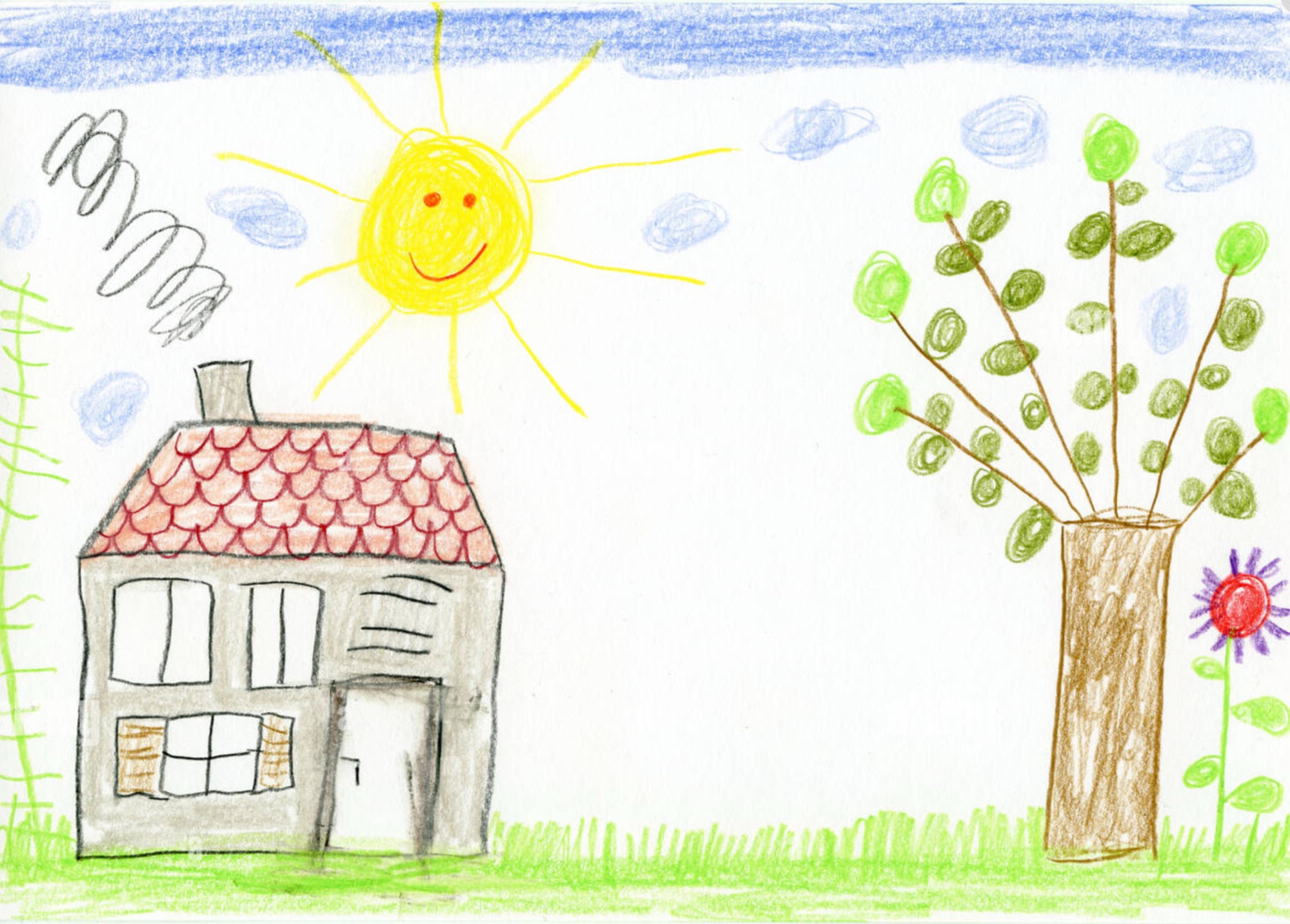
    To that end it helps to imagine the self not as a pizza or cake (excellent choices though they may be) to be consumed, but as a house to be lived in. Picture the house a child draws: two stories, a door in the center, four square windows, a triangle roof with a chimney. What you don’t see is the basement. Brooks’s model reveals this missed layer.

    The Presented Self is your facade, the foyer and salon — where the neighbors wave, the packages arrive and formal guests make small talk.

    The Inner Self is the study, the bedroom, the private places with books, mirrors, and unwitnessed time.

    The Suffering Self is the basement — damp, hidden, still holding flood marks from old storms.

    And the Transcendent Self is the rooftop — where you climb to see the stars and whisper toward the sky.

    You are not one of these. You are all of them.

    But that leads us to a deeper question.

    Brooks wants us to see others more fully by exploring each of these layers of their persona and opening ourselves to being seen at each of these, in his telling, levels. But what if we turn our gaze inward and ask: where should we look? Not just in how we relate to others — but how we arrange our own time, energy, and attention.

    Further, does the floor we live on determine the shape of our life?

    Should we spend most of our time on the roof, aspiring? Should we strive for balance across all levels? Should we move seasonally, letting life tell us where to be?

    This is the question that haunts the blueprint. Because it seems increasingly clear that the floor you inhabit most often becomes the gravitational center of your character — and perhaps even your destiny.

    Live too long in the Presented Self, and you become a projection.

    Live too long in the Inner Self, and you become a recluse.

    Live too long in the Suffering Self, and you become a wound.

    Live too long in the Transcendent Self, and you become a cloud.

    And yet — perhaps some are called to dwell longer on one floor than another. The grieving must attend to the basement. The contemplative must fortify the roof. The young must learn to clean their rooms before they climb up on the roof.

    So what’s the answer?

    THREE THEORIES OF INHABITANCE

    The Roof is Everything

    One may posit that we should live mostly in the transcendent. That vision, meaning, and moral purpose should be our primary concern — the roof is where orientation happens. We should be standing in the present and looking forward.

    But a roof without a house is a tarp. A gesture towards something that never got built – architecture without inhabitation.

    Spend too much time manifesting abundance, and you become a billboard, not a being.

    Balance is the Goal

    Another possibility is that we are meant to circulate equally. Visit every room. Give no single space priority over the others. This is the ethic of integration.

    But balance can become stasis. It risks imposing a symmetry that even nature does not observe.

    The seasons cycle, yes — but no winter is the same as the last, no summer without its own drought or downpour.

    A perfectly rationed life may be tidy, but is it natural?

    Seasonality is Wisdom

    A third path suggests movement by need. Some days demand the basement. Others call you to the roof. Some seasons require solitude. Others, performance or repair.

    But seasonal living requires discernment. How do you know when it’s time to leave the basement? How do you know whether you’ve reached the rooftop or simply climbed a ladder to nowhere?

    YOU ARE A HOUSE, NOT A FLOOR

    One thing we can say for certain is that the modern obsession with “finding your authentic self” insofar as it assumes there is a single, goldenthreaded core waiting to be uncovered – is a false promise.

    There is no single self, only rooms to be furnished and lived in — some better lit than others, some waiting to be opened.

    You do not find yourself. You become habitable.

    You are the one who climbs the stairs. Who checks for mold. Who opens the blinds. Who replaces the broken knob.

    This is not selfactualization. This is maintenance. This is care.

    THE QUESTION STAYS THE SAME

    Led Zeppelin – The Song Remains The Same

    So, where should you dwell?

    Should you aim for the roof? Balance the levels? Follow the seasons?

    I have no fucking idea.

    But perhaps your destiny lies not in the room you choose, but in the way you move between them.

    Now put that in your pipe and smoke it.

  • Not Everything Can Be KISS’d

    Not Everything Can Be KISS’d

    I have Type 2 diabetes. It didn’t happen overnight.

    It began quietly: elevated liver enzymes, then cholesterol. Each problem had a fix. A pill. A specialist. Statins brought the cholesterol down—but, I later discovered, at the cost of insulin sensitivity. No one was managing the whole system. Each intervention made sense in isolation. But taken together?

    Eventually stress and sugar overwhelmed an already compromised system. My body’s ability to respond to insulin collapsed. Now when insulin knocks, the cells act like no one’s at home.

    My body lost the ability to respond to its own signals. The feedback loops broke down.

    That’s where we are with climate. And not just climate—energy, agriculture, inequality, infrastructure, resource depletion. The entire metabolic system of civilization is out of whack.

    But instead of systems thinking, we get headlines. Straws banned. EVs subsidized. Carbon credits traded like indulgences.
    Every intervention is designed for optics, not integration. We reduce, recycle, offset, and declare victory while the deeper mechanisms degrade.

    This isn’t a new realization. People have been mapping the system for decades. Thinkers like Fritjof Capra explained the interconnected nature of ecological, biological, and social systems. Donella Meadows, in Limits to Growth, warned us that ignoring feedback loops and delays lead to environmental collapse.

    Their work hasn’t gained traction because, well, it’s complicated.

    And we are living in an age that is increasingly falling under the spell of KISS thinking—Keep It Simple, Stupid.

    But not everything can be simplified.
    Some things demand depth. Some truths are complex. And just because something is too tangled for a soundbite doesn’t mean it’s fake news.

    This is where we need to talk—uncomfortably—about the democratization of everything.
    We have built a culture where everyone thinks they’re entitled to an equal opinion on every topic. Where the voter must be flattered at all costs. Where complexity is seen as condescension.

    “If a nation expects to be ignorant and free, in a state of civilization, it expects what never was and never will be.”

    — Thomas Jefferson

    We’ve even KISS’d this quote into “an informed citizenry is essential to democracy”. But information is inert. Democracy requires cognitive bandwidth.

    Most people simply don’t have the processing power for the big issues with which a planet of 9 Billion people must contend.

    This isn’t arrogance. It’s neurology.

    We are facing systemic threats. But we’ve built a culture that treats every policy question like a dinner poll. New administration? New focus. New party? New plan. But this isn’t a dinner party. These are 30- to 50-year infrastructure arcs.

    Nowhere is this more obvious than in how we treat climate change and, consequently, the fossil fuel industry.

    It’s been vilified and politicized, but never governed with strategic clarity.

    We issue contradictory mandates. One administration pushes drilling. The next punishes it. We declare war on carbon, then panic at the pump and beg for more supply. We set climate targets like flipping switches—net zero by 2030, 2040, 2050—without understanding what is required to build the infrastructure to support the transition.

    This isn’t planning. It’s performance.

    And meanwhile, the people who actually understand the system—big oil engineers, planners, project heads—are left trying to steer a supertanker through a policy fogbank. They aren’t the enemy. Many of them want the same thing the rest of us do: clean air, long-term stability, a livable future for them and their children.

    But you can’t bring about long-term change in complex systems with short-term action born of simplistic thinking. You can’t KISS everything.

    Until we evolve more robust cognitive bandwidth across the species—or at least, until those unequipped to deal with complexity learn to stay in their lane—we will remain doomed.

    There’s a paradox here. You know it. The Dunning–Kruger effect:
    The less you know, the more confident you are in what little you do know.

    And if we can’t convince the most ignorant to recognize their ignorance—and to be humble in the face of it—we lose the plot.

    Trump is the Dunning–Kruger presidency.
    Everything he touches reveals an inability—or unwillingness—to think systemically.

    Defunding climate research. Imposing tariffs with no sense of supply chain feedback.
    Stripping away due process as if it were red tape, not bedrock.

    This is not about left or right.
    It’s about consequences.
    The planet isn’t left or right.
    Feedback loops aren’t partisan.
    And complexity doesn’t go away because you’ve conceptually broken it down so you can comprehend it.

    KISS thinking may feel good. But it won’t save us.

    We need to Weigh Interdependencies in Systems and their Effects. We need WISE thinking to survive.

    Any benevolent despot billionaires listening?

  • The Guardrails Are Gone: How Institutional Power’s Decline Will Be the Death of US All

    The Guardrails Are Gone: How Institutional Power’s Decline Will Be the Death of US All

    Niall Ferguson cautioned that empires unravel from within when the institutions meant to sustain them weaken under the strain of their own inefficacy, eroding public trust as they cease to fulfill their intended purpose. The American empire has not yet disintegrated, but its foundations have been critically undermined. Once destabilization reaches a tipping point, the descent is swift and irreversible. Watching the news, it certainly appears as though we’ve crossed the Rubicon.

    The Deep State, ostensibly the mechanism that should have mitigated such an implosion, was and continues to be systematically vilified and dismantled. The very apparatus responsible for insulating democratic governance from impulsive political excess was delegitimized by the very elites it was designed to serve. The power elite failed to recognize the peril of abandoning their stabilizing mechanisms.

    Rather than act as the shadowy, conspiratorial force caricatured in populist rhetoric, the Deep State has historically functioned as a necessary ballast, preserving institutional integrity amid fluctuating political landscapes. However, its failure to navigate a treacherous political realignment—and its inability to circumvent the populist revolt against expertise and bureaucratic governance—has left American democracy increasingly vulnerable to collapse. In the absence of stable institutions, governance defaults to personality-driven rule, where spectacle and gut instinct replace deliberation and strategy.

    The postwar American state was structured around an expanding bureaucratic and security apparatus that safeguarded economic stability, strategic hegemony, and social order. From the 1940s to the early 2000s, institutional growth coincided with the expansion of the middle class and the maintenance of a delicate equilibrium between economic elites and the general populace.

    However, as institutions ossified, their fundamental purpose—protecting the middle class from the unrestrained ambitions of the ruling class and restraining elite overreach—was abandoned. The 2008 financial crisis revealed this failure with devastating clarity: banks were rescued while working-class homeowners were left to absorb the collapse. The Iraq War further discredited institutional legitimacy, exposing the military-industrial complex’s predatory interests as contractors reaped fortunes while veterans returned to shattered lives.

    Globalization, as much maligned as the Deep State, was executed without guardrails—without mechanisms that could have balanced local economic strength, national security, and long-term stability. Instead of serving as a model for inclusive economic expansion, it was weaponized by corporate interests, enabling a mushrooming class of new billionaires to maximize profit at the expense of national resilience.

    The expansion of global markets created unparalleled opportunities for capital accumulation, allowing corporate giants to optimize production through the exploitation of cheap labor while expanding their consumer base to a global population of eight billion. This was not globalization’s failure, but rather the failure of institutions to regulate its trajectory—to ensure that economic expansion did not result in unchecked wealth concentration and the erosion of domestic economic stability.

    The billionaires and multinational corporations that emerged from this transformation did so by systematically reducing production costs through labor arbitrage while maintaining high-margin profitability in the wealthiest consumer markets. The institutions that once constrained corporate excess were no longer equipped to mediate the balance between capital and labor; instead, they facilitated the very conditions that entrenched economic disparity.

    Similarly, the Deep State is neither benevolent nor malevolent; nor can it be dismissed as “anti-democratic” if it works to safeguard a democratic republic. Considering that it is an amalgamation of bureaucratic frameworks, intelligence agencies, regulatory bodies, and financial institutions that collectively function as the administrative machinery of governance, it is not an agent of authoritarian control but rather a structural necessity, ensuring policy continuity beyond electoral volatility. Democracy requires this.

    History provides clear precedents for what happens when institutional stability collapses. The Roman Republic unraveled not solely because of Julius Caesar’s ambition but because the Senate—once the state’s bureaucratic ballast—lost its ability to constrain executive overreach, allowing populist demagoguery to replace deliberative governance. The Ottoman Empire did not simply fall to external pressures; its ruling bureaucracy weakened while the Janissary corps, originally an elite military force loyal to the state, transformed into a self-serving political faction, resisting reform and prioritizing its own privileges over imperial stability. The Qing Dynasty collapsed when its bureaucracy—once a model of Confucian meritocracy—failed to modernize in response to industrial and imperialist pressures, leading to economic stagnation and foreign encroachment.

    Each of these cases underscores the same principle: when the administrative institutions designed to balance power falter, the door opens for opportunists, who, instead of strengthening the system, accelerate its collapse.

    We are living in an era where vitalism is holding sway over determined managerialism. Popular psychology elevates manifestation, energy, and intuitive impulse over deliberate, systematic action. Self-help gurus preach that intention shapes reality, that vision alone bends the arc of events. It is no wonder, then, that political leadership has begun to mirror this trend—governing less through strategic calculation and institutional rigor and more through charisma, instinct, and performance.

    To be sure, human limitations require that iterative deliberation be cut off at a certain point, and decisions must be made. The presence of urgency does not, however, justify the abandonment of rational process in favor of blind impulse. The political organism, much like the biological one, cannot survive on unregulated spontaneity alone.

    This is where Iain McGilchrist’s theory of brain lateralization provides a useful lens. The right hemisphere, associated with intuition, emotion, and big-picture thinking, thrives on immediacy and gut feeling. The left hemisphere, by contrast, specializes in analysis, categorization, and procedural structuring—the very faculties necessary for sustained governance. In a functional system, these two domains are in balance, with the right hemisphere generating vision and the left implementing it.

    But when vitalism dominates without an institutional counterweight, governance devolves into erratic decision-making, unmoored from structure, precedent, or strategic foresight. It is the political equivalent of governing from the right hemisphere without left-hemispheric constraints.

    The United States, once a paragon of structured managerialism, is increasingly operating in this state of dysfunction, where policy is dictated by emotional reaction, spectacle, and the immediacy of the news cycle rather than by institutional continuity and long-term planning.

    Historically, no enduring state has thrived under unchecked vitalism. Napoleon’s France, the Third Reich, and even Imperial Japan all relied heavily on emotional mobilization and ideological fervor, but each succumbed to the limits of unregulated ambition—overextension, internal instability, and the inability to manage power in the long term.

    Lee Kuan Yew’s Singapore, by contrast, succeeded precisely because it recognized the necessity of institutional discipline. A strong state, like a strong mind, must balance intuition with structure, instinct with rational oversight.

    If history has taught us anything, it is that once the guardrails are gone, they do not reappear on their own. The Power Elite who believe they can ride this storm without consequence are mistaken. The time for course correction is vanishing, and when the reckoning comes, it will not be evenly distributed.

  • To Be Still Or To Strive

    To Be Still Or To Strive

    Your smartphone or wearable chimes with a reminder to take a few moments to breathe. You open up your Wim Hof Method Breathing & Cold™ app—”download it; it’s good stuff“—to begin brrrrrreathing in relaxation and breathing out stress. For a couple of minutes, depending on your skill level and what’s going on in your life, you withdraw from the world, release your time-bound attachments, and sink into the present moment.

    But just as soon as your session ends, the world barges back in.

    Civilization itself—the same one built brick by manufactured brick with restless ambition, relentless progress, and long-term foresight—nudges you back on the wheel. This is the domain of Civilizational Drive: the insatiable force that fuels invention, compels societal order, and ensures we don’t simply drift along with the tides of the forever-present but push toward the next transformational innovation. This isn’t some recent obsession either; it’s been with us since the first stone wheel rolled into place.

    So here we are, caught between Placid Contentment and Civilizational Drive, teetering on a tightrope stretched between two towering poles: one anchored in the now—solid, unmoving, still; the other racing forward, unraveling lengths of rope at increasingly accelerated speeds.

    And here’s the rub: without Civilizational Drive, the gross duration of time we have on our tightrope diminishes, leaving less for lotus-legged intentional respiration. Without vaccines and climate-controlled secure shelter, many of us wouldn’t make it out of infancy, and those who do might not live past 30. Without the tools, comforts, and systems born of progress, we wouldn’t have a pocket guru to summon on demand. The entire “center yourself” industry (naturally, it would have to become an industry) exists for, and because of, people sprinting on the treadmill of Civilizational Drive. Are we fated to schizophrenically oscillate from treadmill to being still beneath the Bodhi tree? Can these two states be reconciled?

    A Quantum Quandary: The Physics of Human Life

    This tension, oddly enough, mirrors a deeper one embedded in the structure of reality itself—namely, the stubborn divide between quantum weirdness and the cosmic clockwork that runs the universe. Think of quantum mechanics as the state of placid contentment of the physical world: elusive, fluid, and paradoxical. Down at the quantum level, particles refuse to behave. They exist in states of superposition, occupying multiple states at once, dodging attempts to pin them down. It’s a kind of cosmic meditation, a blurring of boundaries and certainty.

    Now contrast that with the cosmic scale—the vast stage where stars explode and galaxies spin in perfect synchronicity. This is a civilizational drive writ large across the cosmos, operating with clockwork precision and governed by the deterministic laws of general relativity. No quantum fuzziness here; only gravity and motion, spacetime and mass. Predictable. Definable.

    For decades, physicists have sought to reconcile these two irreconcilable levels of reality. The quantum level, where particles refuse to settle into one state, and the cosmic level, where celestial bodies march in lockstep with the steady pulse of gravity’s call. Is there a grand unified theory, an invisible thread, waiting to be discovered? Or are these two worlds fundamentally incommensurable—two systems that must coexist without ever fully merging.

    Shall the Twain Ever Meet?

    Similarly, are nirvana and evolution an irreconcilable duality or opposite ends of a spectrum amenable to unification?

    Consider: what if the relationship between personal harmony and civilizational drive changes depending upon the level of granularity or scale at which the relationship is considered. They represent either an irreconcilable duality or opposite ends of a spectrum depending on the scale of the inquiry; scale as in depth not breadth. At the macro level, these two forces appear distinct and oppositional: Personal harmony is singular and detached from the world, while civilizational drive is complex and interconnected.

    When we zoom into the micro level, this opposition softens into a spectrum within which a person’s states register—for example, balanced focus.

    At the ultramicro level, this relationship resolves again into fundamental, irreducible dualities. In other words, between each macro duality is a continuum, and on each side of a macro duality lies another ultramicro duality.

    For example, at the personal harmony end, you have engaged awareness vs. detached acceptance—you are aware of a thought that has come into your consciousness and are letting it go to return to a state of thoughtlessness. There is no spectrum between these dualities, only tension. They are purely binary—on or off. At the civilizational drive end, you have rigid replication vs. innovational change, another fundamental, irreconcilable duality.

    Applied to the physical world, at the macro level, we have the fundamental duality of General Relativity vs. Quantum Mechanics.

    General Relativity deals with the large-scale structure of spacetime, where gravity shapes the universe in a deterministic, predictable manner. It’s concerned with the behavior of planets, stars, and galaxies.

    Quantum Mechanics deals with the subatomic world, where particles behave probabilistically, and uncertainty dominates.

    This forms the macro-level duality: large-scale determinism vs. small-scale probabilism, or smooth spacetime vs. quantum discontinuity.

    Between these poles, there is a spectrum of theories—such as String Theory and Quantum Field Theory—that attempt to bridge the gap between General Relativity and Quantum Mechanics. These models often merge elements from both ends, forming a continuum where certain aspects of spacetime and quantum behavior overlap or harmonize. This micro level reflects the transitional space where the stark duality between large-scale and small-scale forces softens.

    At the ultramicro level of Quantum Mechanics, we see the internal duality of phenomena such as wave-particle duality and superposition vs. collapse. Here, quantum entities behave as both waves and particles, depending on how they are measured. This duality is irreducible within the framework of quantum theory itself.

    Thus, at both ends of the macro-level General Relativity vs. Quantum Mechanics duality, we find internal dualities at the ultramicro level—wave-particle duality in quantum mechanics and spacetime-observer relativity at the other end. These ultramicro-level dualities reflect the underlying tensions in both poles.

    Living in the Spectrum

    We do not live at the poles. Our experience of the world is non-binary. I am not here referring to our abstract mental life that has created dualities and dichotomies. I am referring to our embodied and lived experience. Our lived experience registers on the spectrum. We have no experience of absolutes. Enlightenment is oblivion. Absolutes are fundamentally resistant to experience. Experience is, perhaps by necessity, spectral. We exist in an asymptotic relationship with these limits.

    We live in thermodynamic processes, biological systems, and chaotic systems that combine aspects of both predictability and probabilism. We are neither living in a world of pure quantum uncertainty nor macro-level absolutes; we are constantly experiencing the interplay between these forces in the middle ground, where complexity emerges from both ends of the spectrum.

    Embracing the Sliding Scale

    Considering the foregoing, I posit that humanity must accept that it lies along a sliding scale and revise its philosophies, judgments, and worldview to contend with this diversity. We are fundamentally and structurally incapable of communing with the divine. We must shed that arrogance. With all the “polarization” we are seeing in the world today, it is important that we all reflect on these fundamental limits and concede that we are all swimming together amid shores that we can never reach and therefore none can claim. Those who speak as though they are firmly rooted on one bank or the other must be ignored, shunned and ultimately forgiven.


    This essay explores the interplay between enlightenment and evolution, drawing parallels with fundamental dualities in physics. By examining these concepts across different scales, it suggests that embracing the spectrum between stillness and striving is essential for a true understanding of our place in the universe.