
SEÑOR

Dispatches from the gap between how the world works and how we pretend it does.

Tag: photography

  • Monuments to Ourselves

    Monuments to Ourselves

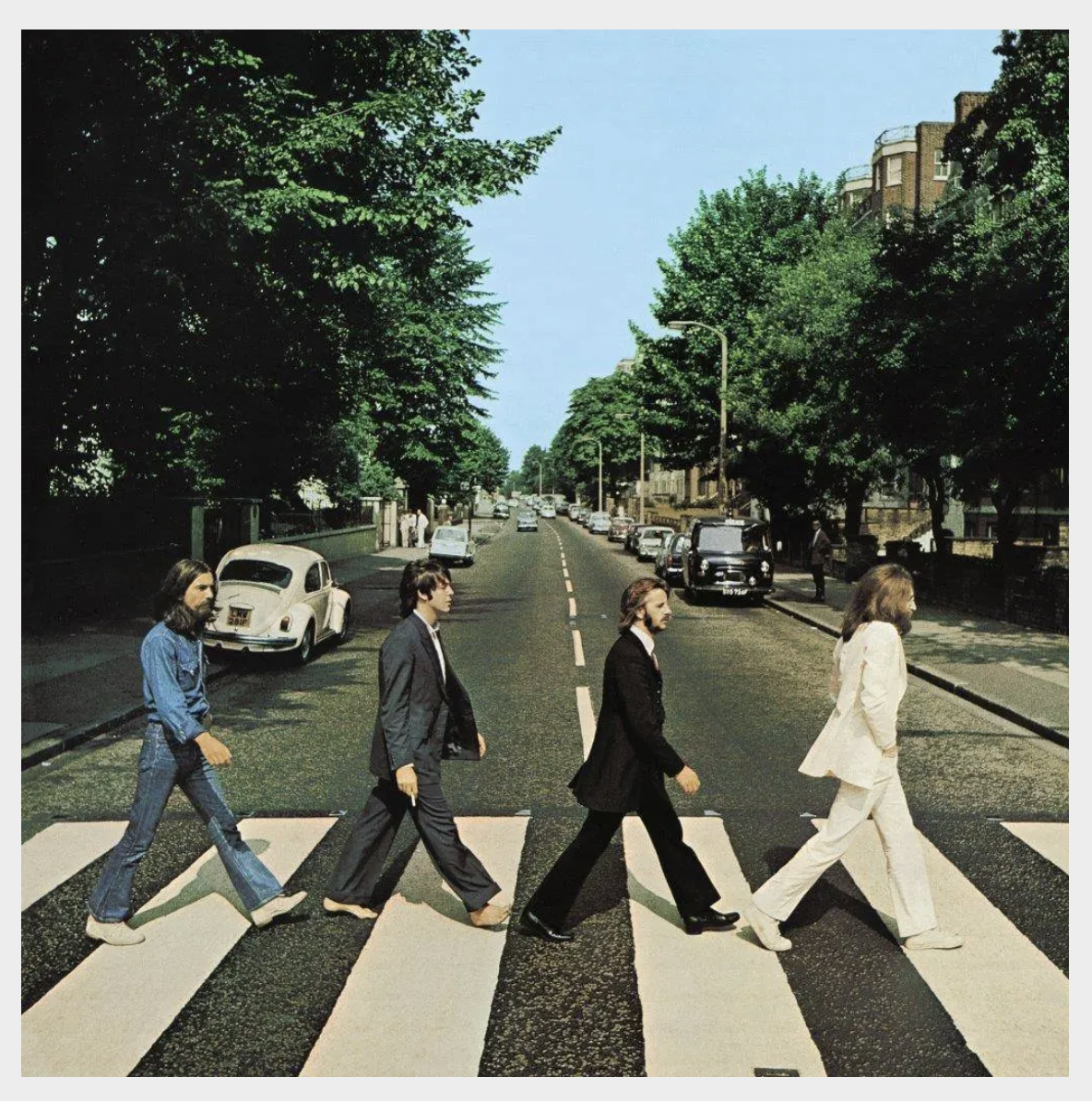
    I recently moved to a place that is a short walk from Abbey Road in St John’s Wood.

    Every day, and night, there is a crowd of varying size gathered at either side of a certain zebra crossing comprised of groups who have turned out for their turn to cross.

    One member from each of the groups (some are pairs, some are a squad) will invariably dash out into the street holding up a phone, or, on rarer occasions, a proper camera, while the others attempt their best approximation of the Beatles stride pictured on the cover of their last recorded album. Traffic pauses. Horns sound. Photographs are taken. The next fireteam files forward while motorists silently shake their heads in scorn.

    For those unfamiliar with the environs of Abbey Road Studios and the crossing beside it, this is not Piccadilly Circus. It is a quiet residential part of London. The assembled faithful therefore constitute a genuine throng in this corner of St John’s Wood. Residents and commuters find themselves incongruously negotiating safe passage through this incessant fracas.

    Before this latest move, I was staying in Notting Hill. There, too, crowds assembled daily in a trafficked side street outside a private residence made famous by a romantic comedy that borrowed the neighbourhood’s name for its title. People emerge from the herd, wait their turn, stand before a particular house’s not so particular blue door, smile, photograph, and then chimp before melting back into the crowd.

    The story of the door is revealing.

    It originally belonged to Richard Curtis, the film’s screenwriter. The production designer chose it by chance, unaware of its ownership. Following the film’s success, the original door was auctioned off for charity. The residents who remained behind grew weary of the endless stream of tourists, graffiti and photographers and replaced it with a plain black door. Eventually, a subsequent owner repainted the replacement door blue and the pilgrims returned.

    The original artifact had vanished.

    And yet the ritual remained.

    My irritation with all this was not surprising to me though that I kept dwelling on it was. There seemed to be something more noxious here than the odor of mass tourism. Something faintly indecent wafted off the transformation of ordinary pieces of infrastructure and private property into tourist attractions at a cost imposed upon people who never consented to bear it.

    Let us linger there for a moment.

    We are accustomed to monuments being erected to receive visitors. The Cenotaph was built to be visited. Cathedrals were built to receive pilgrims. Museums were built to preserve and display objects deemed worthy of our collective attention. Society decides, explicitly or implicitly, that a place or object possesses sufficient significance to justify the inconvenience associated with preserving and visiting it.

    Abbey Road is different.

    The Notting Hill door is different.

    Neither was intended to become a monument.

    Neither was designed to receive visitors.

    Neither was built to absorb the inconveniences that inevitably accompany significance.

    And yet significance arrived all the same.

    This is not a problem in itself. Meaning is rarely conferred by decree.

    John Searle called these things “institutional facts”: realities that exist because we collectively accept them as such. “Money, property, governments, and marriages,” he wrote, “are all institutional facts. They are facts only because we believe them to be facts.”

    Abbey Road is an institutional fact.

    The Notting Hill door is an institutional fact.

    Millions of strangers have collectively invested them with significance.

    In this sense, Abbey Road and the Notting Hill door are indeed monuments.

    No less than the Cenotaph.

    The Cenotaph is, literally, an empty tomb. A carefully shaped arrangement of stone. Yet nobody regards it as merely stone because it has become a vessel for memory, sacrifice and national identity.

    Abbey Road is thermoplastic paint on asphalt.

    The Notting Hill door is painted wood.

    Meaning has transformed matter in all three cases.

    And once a thing or place has been invested with meaning, people will inevitably come to visit it.

    Again, that, in itself, is not the problem.

    The inconvenience of pilgrimage is tolerable when pilgrimage remains an act of reverence. The problem arises when the crowds are not really there for the monument at all.

    The crowds at Abbey Road seem to be engaged in something subtly different. They do not come to stand before the monument. They come to stand at its centre.

    The famous blue door in Notting Hill is gone. The original object was auctioned years ago. The tourists need not know, because once the sign has detached from the referent, that knowledge becomes irrelevant.

    The same is true of Abbey Road. Visitors are not really interested in a zebra crossing. Nor, I suspect, are they particularly interested in the Beatles. What they seek is proximity to significance.

    Not significance itself.

    Its acquisition.

    The photographs they take function as a deed to significance, albeit borrowed. A fragment of cultural meaning harvested and placed on display among the many symbols from which contemporary identity is curated.

    And this is where my two objections converge.

    First, these monuments have been erected without consent. Their costs have been socialized while their benefits remain private. Residents and road users are conscripted into maintaining a theatre whose script they never approved.

    Second, and more damningly, the theatre is not performed in service of remembrance or reverence.

    It is performed in service of extraction.

    The visitors arrive at places invested with meaning not in order to be changed by them, but in order to carry some portion of that meaning away.

    Not transformation, association.

    Not inward change, outward display.

    Not reverence, acquisition.

    They do not seek communion with the monument. They seek to appropriate its symbolic capital and attach it to themselves.

    This is what pilgrimage becomes when reverence is replaced by appropriation.

    “The consumer society needs its objects in order to be, and more precisely it needs to destroy them.”

    Jean Baudrillard

    While the authentic pilgrim carries home a changed soul, the pilgrim-on-trend carries home a photograph; the latest token in a civilization organized around endless acquisition.

    Experiences are accumulated.

    Places are accumulated.

    Culture is accumulated.

    Even identity becomes a project of curation in which symbols are gathered, displayed and discarded in pursuit of an ever-receding core sense of self.

    The object of our interest has not merely lost its sacredness, it has been subordinated to the project of self-construction.

    The tourists play at paying homage to the Beatles when in fact something more parasitic is taking place.

    The crossing is mined.

    The film is mined.

    Culture itself is mined.

    Meaning is excavated, photographed and carried away in pockets.

    And when every monument becomes a quarry for the self, the self ceases to be formed by reverence and is instead enlarged by annexation.

    This is not growth.

    It is accumulation.

    The encounter is no longer metabolized.

    It is recorded.

    Its significance is not digested and transmuted into character.

    It remains external.

    The photograph.

    The association.

    The anecdote.

    The proof of having been there.

    Each is affixed to the self rather than incorporated within it.

    The self becomes an assemblage of borrowed meaning: a collage of appropriated symbols whose significance derives from elsewhere.

    It grows larger.

    But not deeper.

    More decorated.

    But not more substantial.

    Its parts never fuse into a coherent whole because they were never truly absorbed. They remain trophies of encounter rather than agents of transformation.

    And so the monuments remain.

    The crossing.

    The blue door.

    The Cenotaph.

    But increasingly they are no longer destinations.

    They are mirrors.

    No longer places before which we diminish ourselves.

    Increasingly, they are places at which we place ourselves at the center.

    And the most elaborate monuments we build today are not dedicated to our heroes, our dead, or our ideals.

    They are monuments to ourselves.

  • The War Correspondent on Holiday

    The War Correspondent on Holiday

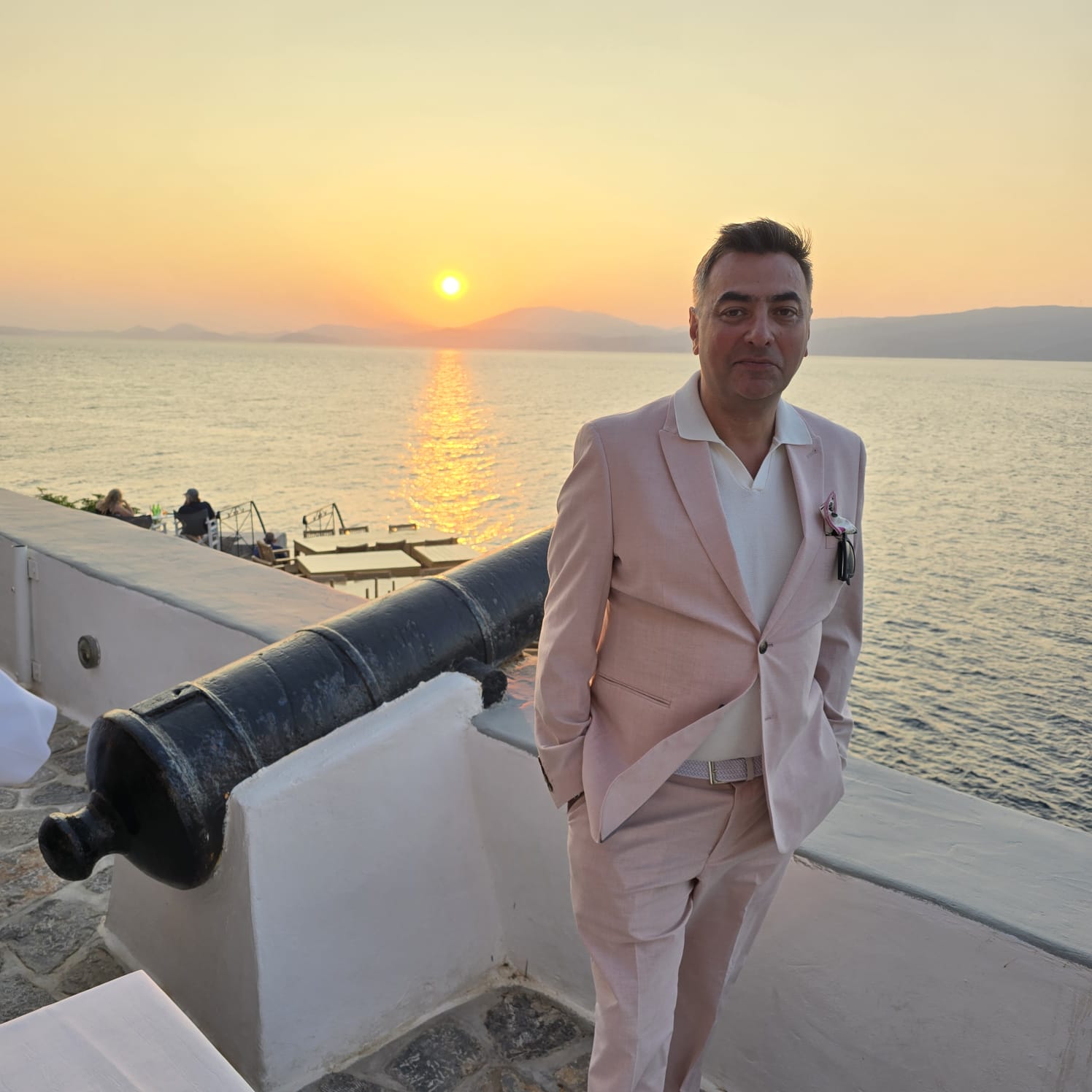
    Imran Khan sent us a thousand words from his holiday in Greece. They describe a man camouflaged in a pale pink suit and white polo that dissolve into the golden hour’s lavender-tipped amber light washing over the Aegean, the whitewashed walls, even the tablecloths of the repurposed fortification where he stands.

    For someone who has spent years making himself visible as PRESS in the world’s darkest corners—to bear witness and document what others couldn’t or wouldn’t see—there’s something profoundly moving in seeing him appear and disappear in a Rorschach of serene beauty instead.

    His companion in the image: our Sun, with its widening reflection on the water forming a golden body alongside his. One, ethereal, radiating its warmth with indifference— its golden light falling equally on celebration and carnage.  The other, a man of memories painfully seared into his mind by flashes of light that turned flesh to ash.

    The cannon beside him creates a perfect visual trick: in one dimension it seems aimed right at his heart, in another it looks past him toward the sea, and in another still it is inert, a relic stripped of all its menace by time and tourism.  A fitting metaphor for someone in his line of work—how perspective can transform the same scene from threatening to benign, how what looks dangerous from one angle might actually be safe from another.  How all this exists in minds that make a mess of it all.

    There he stands with the expression of someone who harbors life’s joys alongside its sorrows.  His lips at once a smile and a frown. Hands easy in his pockets, his stance relaxed against that ancient rigid fortification. Meanwhile below, humanity watches another Earthen sunset with the romance that can only exist in compartmentalized minds, but he’s standing there like someone who can see both sides of the coin at the same time.

    There is art in standing beside the sun as an equal, invisible not because he’s hiding but because he has harmonized with his setting. After all the burning front-lines, killing grounds and shattered cities, here’s our friend melding into a sunset. May there be many more sunsets like this one, Imran. And happy Father’s Day.

  • An Interview with Renard Baudrillard on The Digital Fossil

    An Interview with Renard Baudrillard on The Digital Fossil

    Dense black-and-white maze-like digital pattern

    Felix Saxa sat down with Renard Baudrillard to discuss his project “Digital Fossil.” The following is a transcript of their discussion.


    Felix : Welcome, dear listeners, to another edition of our podcast “Shooting the Sh*t and Eating Some Food.” Today, I have the pleasure of speaking with Renard Baudrillard, an artist who rejects that label and now insists on being referred to as a hose.  He has been making waves with his latest project, Digital Fossil. Renard, thank you for joining us.

    Renard : It’s great to be here.

    Felix: Today we are serving Crispy Duck Salad from Hakkasan. What do you think?

    Renard: I like it. But I am starting to feel that this salad is going the way of seared tuna from decades back and truffle everything which just won’t die.

    Felix: Can’t we just react to flavor, presentation, and mouthfeel?

    Renard: Do I have to answer that?

    Felix : Renard, I’ve been following your work for a while, and Digital Fossil really caught my attention. But before we dive into the specifics, I’m curious to learn how the idea for this project was born.

    Triptych portrait of a young man posing with one hand on his shoulder

    Renard : Who knows how these sorts of things emerge, I guess the closest I can come to fixing a point is an afternoon spent at a friend’s house—she works for Vogue, so you can imagine the stacks of magazines scattered all over. I remember noticing how they were in various states of wear, some as though freshly pressed, others torn and faded. She was droning on about something or other, and I got to thinking about how physical publications are being replaced by digital media the way online shopping has replaced brick and mortar retail and that got me wondering—do things somehow age online as they do in the real world? Does the digital decay?  Booom! I get smacked in the head by a magazine and my eyes refocus to see Birgit Freund staring at me as the words “RB ARE YOU LISTENING?” echo in my ears.

    Felix : laughs Birgit Freund! Did you piss yourself?

    Renard : Almost but my bladder control is competition-class. Anyway, the thought stuck with me and I started thinking more about digital decay, and that’s how Digital Fossil came to be. I wanted to explore the idea of a digital aging. So, I used a downsampling algorithm to induce degradation, progressively reducing the quality of the image over 148 stages as if the file were being ravaged by time.

    Felix : And why 148? That’s a very specific number.

    Renard : It was just the point where the degradation plateaued. At first, each pass through the downsampler results in noticeable loss of detail and artifacting, but as the image “decays”, the changes become less pronounced, almost imperceptible. It’s kind of like how a fossil stabilizes over time. The image reaches a point where there’s no more significant detail to lose, and that’s where it stops changing in any noticeable way. The plateau.

    Felix : So, the image is wasting away, but then it hits a point where it can’t really degrade any further?

    Renard : Right. And that ties into the math of it.

    Felix: No math please.

    Triptych portrait disrupted by digital pixelation

    Renard: Laughs No no, it’s nothing too obtuse.  When you downsample an image, you’re essentially averaging out pixel values in groups. Early on, each pass strips away a lot of detail, but as the data becomes more homogenized, the algorithm can’t really differentiate between pixels anymore. It’s a consequence of entropy leveling out, the image no longer has enough fidelity to lose anything substantial. So after a certain number of iterations, the degradation reaches an asymptote.

    Felix: I can’t believe you said asymptote.  This is the second time I hear that word in a week after almost an entire lifetime of absence.

    Renard: Where did you hear asymptote?

    Felix: You know Hector Dupaix right?

    Renard: I’m not sure I do…

    Felix: Hector, the guy who became famous for sc…

    Renard: Oh, yes, yes…

    Felix: Well, he’s now written a book, and I recently sat down with him to talk about it and at a certain point in the conversation he said that human experience bears an asymptotic relationship with the ideal forms and that we can never experience them no matter what we do.

    Renard: Oh right.  Interesting.  Crazy how things “trend” in our lives for a certain time and then they disappear.  You think you’ll hear asymptote again?

    Triptych portrait heavily fragmented into black, white and tan pixels

    Felix: Laughs. Somehow I doubt it.  But back to topic, so are you saying that digital imagery have a base skeleton, if you will, that downsampling reveals?”

    Renard: Not quite.  I mean you can have a hi-fi dinosaur fossil and a lo-fi one depending on various factors, it all depends on the image you start with and the downsampling algorithm.

    Felix : It’s still fascinating how that mirrors what happens in the natural world with fossils. They degrade until they stabilize into something preserved over time.

    Renard : Well, you get different types of fossils depending on the process—some are impressions left behind, others are fully mineralized, like bones turned to stone. But they all share that idea of degradation ultimately stabilizing. In Digital Fossil, the plateau mirrors that moment when the fossil is preserved, where it’s no longer decaying, but it’s far from what it once was.

    Felix : So, are you suggesting there’s a similar process happening with data? That over time, it degrades and fossilizes in a sense?

    Renard : I am. Data stored digitally degrades over time—not necessarily in terms of pixels, but in terms of recall integrity or file compatibility. Think about it: 1000 years from now, much of what we store today will likely be incomplete, corrupt, or incompatible with future systems. Future historians or archaeologists—digital archaeologists, if you will—will need to sift through the remnants of our digital lives the way paleontologists dig through fossils.

    Felix : So, we’re looking at the rise of “digital paleontologists” or “digiteologists” unearthing “datasaurs”?

    Renard : Exactly. We will be piecing together fragments from the past, just like paleontologists, we will have to reconstruct entire systems from fragments, analyzing the strata of our digital history.

    Triptych portrait reduced to dense black-and-white digital outlines

    Felix : The thought of that is both fascinating and a little terrifying. Do you think we’ll ever reach a point where we can preserve everything perfectly?

    Renard : I doubt it. I think the allure of Digital Fossil is that it references something immutable about creation the inevitability of decay.  I’ve always been drawn to the beauty of decay.

    Felix : I didn’t take you for an afficionado of the macabre.

    Renard: I don’t think it’s that really because I am not interested in the morbid or the gory.  I think what draws me to decay is more about what peaks through from the past.  It’s more about connecting with what has ceased to be and extrapolating what may have been there from what remains. 

    Felix: I like that. So for you it’s about puzzling out what was there from the remains.

    Renard: I think so.

    Felix: What’s next for you after Digital Fossil?

    Renard : I’m diving into how information decay manifests in biological environments. While quantum computing is currently taking up everyone’s attention because of its potential for a paradigm shift in processing, organic computing—using biological systems for data storage and processing—is a present curiosity that will undoubtedly see major development. I’m exploring how data would decay in that kind of system.

    Felix : Organic computing? Like using brain tissue or living organisms as usable computers?

    Renard : Exactly. Imagine being able to input and output from brain tissue.  The question becomes: how does data degradation work in an organic medium? What does it mean when you lose information saved in a chemical form, as opposed to binary code in silicon?  Is it more or less stable and is it so inherently or is it dependent on other factors.  So for example, would our ability to code stem cells to ensure the integrity of memories make forgetting obsolete?  How would that affect us?  We believe there is solace in forgetting.  Imagine having control over what you recall and what you forget.  Would hoarders get buried in memories?  Would we prefer degradation of memories or erasure?  It’s a frightening prospect but one with which we may soon be confronted.

    Abandoned bar reclaimed by moss, ferns and other vegetation

    Felix : I had no idea your work extended so far beyond the aesthetic.

    Renard : There’s something ironically annihilative about permanence in the same way that we imagine living forever something categorically different from the meaning of life.  These paradoxes have always interested me.

    Felix : I have to end it here as we’re out of time and increasingly out of my depth, but I think you should talk to Hector Dupaix about how these ideas play out on different scales of time and matter.

    Felix raises his glass in a toast. “To the datasaurs and the digiteologists who will uncover them.”

    Renard : laughs “To decay!”

    Felix : Thanks for coming on the program, Renard. And for our listeners, if you haven’t already, check out Renard Baudrillard’s work on his Instagram account, @r.baudrillard. Thanks for tuning in.