

SEÑOR

Dispatches from the gap between how the world works and how we pretend it does.

Tag: Europe

  • Monuments to Ourselves

    Monuments to Ourselves

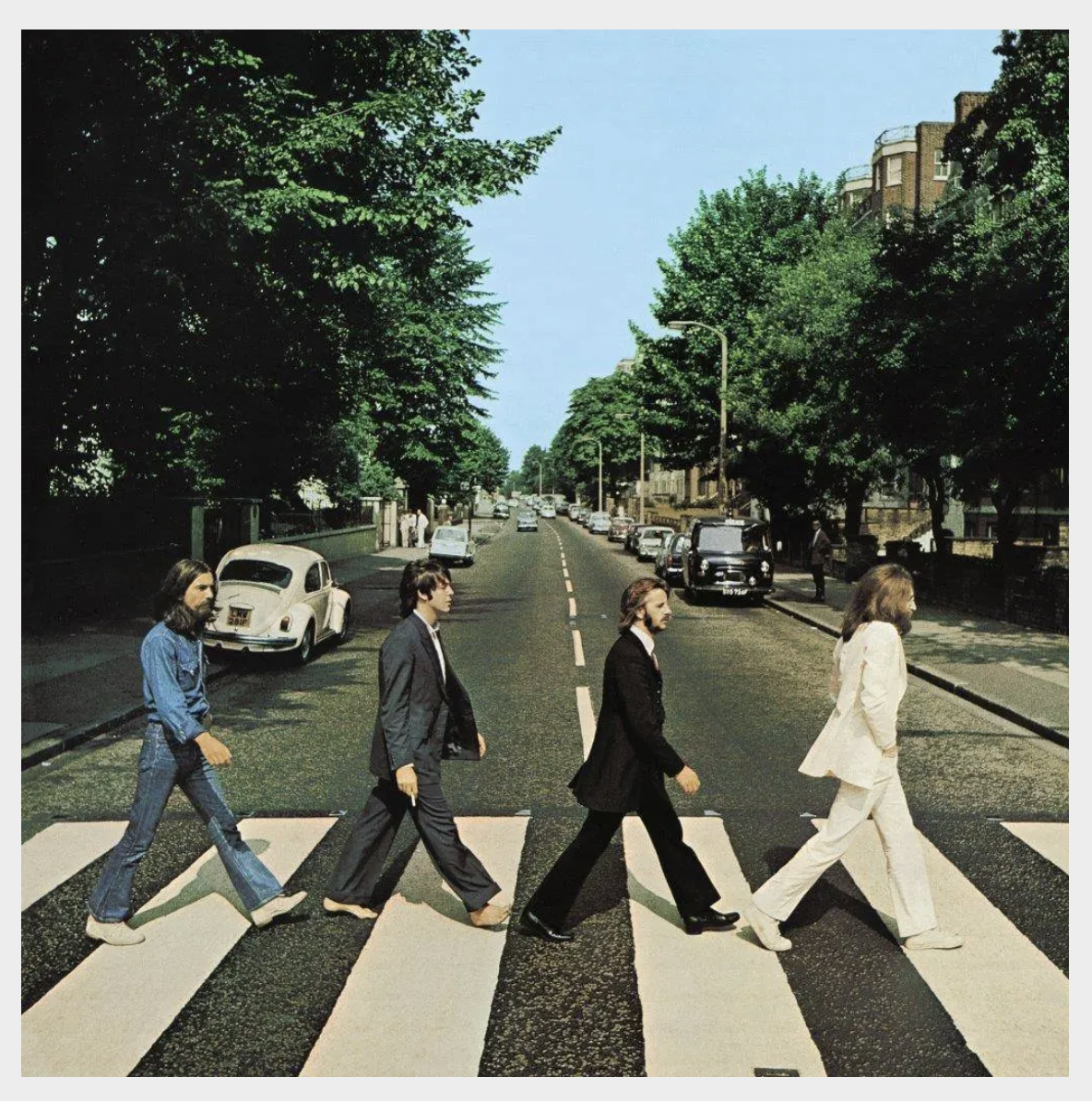
    I recently moved to a place that is a short walk from Abbey Road in St John’s Wood.

    Every day, and night, there is a crowd of varying size gathered at either side of a certain zebra crossing comprised of groups who have turned out for their turn to cross.

    One member from each of the groups (some are pairs, some are a squad) will invariably dash out into the street holding up a phone, or, on rarer occasions, a proper camera, while the others attempt their best approximation of the Beatles stride pictured on the cover of their last recorded album. Traffic pauses. Horns sound. Photographs are taken. The next fireteam files forward while motorists silently shake their heads in scorn.

    For those unfamiliar with the environs of Abbey Road Studios and the crossing beside it, this is not Piccadilly Circus. It is a quiet residential part of London. The assembled faithful therefore constitute a genuine throng in this corner of St John’s Wood. Residents and commuters find themselves incongruously negotiating safe passage through this incessant fracas.

    Before this latest move, I was staying in Notting Hill. There, too, crowds assembled daily in a trafficked side street outside a private residence made famous by a romantic comedy that borrowed the neighbourhood’s name for its title. People emerge from the herd, wait their turn, stand before a particular house’s not so particular blue door, smile, photograph, and then chimp before melting back into the crowd.

    The story of the door is revealing.

    It originally belonged to Richard Curtis, the film’s screenwriter. The production designer chose it by chance, unaware of its ownership. Following the film’s success, the original door was auctioned off for charity. The residents who remained behind grew weary of the endless stream of tourists, graffiti and photographers and replaced it with a plain black door. Eventually, a subsequent owner repainted the replacement door blue and the pilgrims returned.

    The original artifact had vanished.

    And yet the ritual remained.

    My irritation with all this was not surprising to me though that I kept dwelling on it was. There seemed to be something more noxious here than the odor of mass tourism. Something faintly indecent wafted off the transformation of ordinary pieces of infrastructure and private property into tourist attractions at a cost imposed upon people who never consented to bear it.

    Let us linger there for a moment.

    We are accustomed to monuments being erected to receive visitors. The Cenotaph was built to be visited. Cathedrals were built to receive pilgrims. Museums were built to preserve and display objects deemed worthy of our collective attention. Society decides, explicitly or implicitly, that a place or object possesses sufficient significance to justify the inconvenience associated with preserving and visiting it.

    Abbey Road is different.

    The Notting Hill door is different.

    Neither was intended to become a monument.

    Neither was designed to receive visitors.

    Neither was built to absorb the inconveniences that inevitably accompany significance.

    And yet significance arrived all the same.

    This is not a problem in itself. Meaning is rarely conferred by decree.

    John Searle called these things “institutional facts”: realities that exist because we collectively accept them as such. “Money, property, governments, and marriages,” he wrote, “are all institutional facts. They are facts only because we believe them to be facts.”

    Abbey Road is an institutional fact.

    The Notting Hill door is an institutional fact.

    Millions of strangers have collectively invested them with significance.

    In this sense, Abbey Road and the Notting Hill door are indeed monuments.

    No less than the Cenotaph.

    The Cenotaph is, literally, an empty tomb. A carefully shaped arrangement of stone. Yet nobody regards it as merely stone because it has become a vessel for memory, sacrifice and national identity.

    Abbey Road is thermoplastic paint on asphalt.

    The Notting Hill door is painted wood.

    Meaning has transformed matter in all three cases.

    And once a thing or place has been invested with meaning, people will inevitably come to visit it.

    Again, that, in itself, is not the problem.

    The inconvenience of pilgrimage is tolerable when pilgrimage remains an act of reverence. The problem arises when the crowds are not really there for the monument at all.

    The crowds at Abbey Road seem to be engaged in something subtly different. They do not come to stand before the monument. They come to stand at its centre.

    The famous blue door in Notting Hill is gone. The original object was auctioned years ago. The tourists need not know, because once the sign has detached from the referent, that knowledge becomes irrelevant.

    The same is true of Abbey Road. Visitors are not really interested in a zebra crossing. Nor, I suspect, are they particularly interested in the Beatles. What they seek is proximity to significance.

    Not significance itself.

    Its acquisition.

    The photographs they take function as a deed to significance, albeit borrowed. A fragment of cultural meaning harvested and placed on display among the many symbols from which contemporary identity is curated.

    And this is where my two objections converge.

    First, these monuments have been erected without consent. Their costs have been socialized while their benefits remain private. Residents and road users are conscripted into maintaining a theatre whose script they never approved.

    Second, and more damningly, the theatre is not performed in service of remembrance or reverence.

    It is performed in service of extraction.

    The visitors arrive at places invested with meaning not in order to be changed by them, but in order to carry some portion of that meaning away.

    Not transformation, association.

    Not inward change, outward display.

    Not reverence, acquisition.

    They do not seek communion with the monument. They seek to appropriate its symbolic capital and attach it to themselves.

    This is what pilgrimage becomes when reverence is replaced by appropriation.

    “The consumer society needs its objects in order to be, and more precisely it needs to destroy them.”

    Jean Baudrillard

    While the authentic pilgrim carries home a changed soul, the pilgrim-on-trend carries home a photograph; the latest token in a civilization organized around endless acquisition.

    Experiences are accumulated.

    Places are accumulated.

    Culture is accumulated.

    Even identity becomes a project of curation in which symbols are gathered, displayed and discarded in pursuit of an ever-receding core sense of self.

    The object of our interest has not merely lost its sacredness, it has been subordinated to the project of self-construction.

    The tourists play at paying homage to the Beatles when in fact something more parasitic is taking place.

    The crossing is mined.

    The film is mined.

    Culture itself is mined.

    Meaning is excavated, photographed and carried away in pockets.

    And when every monument becomes a quarry for the self, the self ceases to be formed by reverence and is instead enlarged by annexation.

    This is not growth.

    It is accumulation.

    The encounter is no longer metabolized.

    It is recorded.

    Its significance is not digested and transmuted into character.

    It remains external.

    The photograph.

    The association.

    The anecdote.

    The proof of having been there.

    Each is affixed to the self rather than incorporated within it.

    The self becomes an assemblage of borrowed meaning: a collage of appropriated symbols whose significance derives from elsewhere.

    It grows larger.

    But not deeper.

    More decorated.

    But not more substantial.

    Its parts never fuse into a coherent whole because they were never truly absorbed. They remain trophies of encounter rather than agents of transformation.

    And so the monuments remain.

    The crossing.

    The blue door.

    The Cenotaph.

    But increasingly they are no longer destinations.

    They are mirrors.

    No longer places before which we diminish ourselves.

    Increasingly, they are places at which we place ourselves at the center.

    And the most elaborate monuments we build today are not dedicated to our heroes, our dead, or our ideals.

    They are monuments to ourselves.

  • A New Deal with London

    A New Deal with London

    I never took an interest in London.

    Soaked in drizzle and beer for openers, boiled beef as an entrée, and constipation for dessert.

    Why bother?

    London, I figured, is what happens when an empire is forced into retirement and has to downsize – a damp city of souvenirs, visible only in the dim light reflected off the self-satisfied grin of an erstwhile hegemon. In Anglo-Saxon: a city where cankles are pickled in gin and stuffed in heels under a canopy of ceremonial hats on their way to the races.

    I had seen enough of London to know that it wasn’t all damp tweed and tea. And I wasn’t wholly ignorant of its more contemporary contributions to culture (Bond, Burgess, Banksy, the Beatles), but it always seemed like more of a halfway house for things Great Britain before crossing the Atlantic to go global – a secondary concern.

    Then my fellow Americans elected Trump. For a second time.

    Meanwhile, the ethnic cleansing of Semites was never again going on in Gaza with the American military standing overwatch.

    There’s never a good time for a Trump administration or for suborning genocide. But with our son less than a year from applying to university the timing couldn’t be worse. Our expatriate life notwithstanding, we had always considered an American university education obligatory. That is, until we saw U.S. universities kowtow to Trump’s threats and curtail freedom of expression with the pliancy of a damp cardboard protest sign.

    When the guardians of the rule of law began negotiating exemptions under similar threats, we knew we had to look for alternatives.

    Forlorn, we turned our gaze to the Old World – where, for the time being, fascism was still being held at bay – and booked an exploratory trip to London curated by Banyan Educational Consultancy.

    Our journey from Heathrow to St John’s Wood was made under pleasantly surprising morning sunlight. The pace was the same slow slog through pedestrian crossings we had always encountered, but this time it seemed less like congestion and more like machines politely giving way to people.

    The dusty bric-a-brac of empire had vanished. London now stood smiling upright with the pride of a meticulously kept archive.

    Even the construction sites – reliable eyesores elsewhere – looked as if they had submitted their hoarding for aesthetic approval. Invisibly jointed panels of painted wood encased the bases of perfectly aligned scaffolding, each one begging our pardon for the interruption with an earnestness that almost felt monastic.

    There was a general harmony to this polyglot London — a civic self-respect that had survived the melting pot. Everything appeared nicely coordinated and composed, like an orchestra tuning itself.

    In the sunlight, the descendants of the hackney coach impressed as monuments to British forward thinking and design ingenuity. Unlike the lazy genius of painting every taxi yellow and calling it a system — London’s black cabs were bespoke: designed from the chassis up to transport you comfortably whilst you continued your conversation.

    And like so much else here, they were the product of such careful consideration that their evolution is barely noticeable: today’s cabs hum along in hybrid silence almost indistinguishable from their petrol-driven grandparents.

    The food — long the international punchline — has also stepped up.

    Pubs have gone gastro retaining the services of culinary wizards to innovate beyond traditional offerings and transform once dull slabs of roast beef into piquant medallions of grass-fed filets.

    In the space of days, I ate my way across the former Empire: Greek at Lemonia, Japanese at Roketsu, Indian at Darjeeling Express, Persian at Kish. Bagels at Panzer’s Deli and ramen at Kanada-Ya, hot chocolate at WatchHouse and cappuccino at Hagen.

    It is as though the city had finally stopped trying to hide its sordid past and started making the best of it instead.

    As a bonus, London remains literate to this day – evidenced by the number of bookshops still able to afford brick and mortar rents on the High Street.

    To be sure there’s been consolidation and many independent booksellers have vanished – but that may have been more the result of herd trading than actual economics. Judging by a shelf highlighting titles of the moment, tastes remain sophisticated and eclectic – Surrounded by Idiots; A Book Against Death; How to Read a Tree; A Winter Book; How to Stand Up to a Dictator.

    Mindset matters.

    I would be deluding myself if I thought London had just recently emerged from its chrysalis. There were clearly considerations nudging this affinity into being.

    Our highs were certainly buoyed by dear old friends who had recently moved to London from Den Haag. Walking its streets with them gave the city a fond familiarity, recalibrating our focus onto things we liked rather than things we expected not to.

    The prospect of K Dupaix attending university here also forced us to find opportunities where we would have otherwise seen risks. Again, nudged – not forced. (And helped me, not us. Mum is preternaturally positive.)

    We were shown around K’s short list of Unis by N. Like everyone at Banyan, N is a highly educated professional with a long list of qualifications who happened to have graduated from one of the schools we were visiting. She is also the first person I had ever met that suffers from loose ligaments. I had no idea such a condition even existed.

    I know everyone is unique and special, but people in London are fascinatingly so.

    Guy Hill, for example – one of the proprietors of Dashing Tweeds – has, with his co-founder, transformed tweed in a way that makes you want to move to London and wear it as much as possible. And if you want to get around on bicycle, you can have a jacket made in Lumatwill: a tweed woven with a high-vis reflective thread, sporting elegance in the day safe travels by night!

    NOW, THEREFORE, in consideration of the premises and the mutual covenants set forth herein and for other good and valuable consideration that I just can’t get into right now, the Dupaixes are moving to London.

    At least until the winter – when London, like all great things, reminds one that nothing easy is worth having.

  • Rant: Europe gives US the κατάπυγον?

    Rant: Europe gives US the κατάπυγον?

    https://www.politico.eu/article/europe-gives-us-president-joe-biden-a-one-finger-salute/

    So I see this headline and I think what the fuck!? Why? What have we done now?

    Then I read the caption….

    I look up at the byline and check to see what publication I’m reading. The publication is one I read often and the author has contributed around 350 articles to it alone. So I read on.

    In brief, while the rhetoric from Europe is all about collaboration and working hand-in-hand with the new US administration, Europe is not falling in line with the US in re matters Russian and Chinese. Why do we say this? Because Merkel didn’t use Navalny’s arrest to kill Nord Stream 2 and ze Germanz pushed forward an economic pact with China despite Biden’s request that they hold their horses until he moves in the Oval Office.

    Really?

    So the United States’s voters almost elect, for the second time, an incompetent ass who brayed America First every time he left the stable, who spent 4 years withdrawing from and reneging on agreements and treaties with allies, all the while serenading the world’s despots and malevolent autocrats, who then, after being beaten by a nose, pushes the militant arm of his cult to overthrow Congress…after this and more…Europe is supposed to just wake up the next day and kiss its erstwhile estranged better half Bonjour and change all its plans?

    No Sir.

    We sodomized and shat on Europe before impaling it and now we’re disappointed they’re going their own way!? Our soft power has been extinguished. It will take a lot more than a Presidential election to repair the damage and reignite that flame. And it ain’t looking too good so far.

    Had the Republican Party taken advantage of Trump’s loss and stood up to him the way they had during the 2014 presidential primaries, maybe we could have plead temporary insanity with our allies and shortened our sentence.

    But, no Sir.

    Our body politic is still showing acute symptoms of our derangement. There are members of Congress who are moving offices because they fear being harassed by members newly elected by the Drumpfkins. We don’t even trust ourselves.

    No Sir, Europe did not give us the finger, quite the contrary, they’ve been very civil. But they’re definitely not going to be swayed by any promises we make any time soon.