
Your smartphone or wearable chimes with a reminder to take a few moments to breathe. You open up your Wim Hof Method Breathing & Cold™ app—”download it; it’s good stuff“—to begin brrrrrreathing in relaxation and breathing out stress. For a couple of minutes, depending on your skill level and what’s going on in your life, you withdraw from the world, release your time-bound attachments, and sink into the present moment.

But just as soon as your session ends, the world barges back in.
Civilization itself—the same one built brick by manufactured brick with restless ambition, relentless progress, and long-term foresight—nudges you back on the wheel. This is the domain of Civilizational Drive: the insatiable force that fuels invention, compels societal order, and ensures we don’t simply drift along with the tides of the forever-present but push toward the next transformational innovation. This isn’t some recent obsession either; it’s been with us since the first stone wheel rolled into place.
So here we are, caught between Placid Contentment and Civilizational Drive, teetering on a tightrope stretched between two towering poles: one anchored in the now—solid, unmoving, still; the other racing forward, unraveling lengths of rope at increasingly accelerated speeds.
And here’s the rub: without Civilizational Drive, the gross duration of time we have on our tightrope diminishes, leaving less for lotus-legged intentional respiration. Without vaccines and climate-controlled secure shelter, many of us wouldn’t make it out of infancy, and those who do might not live past 30. Without the tools, comforts, and systems born of progress, we wouldn’t have a pocket guru to summon on demand. The entire “center yourself” industry (naturally, it would have to become an industry) exists for, and because of, people sprinting on the treadmill of Civilizational Drive. Are we fated to schizophrenically oscillate from treadmill to being still beneath the Bodhi tree? Can these two states be reconciled?
A Quantum Quandary: The Physics of Human Life
This tension, oddly enough, mirrors a deeper one embedded in the structure of reality itself—namely, the stubborn divide between quantum weirdness and the cosmic clockwork that runs the universe. Think of quantum mechanics as the state of placid contentment of the physical world: elusive, fluid, and paradoxical. Down at the quantum level, particles refuse to behave. They exist in states of superposition, occupying multiple states at once, dodging attempts to pin them down. It’s a kind of cosmic meditation, a blurring of boundaries and certainty.
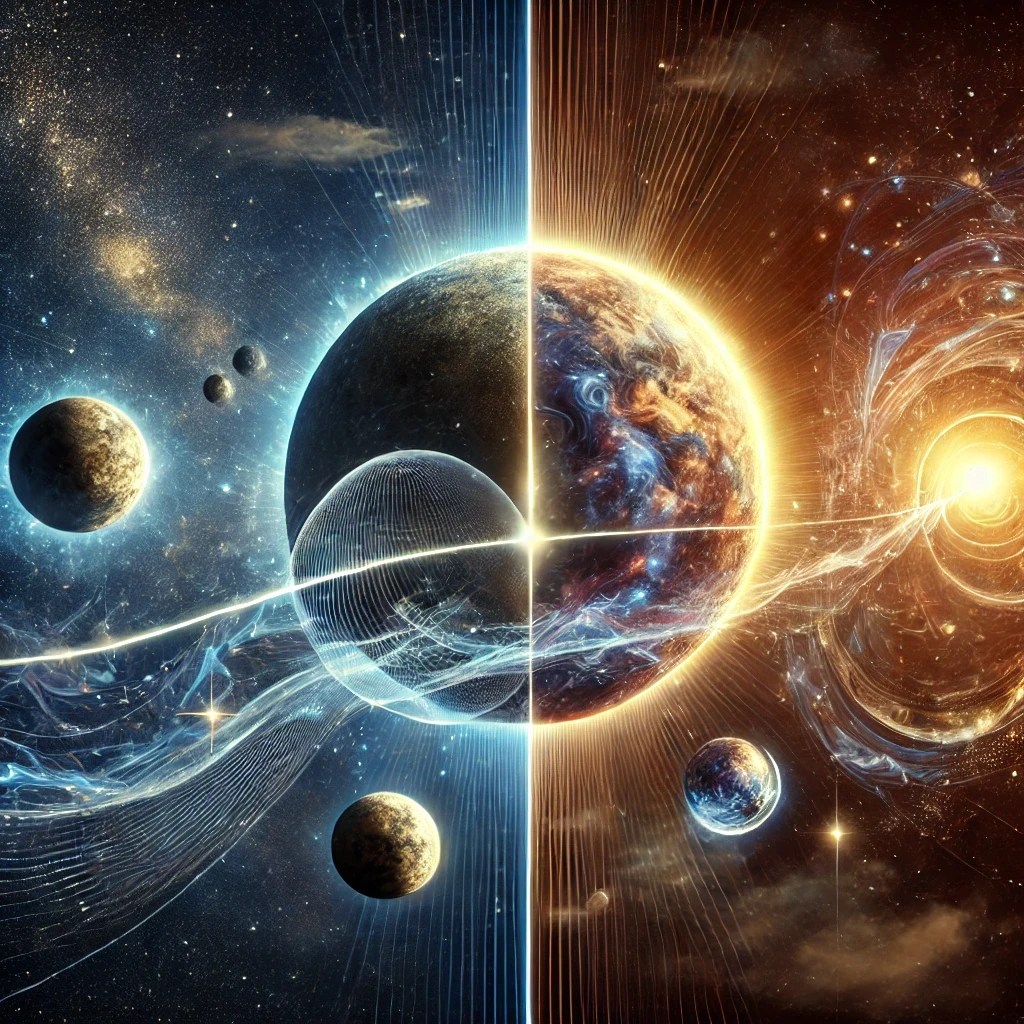
Now contrast that with the cosmic scale—the vast stage where stars explode and galaxies spin in perfect synchronicity. This is a civilizational drive writ large across the cosmos, operating with clockwork precision and governed by the deterministic laws of general relativity. No quantum fuzziness here; only gravity and motion, spacetime and mass. Predictable. Definable.
For decades, physicists have sought to reconcile these two irreconcilable levels of reality. The quantum level, where particles refuse to settle into one state, and the cosmic level, where celestial bodies march in lockstep with the steady pulse of gravity’s call. Is there a grand unified theory, an invisible thread, waiting to be discovered? Or are these two worlds fundamentally incommensurable—two systems that must coexist without ever fully merging.
Shall the Twain Ever Meet?
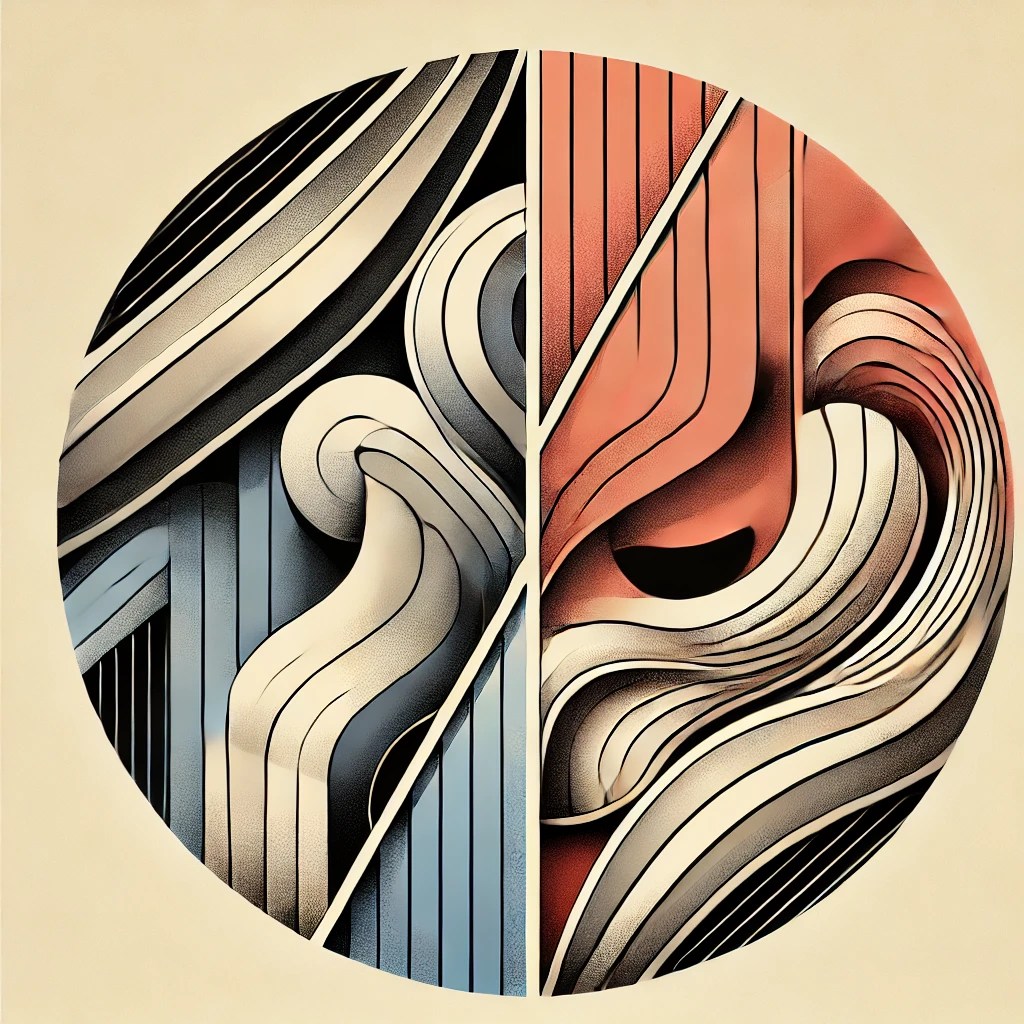
Similarly, are nirvana and evolution an irreconcilable duality or opposite ends of a spectrum amenable to unification?
Consider: what if the relationship between personal harmony and civilizational drive changes depending upon the level of granularity or scale at which the relationship is considered. They represent either an irreconcilable duality or opposite ends of a spectrum depending on the scale of the inquiry; scale as in depth not breadth. At the macro level, these two forces appear distinct and oppositional: Personal harmony is singular and detached from the world, while civilizational drive is complex and interconnected.
When we zoom into the micro level, this opposition softens into a spectrum within which a person’s states register—for example, balanced focus.
At the ultramicro level, this relationship resolves again into fundamental, irreducible dualities. In other words, between each macro duality is a continuum, and on each side of a macro duality lies another ultramicro duality.
For example, at the personal harmony end, you have engaged awareness vs. detached acceptance—you are aware of a thought that has come into your consciousness and are letting it go to return to a state of thoughtlessness. There is no spectrum between these dualities, only tension. They are purely binary—on or off. At the civilizational drive end, you have rigid replication vs. innovational change, another fundamental, irreconcilable duality.
Applied to the physical world, at the macro level, we have the fundamental duality of General Relativity vs. Quantum Mechanics.
General Relativity deals with the large-scale structure of spacetime, where gravity shapes the universe in a deterministic, predictable manner. It’s concerned with the behavior of planets, stars, and galaxies.
Quantum Mechanics deals with the subatomic world, where particles behave probabilistically, and uncertainty dominates.
This forms the macro-level duality: large-scale determinism vs. small-scale probabilism, or smooth spacetime vs. quantum discontinuity.
Between these poles, there is a spectrum of theories—such as String Theory and Quantum Field Theory—that attempt to bridge the gap between General Relativity and Quantum Mechanics. These models often merge elements from both ends, forming a continuum where certain aspects of spacetime and quantum behavior overlap or harmonize. This micro level reflects the transitional space where the stark duality between large-scale and small-scale forces softens.
At the ultramicro level of Quantum Mechanics, we see the internal duality of phenomena such as wave-particle duality and superposition vs. collapse. Here, quantum entities behave as both waves and particles, depending on how they are measured. This duality is irreducible within the framework of quantum theory itself.
Thus, at both ends of the macro-level General Relativity vs. Quantum Mechanics duality, we find internal dualities at the ultramicro level—wave-particle duality in quantum mechanics and spacetime-observer relativity at the other end. These ultramicro-level dualities reflect the underlying tensions in both poles.
Living in the Spectrum
We do not live at the poles. Our experience of the world is non-binary. I am not here referring to our abstract mental life that has created dualities and dichotomies. I am referring to our embodied and lived experience. Our lived experience registers on the spectrum. We have no experience of absolutes. Enlightenment is oblivion. Absolutes are fundamentally resistant to experience. Experience is, perhaps by necessity, spectral. We exist in an asymptotic relationship with these limits.
We live in thermodynamic processes, biological systems, and chaotic systems that combine aspects of both predictability and probabilism. We are neither living in a world of pure quantum uncertainty nor macro-level absolutes; we are constantly experiencing the interplay between these forces in the middle ground, where complexity emerges from both ends of the spectrum.
Embracing the Sliding Scale
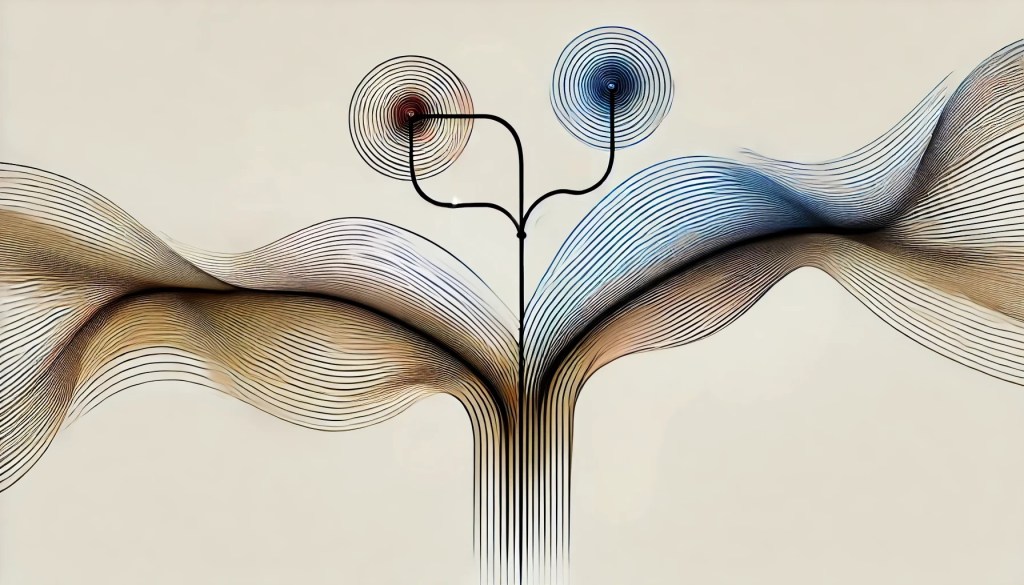
Considering the foregoing, I posit that humanity must accept that it lies along a sliding scale and revise its philosophies, judgments, and worldview to contend with this diversity. We are fundamentally and structurally incapable of communing with the divine. We must shed that arrogance. With all the “polarization” we are seeing in the world today, it is important that we all reflect on these fundamental limits and concede that we are all swimming together amid shores that we can never reach and therefore none can claim. Those who speak as though they are firmly rooted on one bank or the other must be ignored, shunned and ultimately forgiven.
This essay explores the interplay between enlightenment and evolution, drawing parallels with fundamental dualities in physics. By examining these concepts across different scales, it suggests that embracing the spectrum between stillness and striving is essential for a true understanding of our place in the universe.

 SEÑOR - The Blog