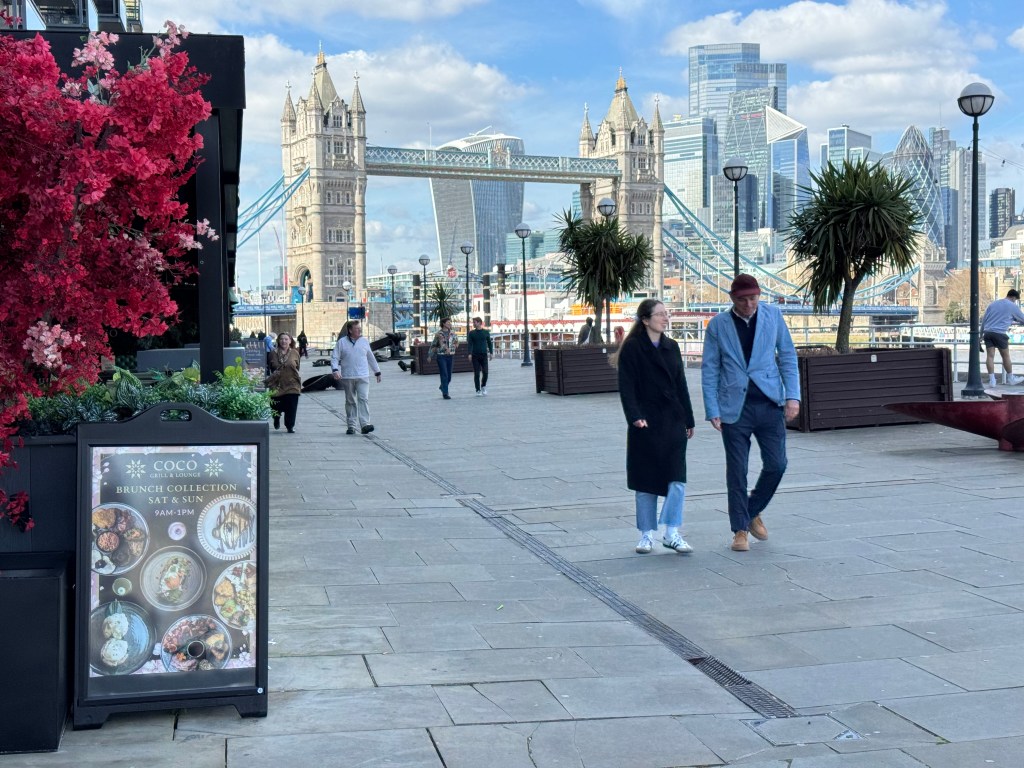
I never took an interest in London.
Soaked in drizzle and beer for openers, boiled beef as an entrée, and constipation for dessert.
Why bother?
London, I figured, is what happens when an empire is forced into retirement and has to downsize – a damp city of souvenirs, visible only in the dim light reflected off the self-satisfied grin of an erstwhile hegemon. In Anglo-Saxon: a city where cankles are pickled in gin and stuffed in heels under a canopy of ceremonial hats on their way to the races.
I had seen enough of London to know that it wasn’t all damp tweed and tea. And I wasn’t wholly ignorant of its more contemporary contributions to culture (Bond, Burgess, Banksy, the Beatles), but it always seemed like more of a halfway house for things Great Britain before crossing the Atlantic to go global – a secondary concern.
Then my fellow Americans elected Trump. For a second time.
Meanwhile, the ethnic cleansing of Semites was never again going on in Gaza with the American military standing overwatch.
There’s never a good time for a Trump administration or for suborning genocide. But with our son less than a year from applying to university the timing couldn’t be worse. Our expatriate life notwithstanding, we had always considered an American university education obligatory. That is, until we saw U.S. universities kowtow to Trump’s threats and curtail freedom of expression with the pliancy of a damp cardboard protest sign.
When the guardians of the rule of law began negotiating exemptions under similar threats, we knew we had to look for alternatives.
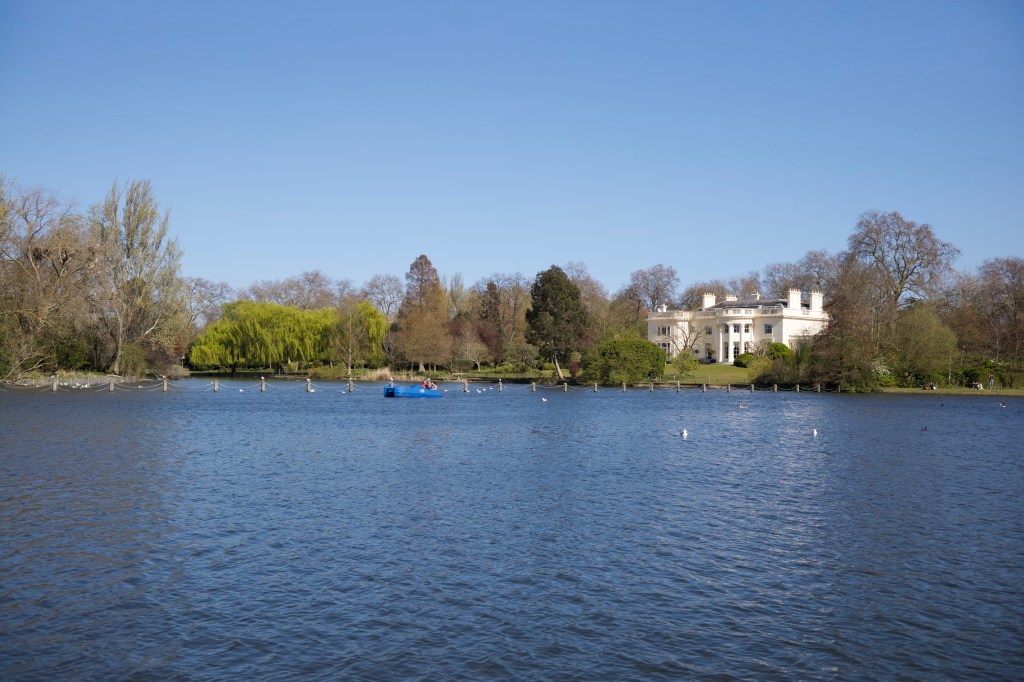
Forlorn, we turned our gaze to the Old World – where, for the time being, fascism was still being held at bay – and booked an exploratory trip to London curated by Banyan Educational Consultancy.
Our journey from Heathrow to St John’s Wood was made under pleasantly surprising morning sunlight. The pace was the same slow slog through pedestrian crossings we had always encountered, but this time it seemed less like congestion and more like machines politely giving way to people.
The dusty bric-a-brac of empire had vanished. London now stood smiling upright with the pride of a meticulously kept archive.
Even the construction sites – reliable eyesores elsewhere – looked as if they had submitted their hoarding for aesthetic approval. Invisibly jointed panels of painted wood encased the bases of perfectly aligned scaffolding, each one begging our pardon for the interruption with an earnestness that almost felt monastic.
There was a general harmony to this polyglot London — a civic self-respect that had survived the melting pot. Everything appeared nicely coordinated and composed, like an orchestra tuning itself.
In the sunlight, the descendants of the hackney coach impressed as monuments to British forward thinking and design ingenuity. Unlike the lazy genius of painting every taxi yellow and calling it a system — London’s black cabs were bespoke: designed from the chassis up to transport you comfortably whilst you continued your conversation.
And like so much else here, they were the product of such careful consideration that their evolution is barely noticeable: today’s cabs hum along in hybrid silence almost indistinguishable from their petrol-driven grandparents.
The food — long the international punchline — has also stepped up.
Pubs have gone gastro retaining the services of culinary wizards to innovate beyond traditional offerings and transform once dull slabs of roast beef into piquant medallions of grass-fed filets.
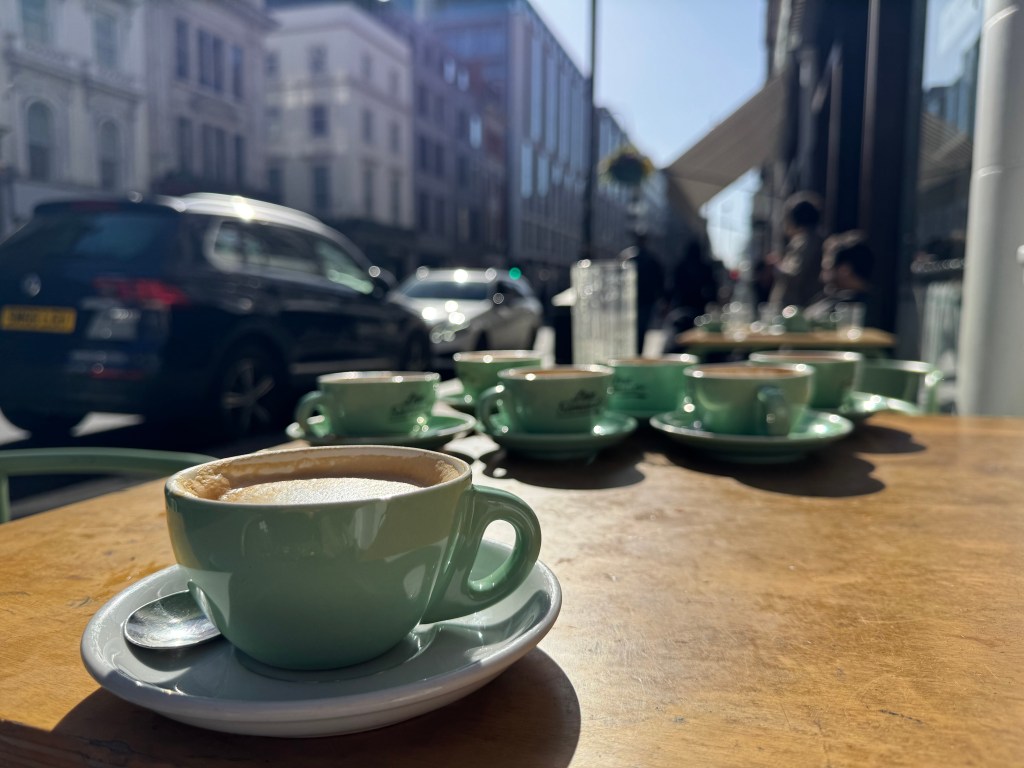
In the space of days, I ate my way across the former Empire: Greek at Lemonia, Japanese at Roketsu, Indian at Darjeeling Express, Persian at Kish. Bagels at Panzer’s Deli and ramen at Kanada-Ya, hot chocolate at WatchHouse and cappuccino at Hagen.
It is as though the city had finally stopped trying to hide its sordid past and started making the best of it instead.
As a bonus, London remains literate to this day – evidenced by the number of bookshops still able to afford brick and mortar rents on the High Street.
To be sure there’s been consolidation and many independent booksellers have vanished – but that may have been more the result of herd trading than actual economics. Judging by a shelf highlighting titles of the moment, tastes remain sophisticated and eclectic – Surrounded by Idiots; A Book Against Death; How to Read a Tree; A Winter Book; How to Stand Up to a Dictator.
Mindset matters.
I would be deluding myself if I thought London had just recently emerged from its chrysalis. There were clearly considerations nudging this affinity into being.
Our highs were certainly buoyed by dear old friends who had recently moved to London from Den Haag. Walking its streets with them gave the city a fond familiarity, recalibrating our focus onto things we liked rather than things we expected not to.
The prospect of K Dupaix attending university here also forced us to find opportunities where we would have otherwise seen risks. Again, nudged – not forced. (And helped me, not us. Mum is preternaturally positive.)
We were shown around K’s short list of Unis by N. Like everyone at Banyan, N is a highly educated professional with a long list of qualifications who happened to have graduated from one of the schools we were visiting. She is also the first person I had ever met that suffers from loose ligaments. I had no idea such a condition even existed.
I know everyone is unique and special, but people in London are fascinatingly so.
Guy Hill, for example – one of the proprietors of Dashing Tweeds – has, with his co-founder, transformed tweed in a way that makes you want to move to London and wear it as much as possible. And if you want to get around on bicycle, you can have a jacket made in Lumatwill: a tweed woven with a high-vis reflective thread, sporting elegance in the day safe travels by night!


NOW, THEREFORE, in consideration of the premises and the mutual covenants set forth herein and for other good and valuable consideration that I just can’t get into right now, the Dupaixes are moving to London.
At least until the winter – when London, like all great things, reminds one that nothing easy is worth having.

 SEÑOR - The Blog