
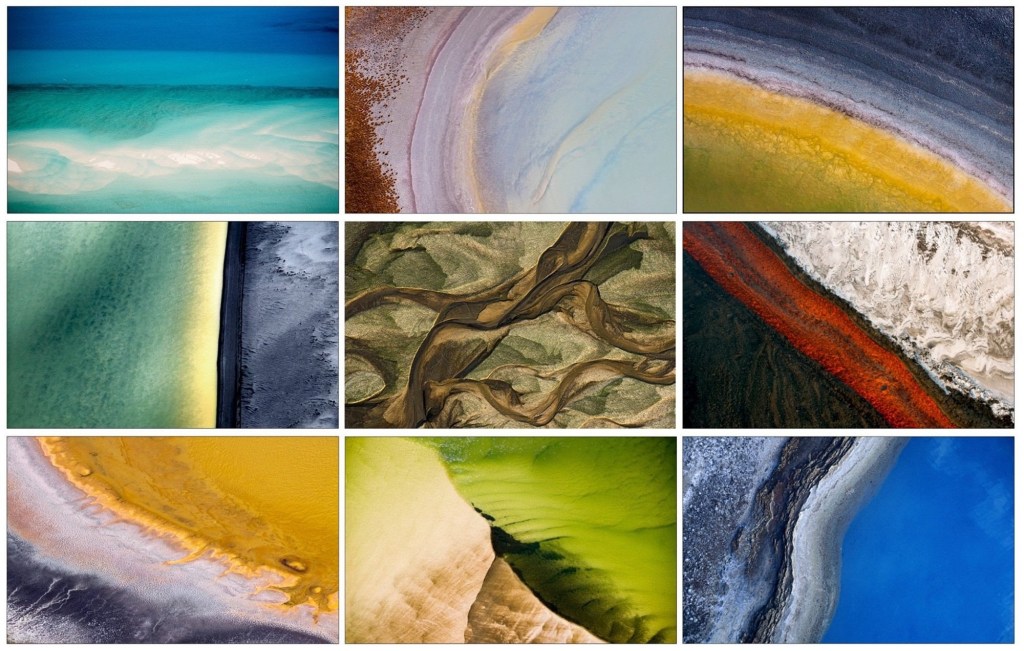
Freshly baked by back-to-back meetings in the beige desert boardroom that is my day job, I collapsed onto the couch—equal parts mogul teetering on the brink of bankruptcy and tired toddler whose tantrum ended before it could even begin—when Apple TV served me a drone-shot sermon on why Earth is an anomaly that defies belief even by the most baroque minds.
You know what I’m talking about, right?
Those absurdly super high-def 4-billion-K landscape montages—shot from drones, saturated with impossible clarity, drifting across deserts and glaciers and canyons as if the Earth were auditioning for Miss Universe.
It struck me in my stupor—not in some dramatic, epiphany sort of way, but with the paced buildup of Strauss’s Also Sprach Zarathustra: hosting life is not what makes this planet wildly unique.
If every last creature, no matter how insignificant or tenuous its claim to be considered among the living, vanished—Earth would still be unlike anything else in the universe that we’ve seen.
No other planet in our solar system even comes close to the kind of variation on display. Ochre deserts sculpted by wind, volcanic cones seared into basalt monuments, iridescent salt flats, glacial carvings, sedimentary folds, vast canyons, elliptical atolls, granite tors, limestone karsts, and deep-ocean trenches as dramatic as any mountain range.
Each of these is the consequence of cosmic collisions, temperatures, deep time, pressure, movement, chemical weathering, cosmic bombardment—and water, nature’s sculptor.
Other planets have features—Mars has Olympus Mons, Venus has tesserae—but they feel like sketches next to Earth’s baroque architecture. The gas giants are elegant, yes—but homogeneous. Their beauty lies in scale, not in variation.
The variation here isn’t just a matter of scale, but of intricacy. Our planet is wildly textured, endlessly reworked by tectonics, erosion, hydrology, and atmospheric feedback loops.
And then there’s the chromatic richness—turquoise glacial lakes, red iron-rich cliffs, yellow sulfuric vents, obsidian flows, white chalk bluffs, and pink salt lagoons.
Without life, it would still be a museum of minerals and movement. Discovering mold fossils on Mars doth not a museum make!
Earth stuns not just because it teems, but because it folds and fractures. It is no wonder that life emerged here. It was inevitable. The miracle would have been for a stage so intricate to open its curtains to an empty, silent hall.
On this stage, the orchestra was already playing. Life just took a seat.

 SEÑOR - The Blog
[…] I recently wrote about the Earth as an anomaly of abundance: a planet bursting with color, texture, chemistry, and gratuitous detail, adrift in a universe otherwise dominated by emptiness, repetition, gas giants, gravitational fields, and uniform stone. Against a cosmological backdrop that seems to favor scale over subtlety and uniformity over nuance, Earth reads almost as an error. An unusual indulgence. A place where variation was not merely allowed but overproduced. […]
LikeLike