
No. 24–1209
SUPREME COURT OF THE UNITED STATES
October Term, 2024
By the People v. United States
No. 24–1209
Opinion of the Court
Justice H. S. Shaaban delivered the opinion of the Court.
Petitioners, self-styled as representatives of a philosophical movement rooted in individual sovereignty, seek to establish that broad swaths of the modern administrative state are constitutionally illegitimate. Relying heavily on the argument advanced in Charles Murray’s 2015 book By the People: Rebuilding Liberty Without Permission, they assert that federal regulations lack lawful authority where they infringe upon what they define as “pre-constitutional” liberties. In so doing, they urge this Court to affirm a conception of liberty that authorizes organized civil disobedience against executive agencies and enshrines elite-sponsored resistance as a constitutional remedy.
We decline to do so.
Petitioners are entitled to their philosophical convictions. They are not entitled to constitutional reinvention.
I. The Claim
At its core, Petitioners’ argument rests on an inversion: that liberty is not preserved by the Constitution but precedes and overrides it. They claim that modern government, by enforcing regulations not expressly authorized by name in the Constitution, has forfeited its legitimacy. Petitioners further assert that because elections and legislative processes have failed to reverse this “overreach,” private citizens may treat such laws as void, and wealthy patrons may lawfully underwrite systematic resistance.
This is not a constitutional claim. It is a philosophical protest dressed in constitutional language.
II. Liberty in the Constitutional Order
This Court has long recognized that the Constitution was designed to secure individual liberty—not to render government powerless, but to cabin its power within a structure of enumerated authority, separated powers, and legal process. It did not set liberty above government; it embedded liberty within government.
To read the Founding charter as a perpetual license to disobey democratically enacted laws is to misunderstand the very liberty it secures. Liberty under the Constitution is neither license nor anarchy. It is ordered freedom, protected by rules, interpreted by courts, and enforced through accountable institutions.
III. The Administrative State and Constitutional Structure
Petitioners argue that the Constitution forbids what it does not explicitly permit. This strict construction finds no support in the historical practice of the Founding generation. The Constitution’s Necessary and Proper Clause (Art. I, §8, cl. 18), the Executive Vesting Clause (Art. II, §1), and the Appointments Clause (Art. II, §2) form a structural framework that empowers Congress to legislate broadly and to delegate ministerial and regulatory duties to subordinate officers of the Executive.
Indeed, early federal statutes—including the Lighthouse Act of 1792 and the organization of the Treasury under Secretary Alexander Hamilton—vested considerable discretion in executive officials. These actions were not viewed as betrayals of constitutional limits but as faithful and necessary implementations of congressional authority. No court of the era found fault with these delegations; nor did the Founders, many of whom occupied the very offices enacting them.
The omission of a clause expressly authorizing an “administrative state” is not evidence of its prohibition. It is a reflection of its novelty. Constitutional silence is not constitutional censure.
IV. On the Right to Resist
Petitioners appeal, implicitly if not explicitly, to a Lockean right of resistance—a moral doctrine asserting that unjust laws may be defied when the sovereign breaches the social contract. Such arguments animated the Declaration of Independence, and history remembers them fondly as seeds of revolution.
But the Constitution was written to replace that state of nature with a system of lawful redress. It removed the justification for private revolution by institutionalizing the right to challenge government action—through elections, legislation, litigation, and judicial review. In so doing, it substituted process for insurrection and petition for nullification.
To claim a constitutional right to organized civil disobedience outside these channels is to claim a right to secede from the very government the Constitution establishes. This we cannot accept.
V. A Word on Entitlement and Moral Sympathy
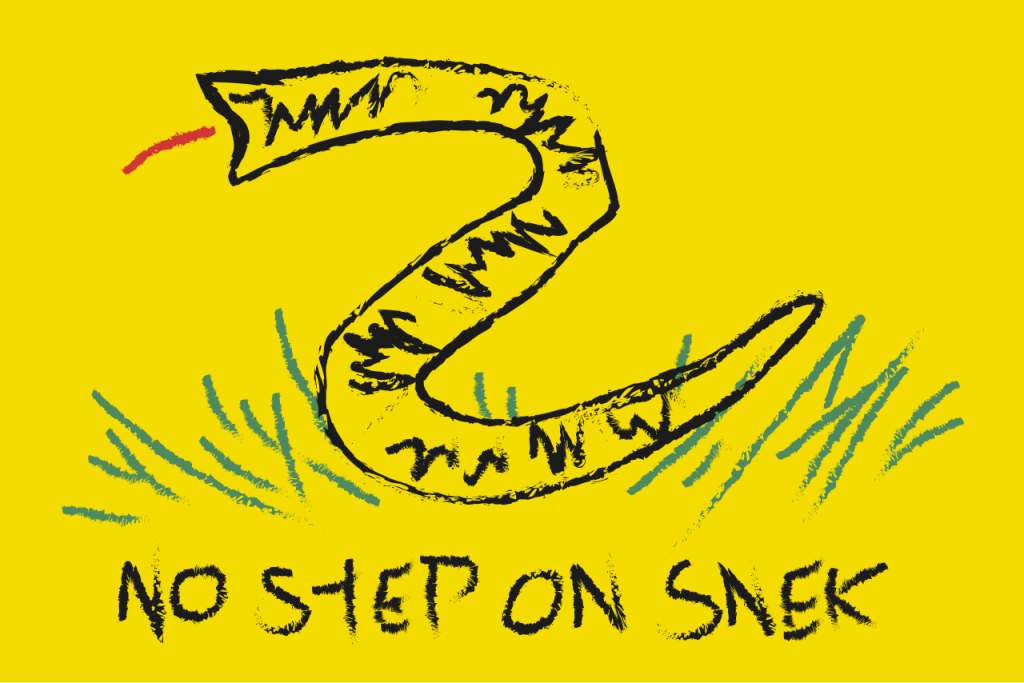
Petitioners, and the broader movement they represent, are heirs to a proud tradition of American skepticism toward centralized authority. Their invocation of “Don’t Tread on Me” captures a moral sentiment with deep roots in our national mythology. But nostalgia is not jurisprudence. Neither slogans nor private convictions suffice to reshape the constitutional order.
Yet I would be dishonest if I did not acknowledge the emotional and philosophical force of their frustration.
Like them, I too can envision a scenario in which a government, though procedurally legitimate and acting within its constitutional powers, is so unwise, so hostile to dignity or reason, that it becomes intolerable. Consider a Congress lawfully enacting a national curriculum that, while not violating the First Amendment, teaches children that obedience to the state is a moral good. Or a law that mandates border walls be adorned with surveillance billboards praising the ruling party. These might not violate the Constitution as written. But they would offend every moral instinct I possess.
If that day came — when my country’s laws were still technically constitutional but morally unlivable — I too might be tempted to rise up and resist.
But if I did, I would do so not in the name of the Constitution, but in recognition that the Constitution had reached its logical and perhaps tragic conclusion. I would not lie to myself or to others by claiming that rebellion was fidelity to the system. It would be, by definition, a rejection of the system, however justified by conscience.
The Constitution is not the immutable word of the Creator. It is a human compact, born of its time, shaped by its compromises, and dependent for its success on the wisdom of those entrusted to govern within it. It can fail. But to rebel against it is not to fulfill it.
VII. Response to the Dissent
The dissent rests its case on an instinct we do not dismiss: that liberty is fragile, that power must be watched, and that governments — even constitutional ones — may drift toward excess. But it then advances a theory in which conscience and wealth combine to override law, and where fidelity to the Constitution is measured not by what it permits, but by what it no longer inspires.
This is not constitutionalism. It is a privatized veto.
The dissent elevates the Declaration of Independence above the Constitution — mistaking a revolutionary creed for a governing charter. It points to the Founders’ suspicion of centralized power but ignores their creation of structural mechanisms for that very power’s lawful expression: bicameralism, presentment, the Necessary and Proper Clause, and a unified Executive.
It romanticizes Hamilton’s customs officials as harmless clerks but offers no evidence that the Founders would have recoiled at the far more modest rulemaking tasks assigned to modern agencies. Indeed, those early institutions show not a rejection of administrative execution, but its sober embrace.
Most crucially, the dissent defends a form of organized resistance bankrolled by private wealth — a scheme in which noncompliance is shielded not by the courts, but by capital. Let it be clear: wealthy patrons are free to spend their resources as they choose. But when the consequences of their sponsored resistance are lawfully challenged, they cannot shelter behind the Constitution to avoid accountability.
The Constitution protects protest, not immunity. It safeguards conscience, not nullification. The moment we mistake private defiance for public legitimacy is the moment we convert the Constitution from a governing document into a cultural artifact.
The dissent does not preserve the Constitution. It licenses its unraveling under the illusion of its defense. We decline to join it.
VIII. Conclusion
The American Constitution does not prohibit the existence of an administrative state, nor does it authorize private entities to nullify or defy lawful regulations by financial proxy. Petitioners may persuade their fellow citizens to repeal, restrain, or reform federal authority through the ballot or the courts. But they may not, under cover of constitutional righteousness, exempt themselves from the rule of law.
The judgment is affirmed.

 SEÑOR - The Blog