I observed my 52nd year Anno Samini with a soup at Koo Madame hier soir. It was the finest soup I have ever had.
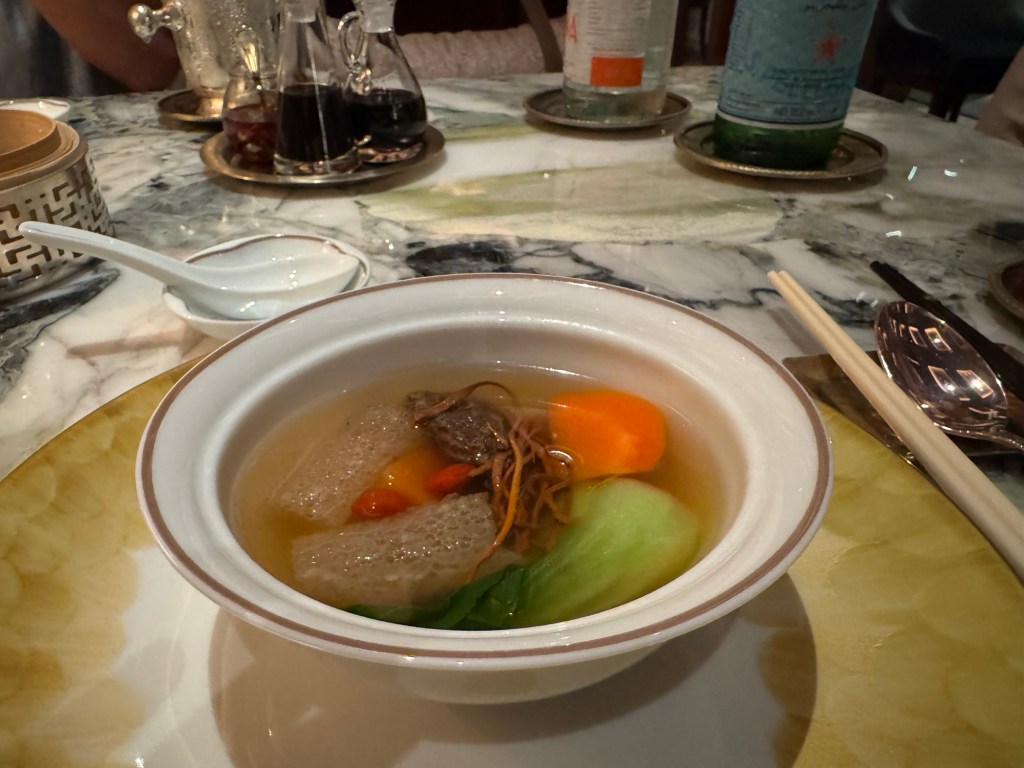
The consommé was the star. A double-boiled vegetable broth of corn, potato, and figs, it was perfectly clear, holding its secrets until the moment broth meets buds. On the tongue it opens up slowly, releasing sweetness from the corn, earthiness from the potato, and a depth that is shallow enough it is like a memory you are unable to recall.
Maurice, our server, reminded us it was the fig. It still failed to coalesce. This is the Cantonese mastery of subtlety: a flavor so restrained you can hear it murmuring beyond sight leaving you to wonder whether it was there once it fades.
In Chinese high cuisine, a great broth is only half the conversation. The other half comes from the textures and flavors carried by its companions.

Here, morels appeared in two registers, white and black, their pits cradling tiny pools of broth. Brown enoki mushrooms brought a deeper, almost woody undertone. Carrot chunks and Chinese jujube added a mellow sweetness and visual pop of color. A single head of pak choi, cooked just to the point where the stem offered a clean crunch, refreshed the palate and primed it for the next sip. Each element was cooked to an exact point of doneness so that flavor release, crunch, and mouthfeel landed precisely as intended.
The image that the world imports of Chinese cuisine is narrow: take-away cartons dripping with sauce or the wet markets of Wuhan offering chicken feet, skewered scorpions, deep-fried tarantulas, sea cucumbers, silkworm pupae….and steaming vats of entrails.
For over two thousand years though, China has cultivated a fine dining tradition as formal and philosophically grounded as any in France. In the imperial courts of the Tang and Qing dynasties, banquets were built on balance, not only of yin and yang or the five elements, but of how textures and aromas spoke to one another. Double boiling, the technique used here, is a Cantonese hallmark: ingredients sealed in an inner vessel, placed in gently simmering water, flavors extracted without agitation, clarity and nutritional “qi” preserved.
Unlike the food coma that often follows Michelin-starred French menus, where richness and reduction are pursued with little regard for how the body will bear them, Chinese haute-cuisine leaves you feeling light, clear-headed, and well-treated.
This difference is owing to their respective evolutions. French haute cuisine evolved largely in the context of aristocratic pleasure whereas Chinese fine cuisine was deeply tied to the principles of yin-yang balance and the “five elements” (wood, fire, earth, metal, water) as applied to flavors, colors, and textures.
Food was not only to be beautiful and delicious but also harmonious for the body and spirit. This led to centuries of refinement in pairing ingredients, timing their harvest, and preparing them to preserve nutritional “qi” (vital energy).
While some find French mastery of flavor unrivaled, it is a mastery that can weigh heavily on the metabolism. Cantonese refinement works differently, coaxing depth without overburdening the body, so you leave the table restored rather than subdued.
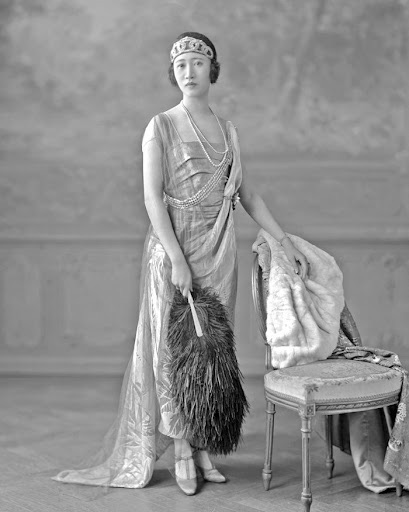
Madame Vi Kyuin Wellington Koo, née Oei Hui-Lan (1899-1992), the wife of the Chinese Minster to London is photographed here in connection with her attendance at a State Ball at Buckingham Palace on 7 July 1921.
Koo Madame is a fine emissary of this tradition beyond the Great Wall, translating the language of imperial kitchens into a form that a modern, moderately adventurous diner can understand, without losing the restraint, clarity, and quiet confidence that define it. My wife, who made the reservation, was addressed by name with the appropriate honorific by each member of the staff.
This refinement extended to the table setting. Flatwear and porcelain evocative of 1920s Shanghai. Two pairs of chopsticks were laid out for each guest, black for serving, white for eating; a nicety even the Japanese rarely specify. Yet both rested on a ridged silver plate from which they rolled away, a poorly conceived pairing of form and function the Japanese would never have allowed.
It was mastery in the kitchen, innovation in service, and a small, human imperfection at the edge of perfection that allows one to exhale. Maurice even advised us not fret if we soiled the table. In fact, he told us, it would be considered a sign we had enjoyed ourselves. And we did. Enjoy ourselves.

 SEÑOR - The Blog