Nature: The phenomena of the physical world collectively; especially plants, animals and other features and products of the Earth itself, as opposed to humans and human creations.
Oxford English Dictionary
1.
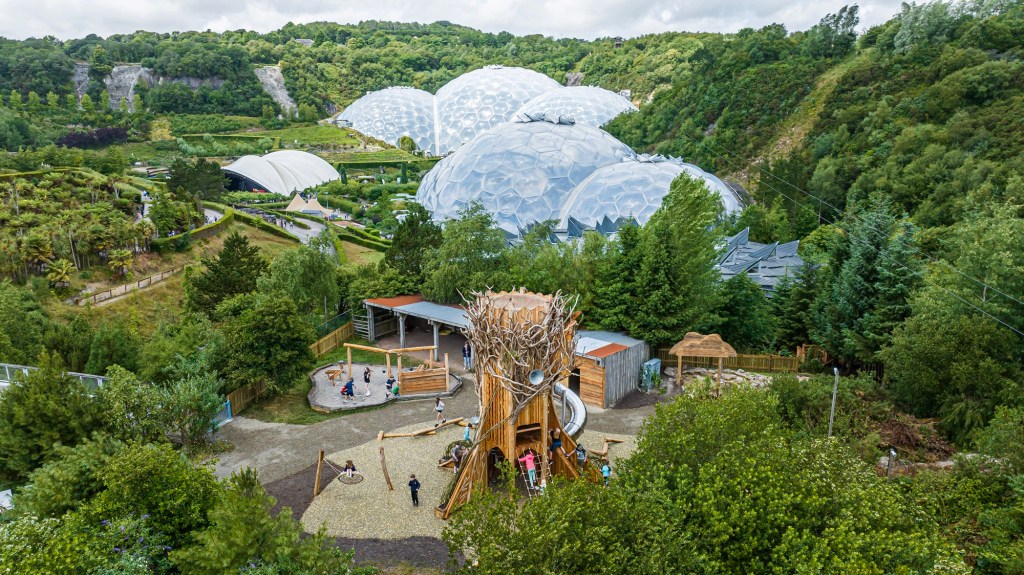
At a gathering of the Eden Project in Cornwall a year ago, the foregoing definition of Nature left attendees shocked over our collective exclusion. We had defined ourselves out of nature sitting in a glass dome built to preserve it. Frieda Gormley of House of Hackney, who was speaking at the conference and to whom the definition was read, responded by engaging a lawyer to do something about this shocking carve-out. Their campaign ultimately achieved what they considered a partial victory with the OED removing the “obsolete” label from an alternative definition that included humanity.
It seems only right for us to be considered natural but where does this inclusive definition leave matters?
If nature means “everything” it risks meaning nothing. If it means “everything but us and what we’ve made” it begs the question – at what point did or do we stop being natural?
2.
In ordinary speech, natural rarely serves as a neutral description. It is put into service to play a normative role: natural food is good, natural beauty authentic, natural behavior spontaneous. We have smuggled moral and aesthetic judgments into the sense of a term that pretends to be ontologically descriptive.
But if we mean good, we should, or simply could, say good or healthy or whatever we actually mean in this regard. If we mean authentic, then authentic, spontaneous, then that, etc. Each of those terms has its own criteria. To collapse them all into “natural” doesn’t enrich meaning; it muddies it.
The history of the word confirms this non-ontological normative function. It never stood squarely over a clearly defined set. From Latin natura (birth) it translated the Greek physis (growth). It sought to describe that which spontaneously emerged in the world. Medieval scholastics attempted to refit its boundaries over the God created order. The mechanistic philosophers made it the sum of physical laws. Modernity turned it into “everything but human creation.” Each shift wasn’t additive or subtractive but transformative. The word mutated with our attempts to fit its use to our then prevailing understanding of the world. What began as process became order, then system, and finally an overly broad exclusion.
Seen this way, the etymology does not uncover a true meaning waiting underneath. It reveals that the word has always been poking in the dark to find the concealed lurker. When we say “natural,” we are not naming a set; we are gesturing at the tension arising from our being creatures of nature who in beholding it stand apart from it. The word crystallizes this doubleness, which no campaign or dictionary edit can erase.
Natural persists in our quiver of nomenclature not for its descriptive precision, but because it aims to strike a boundary, regardless whether it succeeds in doing so.
3.
Most would have us accede to a configuration of the term that would put the given, the spontaneous and the uncontaminated on the inside; outside lies the made, the deliberate, the artificial. Some among us might ask for added scrutiny of this demarcation on the grounds that it would put out compatriots we’ve always treated as rightful citizens.
The beaver builds a dam. We call this natural. Humans build a dam. We call this artificial. But what exactly distinguishes them?
Not the action: both involve moving materials to alter water flow. Not the impact: beaver dams can transform ecosystems as dramatically as human ones. Not even tool use: beavers use their teeth, we use machines, but both are tools in any coherent sense of the term.
The difference, we want to say, lies in the bringing about. The beaver acts from instinct. Humans act from intention. But this merely pushes the problem back a step. What makes intention different from instinct? Both are forms of directedness toward goals. Both are thought to emerge from neural activity, though there are dissenters. Both act on and modify the world.
4.
Perhaps the difference is that humans can contemplate and communicate their intentions abstractly, can imagine what doesn’t yet exist. Animals, including the beaver, as far as we can tell, cannot. But then the boundary isn’t between natural and artificial. It’s between the conscious and the unconscious.
And yet if consciousness emerged from natural processes – through evolution, increasing neural complexity – then it ought to remain natural. Our thoughts, our cities, our languages would be nature’s experiments, no different in kind from termite mounds or bird songs, only in degree.
But this pushes the boundary too far. If there is nothing outside the boundary, is it a boundary? If Nature includes everything, then “natural” becomes a vacuous predicate. If everything is natural, the word loses all utility. It demarcates nothing. We might as well say everything is “existing” or “actual.”
5.
Yet when I think, I experience myself as outside the causal flow, as an observer rather than a participant. This reflexivity, consciousness aware of itself, creates the very conceptual space in which “nature” appears as ontological object. Consciousness doesn’t just arise from nature; it makes “nature” thinkable as such.
In the beginning we lived in what has been called a state of nature. It was only when we ate the fruit of knowledge that we fell from grace, or more precisely, fell out of nature.
At that moment, we became aware of ourselves as beings who could be seen by others like us. Immediately, our genitalia, once organs like any other, serving excretion and reproduction, suddenly signaled a variety of thoughts emerging from this awareness.
They became centers of modesty, of shame, of curiosity, and at a more basic level, of pleasure. Not the physical pleasure of chemical reactions and biological discharge, but the awareness of pleasure itself, the contemplation of it.
This is the work of consciousness: separation. Not only our separation from the world, or from other centers of awareness, but the act of separating the world itself into categories, classes, concepts. A river simply flows; a tree simply grows. The beaver gnaws and piles branches, but it does not call them dam. It does not place its own activity within a class of actions, nor distinguish its teeth from our saws as two kinds of tools.
Consciousness interrupts. It names the river, labels the tree, distinguishes branch from trunk, species from genus. It sees the beaver’s work as dam-building and its own as engineering, categories folded into larger systems of meaning. Where nature offers continuity, consciousness inscribes boundaries, turning the seamless real into a conceptual grid. That is why the problem of nature arises at all: only consciousness asks where the line lies, and in asking, creates the very line it seeks to discover.
6.
If consciousness is outside of the natural world, then we must abandon emergence as a theory of consciousness. As maintaining that position would require us to explain how something tied so intimately to a biological organism could nevertheless belong to another order altogether. At what point in evolution did our ancestors cross into this realm? With the first tool? With language? With self-awareness? Each proposed boundary dissolves under examination. The line can be infinitely parsed. This interminable recursive parsing does not exist in Nature.
Said differently, if consciousness were natural in the same way as other phenomena then its point of provenance should be specifiable just as we can specify when multicellularity or photosynthesis arose.
But in practice every attempt to specify the crossing point dissolves into an infinite regress: was it with Homo erectus? with stone tools? with language? with symbolic art? with mirror-recognition? Each boundary can be subdivided further and no decisive line holds. That indefinite parsing signals a category problem; unlike other natural phenomena consciousness resists specification of origin within the natural order.
Natural phenomena are finite and specifiable, bound by nature’s laws. They admit of clear provenance. Consciousness by contrast does not admit of such specification. If its provenance is infinitely postponable, then consciousness cannot be fully natural in the same sense as other biological processes.
Animals, we are increasingly learning, display remarkable levels of awareness. Their problem solving capabilities rival our own on an individual level. And yet none have had human level consciousness emerge despite similar if not greater neural complexity, especially if we compare anomalies in both kingdoms at extreme ends of the scale.
It is more acceptable to the mind to say consciousness came from an apple. Or perhaps the point of that tale was not so much the apple as our breaking the rules by eating it. We acted outside of the natural order.
Here lies the knot: our sense of self is as an embodied consciousness. Our bodies are natural through and through. But consciousness itself seems to stand apart. It cannot be comfortably contained in the category of nature, nor denied outright as if it were merely another property of matter. Nor is it “unnatural,” with all the pejorative weight that word carries, but more extra-natural – a phenomenon that communes with nature, interprets it, reshapes it, but does not belong to it in the same way that stones, rivers or beavers do.
7.
The error of our recent attempts to refine the definition of Nature lies in mistaking the human animal for the anomaly, when in fact it is consciousness that resists absorption into the natural order. A beaver dam and a hydroelectric dam alike are natural – both are configurations of matter obeying the same laws. What stands apart is not the artifact but the awareness that conceives it.
The distinction, then, is not natural versus unnatural, nor human versus non-human. It is natural versus extra-natural. Everything material belongs to nature. The one thing outside it – and yet bound up with it – is consciousness.
8.
Natural as a term persists because it points toward a real felt difference between the world we experience and the consciousness through which we experience it. We sense there is something “other” about mind in relation to the material world even if we cannot agree on what it is. The word natural became a placeholder for this intuition.
Because there is no agreement on the nature of consciousness, it has never been set as the true bounding element. Instead we have given the word natural the job of pointing out this sensed boundary. But when The People saw that our feces and mud-huts were excluded, they naturally saw the absurdity of this unnatural border. But then they went too far.
Once we recognize consciousness as the horizon for the extra-natural, the placeholder function of natural becomes unnecessary. The correct distinction is not natural and unnatural but consciousness and the world.
9.
In daily life we move through a world of causality, continuity and shared objects. In dreams we inhabit a world that feels equally real but is ungoverned and, more importantly, does not exist or persist outside our consciousness.
Put on a VR set and take a virtual tour of the villa you have been designing with your architect and his team of digital developers. The hallways you traverse were created outside your consciousness. They persist whether you perceive them or not, albeit as code. Unless someone decided to play a trick on you, opening the bathroom door will lead you to the bathroom and not the bowels of a dragon. The experience is subject to causality, continuity and shared objects.
Are dreams part of the natural world? There is a sense in which they are and another in which they aren’t. Is your virtual villa part of the natural world? Again, yes and no. The definition excluding humanity and its creations puts both out of bounds, the one incorporating them puts them both inbound. Neither feels right because neither is right.
10.
The controversy over definitions – whether nature should include us or exclude us – misses the deeper point. Both attempts are misfires. The human animal belongs to nature in every respect. The anomaly is not the body but the awareness that inhabits it.
Consciousness is extra-natural: it communes with nature, interprets it, and reshapes it, yet it cannot be reduced to it. The word natural persists not because it perfectly marks a category, but because it registers this doubleness. We are matter continuous with the world, yet accompanied by a faculty that stands apart from it.
To call something “natural” is to voice that tension. The term is not a mirror of the world but of ourselves – creatures who belong entirely to nature and, at the same time, carry within us the one thing that does not.
Ms. Gormley, call your attorney. We need to write to the Oxford English Dictionary.

 SEÑOR - The Blog