
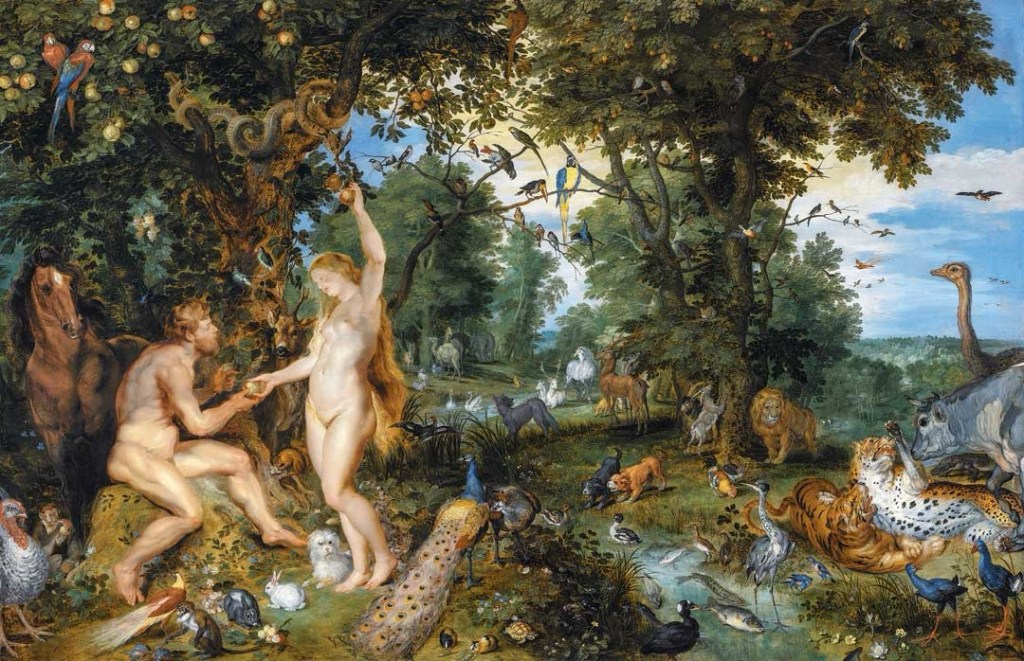
“Then the eyes of both were opened, and they knew that they were naked.” — Genesis 3 : 7
Long before Darwin described natural selection, before we mapped the brain’s hemispheres or charted consciousness in cortical diagrams, humanity dreamed. And its dreams, recorded through myth and poetry, seemed to orbit, if not converge, on the same central intuition: that there was a moment when we became self-aware.
Whether framed as a fall, loss of innocence or succumbing to temptation, humanity appears to have actually been referencing its transition from behavior compelled by instinct to promētheia, literally “fore-thought”.
We have long read these myths as moral allegory that seek to explain, through disobedience or hubris, the evil deed that brought about the “human predicament”. But perhaps the ancients were intuiting something far deeper and more fundamental about their state of angst. Perhaps they were actually marking the moment we, as a species, became self-aware.
Four ancient myths – Gilgamesh, Eve, Prometheus and Pandora – seem to speak to a break from embeddedness in nature to the individuation arising from self-consciousness. What might these myths reveal about consciousness if they are in fact artifacts from a time nearer to humanity’s first awakening , when awareness first turned upon itself and saw the world as something outside it?
If we regard these myths as narrative fossils of consciousness, created at a time when humanity had only just acquired the linguistic sufficiency to make meaning but long before it had developed and tested the conceptual categories to understand consciousness itself, then we must consider the possibility that consciousness is not entirely local.
To what extent then does consciousness tap into, or participate in, something beyond itself: a shared field, a universal mind, a substrate of awareness from which individual consciousness arises and to which it remains connected. Such a possibility would go far to explain how Ramanujan received mathematical proofs from a goddess and a non-literate prophet left the world the Arabic language’s most revered literary work. These myths may actually suggest that the mind channels insights not wholly its own. The origins of consciousness might lie not in the isolated skull of a hominid, but in some deeper plane from which the skull draws its signal.
Alternatively, there may be something about the structure of consciousness itself that determines what kinds of meaning can appear to it. The ancient myths may be excrescences of that structure, symbolic outgrowths through which consciousness, newly self-aware, began to dimly apprehend its own form. Long before philosophy or neuroscience, the psyche may have been sensing its architecture through image and story. In this view, these myths are not inventions of imagination but imprints, structural echoes of consciousness recognizing itself from within the fabric of nature before it possessed the language to name the act of recognition.
These two possibilities may not be contradictory but complementary. In the same way that genes contain a structural code that determines what is possible, external triggers and their absence determine what from that structured code is expressed.
Consciousness may work in much the same way. It might have a deep and prefigured architecture that defines its potential, while the forms it takes depend on the conditions that meet it. Just as light, temperature, and stress activate certain genetic pathways, so too might language, symbol, or encounter activate higher orders of awareness.
The question becomes twofold: what is the structure of consciousness, and what are the externalities that awaken it? Animals are self-aware within the stream of nature, yet remain embedded in it. Something, perhaps the shock of reflection, the advent of language, or the confrontation with mortality, must have interacted with the latent architecture of mind to produce the rupture that made us human, and later, the refinements that we place at different junctures along the path towards what we have termed enlightenment.
If this is true, then the myths of Gilgamesh, Eve, Prometheus, and Pandora may hold the earliest record of that interaction. Each story may preserve, in symbolic form, an intuition about the structure of consciousness and the conditions that brought it to life. The task now is to examine them closely, to see whether their patterns and ruptures align with the evolutionary drama we are describing: the moment when mind first turned upon itself and saw.
In the next post, I will explore how the Epic of Gilgamesh takes up these questions.

 SEÑOR - The Blog